
24/7 Customer Support

Free returns

Same-day & Next-day Delivery

Quality Guaranteed

Unlock Your Welcome Offers: FREE Delivery | Up to 80% OFF | Free 30-day JoyPlus trial
Download the APP
Buying professional hand tool sets can seem straightforward until you compare socket sizes, drive formats, materials and storage options. A large case may look impressive, but it may still lack the tools needed for your specific work. Conversely, a compact kit can be more useful if it contains the right mechanic tool set, spanner set and accessories.
Whether you maintain vehicles, install plumbing, repair bicycles or handle home renovation tasks, the following guide highlights common buying pitfalls and the specifications worth checking before you order.
A 450-piece case is not automatically more practical than a 123-piece tool set. Some large kits count individual bits, adapters and duplicate sizes as separate pieces. Check whether the set includes the socket sizes, drive sizes and fastener types you regularly use.
For general household and vehicle maintenance, a kit containing 1/4-inch, 3/8-inch and 1/2-inch drives can offer more practical coverage than a larger case concentrated around one drive size.
Low-cost tools may have attractive chrome finishes, but appearance alone does not indicate strength or corrosion resistance. Look for materials such as chrome vanadium steel, heat treatment and drop-forged construction where appropriate. These details matter when tools are used repeatedly on tight fasteners or stored in a damp garage.
A polished or plated finish can also make cleaning easier, but it does not remove the need to dry tools after use, particularly in unheated sheds and workshops.
A standard adjustable wrench is not a substitute for a calibrated torque wrench set, while water pump pliers should not be used as a precision gripping tool on delicate finished surfaces. Similarly, hose clamp pliers designed for flexible hoses are not suitable for hard, reinforced or high-pressure lines.
Match the tool to the task rather than relying on a general-purpose label. This reduces the risk of damaged fasteners, scratched fittings or unsafe slippage.
For automotive repair tools, drive size affects both access and the amount of force a tool can handle:
Check whether sockets are metric, imperial or both. Metric sizes are common across many UK vehicles and household fittings, but imperial sizes may still be needed for older machinery, imported equipment and certain bicycles or motorcycles.
For frequently used DIY tools, look for clear information about steel type and manufacturing. Drop-forged chrome vanadium steel is commonly selected for spanners, ratchets and pliers because it is formed for strength and can be heat-treated.
A tool’s finish should be considered alongside storage. A blow-moulded case or ballistic nylon roll helps prevent tools from being misplaced and reduces contact with moisture. It is still sensible to wipe tools clean and store them in a dry place.
A torque wrench is selected by its measurable range, not simply by its appearance. A bicycle torque wrench may operate at low values such as 2–26 N.m, while larger automotive applications require a different range and drive size.
Always check whether the torque figure is stated in N.m, lbf.in or another unit. Follow the vehicle, bicycle or component manufacturer’s specified setting. After use, adjustable torque wrenches should generally be returned to their minimum setting if the product instructions require it.
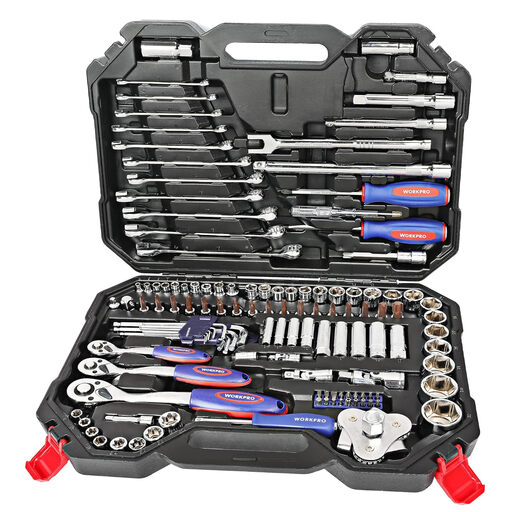
Why This Fits Their Persona: A practical starting point for UK homeowners, new renters and DIY users who want sockets, a ratchet wrench, spanners, bits and hex keys in one organised case.
The listed contents make it easier to judge practical coverage instead of choosing by piece count alone. The case also gives each tool a designated storage position.
Includes 1/2-inch, 1/4-inch and 3/8-inch drive tools, plus a blow-moulded case and polished, triple-chrome-plated finish.
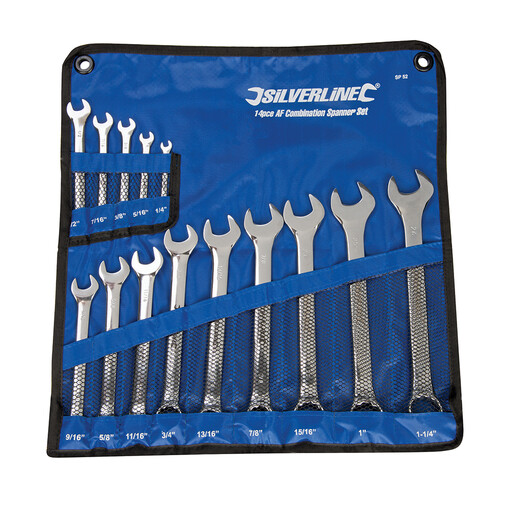
Why This Fits Their Persona: Suitable for mechanics, tradespeople and keen DIY users who prefer a dedicated spanner set with broad size coverage for workshop and maintenance jobs.
The 14 individual sizes are clearly listed from 1/4-inch to 1-1/4-inch, so buyers can assess coverage before purchase rather than relying on vague “multi-size” wording.
Uses hardened, tempered, drop-forged chrome vanadium steel and includes a 15° offset with open and bi-hexagonal ends.
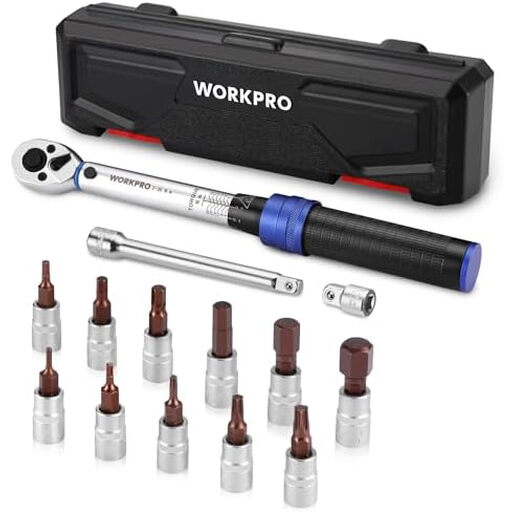
Why This Fits Their Persona: A focused choice for bicycle and motorcycle maintainers who need controlled tightening rather than a general socket set.
Its stated 2–26 N.m range helps users compare it with the torque requirements of their components. It should not be selected for tasks outside that range.
Features a 72-tooth, dual-direction mechanism, ±3% stated accuracy and hex, Torx and extension accessories.

Why This Fits Their Persona: Designed for repeated vehicle or motorcycle work where a compact electric ratchet wrench can save hand movement in confined areas.
The listed 3/8-inch drive, 60 N.m torque and 180 RPM output give clearer information than a generic “powerful” description. Use a manual torque wrench for final torque-sensitive tightening.
Includes two 2,000 mAh batteries, quick charger, LED light, eight sockets, extension rod and storage box.
We have compiled a complete, real-time list of products that fully satisfy these strict selection criteria and UK safety regulations.
A broad tool kit does not cover every maintenance task. Plumbers may need water pump pliers, an adjustable wrench set or a rubber band wrench for smooth fittings and oil filters. The DURATECH hose clamp pliers set is intended for flexible hoses, including fuel, brake, coolant and radiator hoses, but not hard or high-pressure lines.
For bicycles, combine a suitable socket set with a calibrated low-range torque wrench. For tiling, dedicated tile nippers with tungsten carbide-tipped jaws are more appropriate than ordinary pliers. These task-specific tools can prevent damage that a general-purpose tool may cause.
Yes, provided the set contains the sizes and drive formats needed for your projects. A 123-piece mechanic tool set can cover many household and automotive repairs, while specialist plumbing tools or bike repair tools may still need to be purchased separately.
Remove dirt and moisture after use, inspect handles and moving parts, and store tools in their case or roll. Keep them away from persistent condensation. Lightly lubricate adjustable mechanisms where the product instructions permit it, and replace tools showing cracks, deformation or excessive wear.
An electric ratchet wrench can speed up repetitive removal and installation of nuts and bolts, particularly in tight automotive spaces. It is not a replacement for a manual torque wrench when a component requires a specified final tightening value. Always check battery charge, socket compatibility and the tool’s stated torque limits before use.