
24/7 Customer Support

Free returns

Same-day & Next-day Delivery

Quality Guaranteed

Unlock Your Welcome Offers: FREE Delivery | Up to 80% OFF | Free 30-day JoyPlus trial
Download the APP
For any content creator, from a vlogger filming in the Peak District to a journalist conducting interviews in central London, poor audio can undermine even the most stunning visuals. Investing in a professional wireless microphone is a critical step, but the market is filled with confusing specifications and overblown marketing claims. Many creators find themselves with gear that is unreliable, complicated or simply not up to the task.
As a Joybuy Product Recommendation Officer, my role is to help you navigate this landscape. We will look past the hype and focus on the practical features that deliver clean, dependable audio. Let's start by identifying the common pitfalls that lead to wasted money and frustration.
clip-on microphone for iPhone might work perfectly, but the same system could produce static or dropouts when connected to a DSLR, ruining a crucial take.intelligent noise cancelling mic should use advanced algorithms to distinguish human speech from background noise, cleaning up the audio without degrading the quality of the voice.To ensure you get a system that enhances your workflow, focus on these non-negotiable specifications.
The primary goal is to capture pristine audio. For professional use, a key feature to look for is an onboard 32-bit float audio recorder. In simple terms, this technology creates a backup recording directly on the transmitter that is virtually impossible to "clip" or distort. If your subject suddenly shouts or a loud noise occurs, 32-bit float recording preserves the audio without the harsh distortion that would ruin a standard recording. It is a safety net that provides immense peace of mind.
While many brands advertise a long range wireless microphone with distances of over 200 metres, this is often measured in ideal, open-field conditions. In a typical UK town or city with Wi-Fi signals and physical obstructions, that range can decrease significantly. The more important factor is signal stability within a practical working distance (e.g., 50-70 metres). A reliable connection that doesn't drop out is far more valuable than a maximum range you will rarely use.
The right microphone should be discreet and easy to use. A compact microphone for interviews should be lightweight and attach securely without pulling on clothing. Consider the entire system:
lavalier mic for camera setup should be straightforward, not a puzzle of wires.Based on these practical criteria, here are some recommendations matched to specific creator profiles.
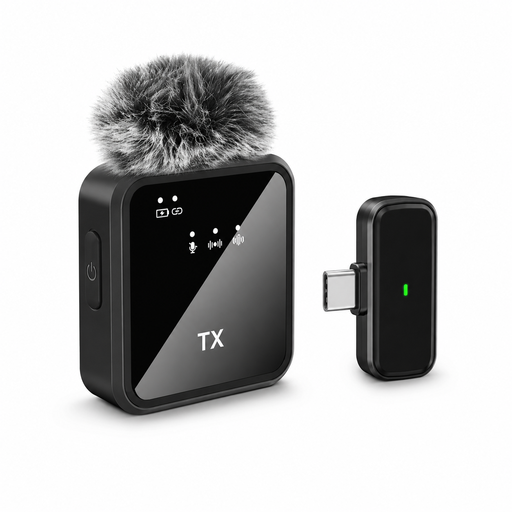
Why This Fits Their Persona: Ideal for solo creators starting their journey with a smartphone. It offers a significant audio upgrade over the phone's internal mic without a complex setup, making it perfect for straightforward vlogging, live streaming or creating social media content.
This model features a dedicated Type-C receiver that plugs directly into a compatible device, eliminating the "universal compatibility" issue and ensuring a stable physical connection.
Its main advantage is its plug-and-play simplicity. There are no complicated menus or settings, making it an accessible entry point into the world of wireless audio.
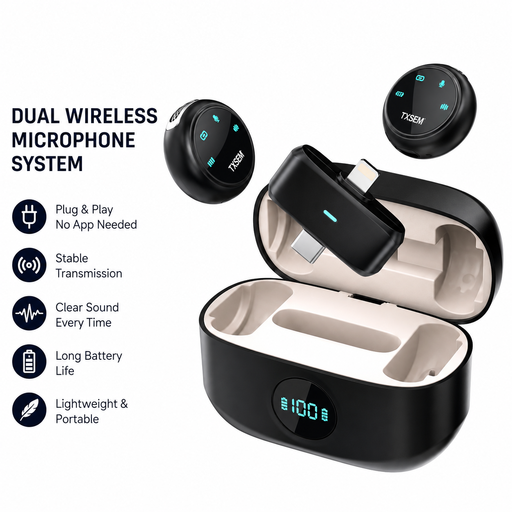
Why This Fits Their Persona: Designed for podcasters, journalists or YouTubers who frequently record two people at once. This kit provides everything needed for a two-channel setup straight out of the box, including a convenient case that charges both transmitters.
It is a purpose-built dual system, so you don't have to worry about syncing two separate kits. The receiver is designed to handle both audio streams and the universal receiver supports both iOS and Type-C devices.
The all-in-one charging case is a major benefit for creators on the move. It keeps the entire system organised and ensures both microphones are charged and ready for the next shoot.
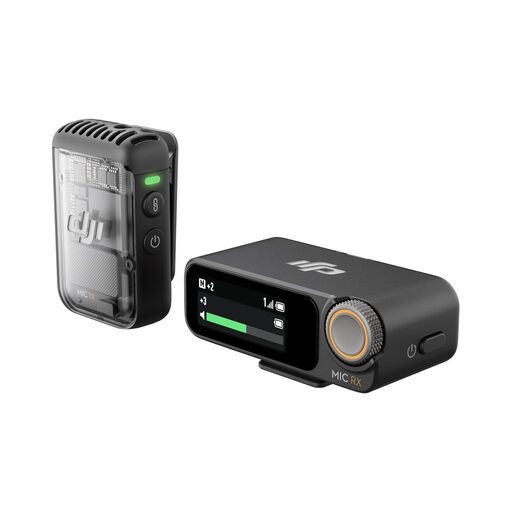
Why This Fits Their Persona: For the serious vlogger, filmmaker or journalist who cannot afford to compromise on audio quality or reliability. This system is built for demanding workflows where failure is not an option.
It directly counters the major pitfalls with professional-grade features: onboard 32-bit float recording acts as a foolproof backup and its intelligent noise cancelling effectively cleans audio without sounding artificial.
The combination of 32-bit float backup, effective noise cancelling and a stable long range wireless microphone connection makes it a highly reliable tool. The magnetic clip and included adapters for smartphones and cameras add to its versatility.
We have compiled a complete, real-time list of products that fully satisfy these strict selection criteria and UK safety regulations.
The lifespan depends on two factors: battery health and build quality. Most modern systems offer 5-8 hours of continuous use per charge. The overall lifespan of the internal batteries is typically several hundred charge cycles, which translates to years of use for most people. Look for models with sturdy casings and secure clips, as physical damage is a more common cause of failure than battery degradation.
For casual vlogging, it may not be essential. However, for anyone conducting interviews, filming in unpredictable environments or creating content where re-shoots are difficult or expensive, it is a valuable feature. It acts as an insurance policy against sudden loud noises (like a passing siren or unexpected laughter) that would otherwise ruin your audio, saving you significant time in post-production.
If you exclusively film yourself, a single-transmitter system is more than sufficient and more cost-effective. However, if you plan to conduct interviews, host a podcast with a co-host or film scenes with two people speaking, a dual-transmitter system is the correct tool for the job. It simplifies your setup by sending both audio sources to a single receiver connected to your camera.