
24/7 Customer Support

Free returns

Same-day & Next-day Delivery

Quality Guaranteed

Unlock Your Welcome Offers: FREE Delivery | Up to 80% OFF | Free 30-day JoyPlus trial
Download the APP
Keeping several subjects, projects or meeting records in one notebook can work well—provided the notebook is designed for structured use. Project notebooks with dividers are useful for students, teachers, office workers, home-office users and professionals who need more organisation than a standard exercise book provides.
However, product descriptions can make similar notebooks appear interchangeable. Before buying, check the page specification, divider design and cover material rather than relying on appearance alone.
A high page count may sound impressive, but the practical value depends on the ruling, paper weight and whether pages can be removed cleanly. Some notebooks have narrow margins, faint ruling that is difficult to follow or pages that tear unevenly.
For project work, check whether the pages are lined, whether the lines are clearly spaced and whether they are perforated if you regularly need to file or share notes.
Fixed dividers may be suitable for a simple subject notebook, but they are less adaptable when projects change. A notebook with repositionable dividers allows sections to be reorganised as coursework, clients or tasks develop.
Also check whether dividers include storage pockets. Without them, loose handouts, receipts and printed meeting notes can quickly become separated from the relevant section.
Card covers can be lightweight, but they may show marks or soften when carried in a busy school bag or work case. A wipe-clean polypropylene cover can be more practical for daily use, although it should still be kept away from excessive moisture to protect the paper inside.
Think about where the notebook will be used most often. A4 is helpful when writing extensively, while A5 can be more comfortable for daily carrying.
Paper weight is measured in gsm, or grams per square metre. The 80 gsm paper found in the featured Pukka Pad project book options is a conventional notebook weight that keeps the book relatively portable. Pen choice still matters: wetter inks may show through, so check the paper with your preferred pen before filling an entire section.
An FSC certified notebook contains paper sourced through the Forest Stewardship Council’s responsible forestry certification system. This describes the paper sourcing standard; it does not guarantee that every component of the notebook has the same certification.
An 8 mm ruling is useful for regular handwriting and structured lists. Feint ruling is less visually prominent, which can suit notes, calculations and annotations without making the page feel crowded.
The most useful organisational features are often simple:
For students, a divider per module can reduce loose papers at the bottom of a bag. For professionals, sections can be assigned to clients, meetings or workstreams.
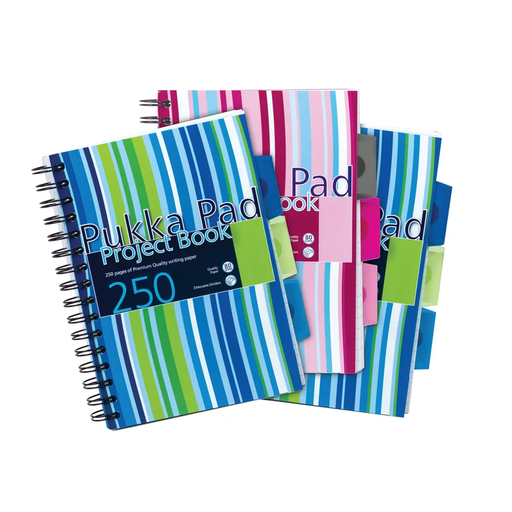
Why This Fits Their Persona: The compact A5 format suits students, trainees and home-office users who want separate books for different tasks without carrying an A4 folder.
It provides three repositionable dividers with storage pockets, rather than relying on fixed sections, and the pack of 3 supports separate subjects or projects.
250 pages per book, 8 mm lined 80 gsm FSC certified paper and a portable 148 × 210 mm size.
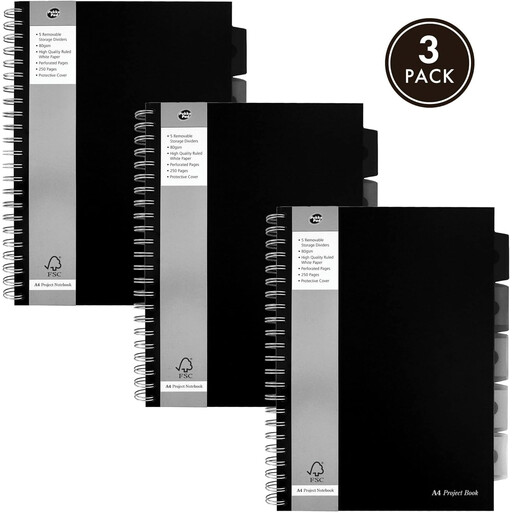
Why This Fits Their Persona: This option is suited to professionals, teachers and home-office users who need generous writing space and a consistent format across multiple workstreams.
The five colour-coded repositionable dividers and integrated pockets provide flexibility, while the polypropylene cover can be wiped clean.
A4 dimensions, 250 pages per book, perforated 8 mm ruled pages and a pack of three for separate projects.
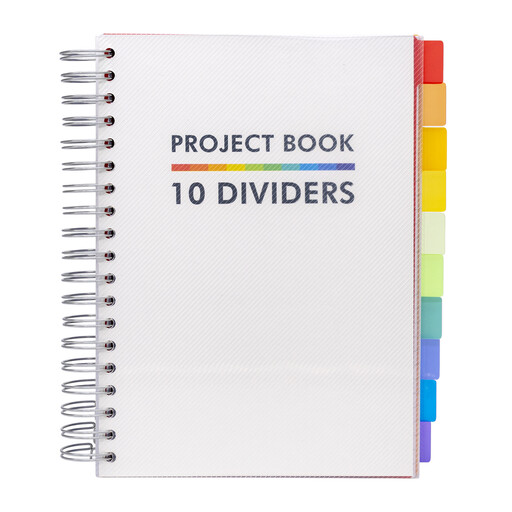
Why This Fits Their Persona: Ten sections suit users managing multiple modules, client files, lesson plans or long-running projects while still needing a notebook that fits in a backpack.
The ten multi-coloured repositionable dividers reduce the need to buy several single-section notebooks, while perforated pages support later filing.
400 pages of 80 gsm FSC certified paper, B5 portability and a wipe-clean translucent cover.
Store any project book in a dry place and avoid bending the spine or overfilling divider pockets. Keep drinks away from the pages, particularly in classrooms, cafés and shared offices. Use pens that do not bleed through the paper, and remove perforated sheets carefully along the intended edge.
We have compiled a complete, real-time list of products that fully satisfy these strict selection criteria and UK safety regulations.
Yes. A5 and B5 formats are easier to carry between lectures, libraries and accommodation, while A4 is useful for technical subjects, diagrams and extensive written work. Repositionable dividers can be assigned to modules, assignments or revision topics.
There is no fixed lifespan. It depends on how frequently it is carried, how full the pockets become and whether it is exposed to moisture. A wipe-clean cover can help manage everyday marks, but careful storage and avoiding overfilled sections will reduce wear.
It can be practical when you manage separate subjects or clients. Three smaller books allow projects to be carried independently, but one B5 or A4 book may be more convenient when all notes need to remain together. Choose based on your carrying routine and the number of active sections.