Detail-first architecture viewers
If you pause to examine plans, façades and interior materials, give image detail and a stable viewing position priority. You will still need to control room light and check the projection surface.


A consistently positioned, higher-output 4K-capable home-cinema projector is worth considering when fine architectural detail and shared-lounge light take priority. Choose a portable 1080p model when moving and storing the projector matter more, but check the available lens-to-wall distance and lighting before committing to either route.
If you pause to examine plans, façades and interior materials, give image detail and a stable viewing position priority. You will still need to control room light and check the projection surface.
If programmes play while the communal room is in use, consider how much light you can exclude and where the projector can sit. A compact body alone will not tell you whether the image will work in that space.
If the projector cannot stay installed, compact storage and quick setup may matter more than a permanent home-cinema arrangement. Check what you give up in stated output and image detail.
Start with the room: decide when you will watch and measure the usable projector position. Then weigh image detail against the effort of moving and setting up the projector.
| Concern | What to check | Who this matters to |
|---|---|---|
| Architectural detail | Check the model’s imaging method, the resolution your chosen source can deliver and the condition of the wall or screen. A 4K label alone does not identify the imaging method. | If I want to examine plans and façade details, I need an image and source that preserve the detail I care about. Around 29% of consumers put architectural detail first. |
| Shared-room brightness | Consider viewing time and whether blinds can be closed; compare stated light output only with its measurement basis and room conditions in mind. | When the lounge cannot be fully darkened, I want the programme to remain comfortable to follow without changing everyone else’s plans. Brightness is the primary need for around 29% of consumers. |
| Placement and noise | Measure lens-to-wall distance against the exact model’s throw information, then check its stated operating noise for the intended mode. | If I have to set up near other flatmates, the projector must fit the available spot without becoming distracting. Around 24% of consumers make placement and noise their first concern. |
| Streaming and shared use | Confirm access to your chosen service and whether focus and image correction make repeated setup manageable. | When several people take turns using the projector, I want to start a programme without a complicated handover. Ease of shared use comes first for around 18% of consumers. |
A maximum image size does not show whether the image will fit from your available shelf or table. ProjectorCentral explains that image width and lens-to-screen distance are linked by the lens optics.
Measure from the planned lens position to the wall and consult the exact model’s distance guidance for your desired image width.
A poor fit may mean finding another position or using a suitable stand or mount.
Epson lists 2,800 lumens for the EH-TW6250, while BenQ lists 500 lumens for the GV50. Those model specifications do not establish how either image will look at your chosen size, picture mode and level of room light.
Check how each figure is specified, and judge whether you can control the lounge lighting at the time you normally watch.
Automatic focus and image alignment can ease repositioning, but they cannot change the available throw distance, room light or the texture of a wall.
Choose a position that fits the image first, then treat automatic adjustments as setup conveniences.
An imported version may need closer attention to its supplied plug, power requirements and seller support. Great Britain’s electrical-equipment safety requirements apply to products placed on that market, according to the Office for Product Safety and Standards; Northern Ireland has different arrangements.
Before ordering for use in Great Britain, confirm the exact version, suitable power arrangement and relevant product information with the seller.
The EH-TW6250 is a home-cinema example for a more consistent shared-room position.
The GV50 represents a portable route when flatmates need to move the projector.
The Freestyle 2nd Gen focuses on temporary placement and repeated setup.
Its HORIZON models offer different combinations of smart setup and stated image specifications.
These portable models suit shoppers considering a temporary or move-between-rooms setup. Their listings do not replace a check of your room’s light, throw distance and preferred streaming service.
 No image available
Consider this model if you need to reposition the projector between shared spaces.
The product title states native 1080p, 900 ANSI lumens, Android 14, 180° rotation and automatic keystone correction. Check the required projection distance and whether its stated output suits your lounge lighting.
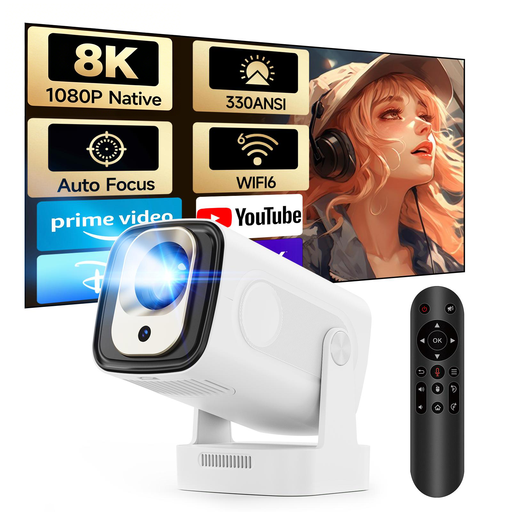 No image available
This is another option for a setup that cannot remain in one position.
The title specifies native 1080p, 330 ANSI lumens, autofocus and Android 14. Its 4K wording should not be read as native 4K; check placement and viewing light for your intended image size.
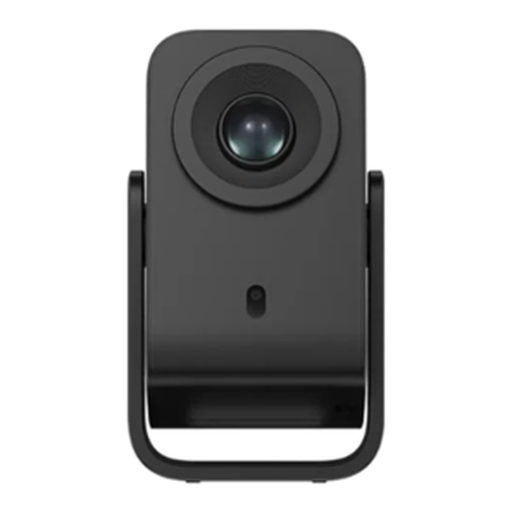 No image available
Consider the C1 if you want a portable projector and can assess it in the room where you will watch.
Its title specifies 1080p Full HD and 4K support, not native 4K. Confirm the required lens-to-wall distance and your streaming-service access before choosing it.
 No image available
The rotating design may appeal when the same projector needs different temporary positions.
The title states Full HD 1080p, 500 lumens, Wi-Fi, Bluetooth and HDMI. Check the model’s throw information rather than relying on its maximum screen-size claim, and confirm the supplied power arrangement for use in your flat.
 No image available
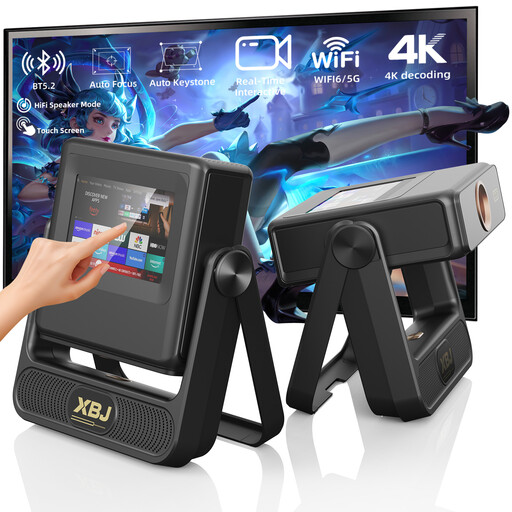
This model is worth considering for temporary placement if automatic focus and keystone correction are useful to your flatmates.
The title states native 1080p, 4K support and an Android system; 4K support does not mean native 4K. Its descriptions give conflicting brightness figures, so confirm the exact specification, throw distance and suitable power arrangement before deciding whether it fits your room.
Measure from the planned projector lens position to the wall or screen, then use the exact model’s throw ratio or projection-distance table to check your desired image width. ProjectorCentral explains the relationship between lens distance and image width; the room’s overall length alone is not enough.
A portable projector can suit architecture programmes when moving it between rooms matters and you can usually control the light. For closer attention to drawings and building details in a shared lounge, also compare the image specifications and placement needs of a 4K-capable home-cinema model rather than assuming portability settles the choice.
Not necessarily: Epson lists Android TV for the EH-TW6250, BenQ lists Google TV for the GV50, and Samsung lists Tizen smart TV for The Freestyle 2nd Gen. Check whether the exact model supports the service and viewing method your flatmates use.
Confirm the exact product version, its power arrangement and the seller’s product and support information. The Office for Product Safety and Standards says electrical equipment placed on the Great Britain market must meet applicable safety requirements; do not assume that a listing title establishes conformity or that Great Britain guidance describes Northern Ireland’s arrangements.