Colour-focused documentary viewers
If you pause on paintings, architecture or restoration footage, look beyond a resolution label. Documented colour coverage and calibration information help you assess a model intended for careful viewing.


Measure the available lens-to-wall distance and decide how wide an image you want before choosing a projector: a model that cannot make that image from your planned position will not suit the room. For art documentaries, compare native resolution and documented colour specifications as well as placement options. If you watch with lamps or daylight on, assess brightness against those conditions rather than relying on a single specification.
If you pause on paintings, architecture or restoration footage, look beyond a resolution label. Documented colour coverage and calibration information help you assess a model intended for careful viewing.
If furniture limits where the projector can sit, measure the lens-to-screen distance and intended image width. Check the exact model’s throw calculation before deciding whether zoom or lens shift would be useful.
If you watch with some daylight or lamps on, consider the room’s light control alongside brightness. Check that the projector can connect to your documentary services and that its position near the seating area is practical.
Start with the image size your room can accommodate, then weigh colour and detail against your usual lighting and the effort of setting up each viewing session.
| Concern | What to check | Who this matters to |
|---|---|---|
| Artwork colour and detail | Check native resolution separately from supported input resolution, then look for colour-gamut and calibration information for the exact model. | If paintings and archive footage are why I want a projector, fine texture and credible colour come before convenience features. Around 35% of consumers put image fidelity first. |
| Image fit in the room | Measure the usable lens-to-screen distance and intended image width; check the model’s throw calculation and any optical placement adjustments. | With few places to put the projector, I need the planned image to fit from a position that works around my furniture. Room fit is the primary concern for around 29% of consumers. |
| Ambient light | Consider the light present when you watch and compare brightness figures on a like-for-like measurement basis where possible. | If I usually leave a lamp on, I need to judge the picture under those conditions rather than assuming a dark-room setup. Around 21% of consumers focus primarily on viewing with ambient light. |
| Everyday streaming | Check access to your intended apps or an HDMI source, plus audio connections and stated operating noise if the projector will sit nearby. | For regular documentary evenings, I want to start watching without repeatedly adjusting the setup or changing devices. Ease of use comes first for around 15% of consumers. |
A projector can accept a 4K signal while displaying it at a lower native resolution. That distinction matters when you are choosing a large image for close-up artwork or subtitles.
Read the native resolution separately from the supported input formats. A Joybuy projector listing, for instance, pairs a native 1080P specification with a 4K-support claim.
A fixed-throw projector may produce the wrong image size from the only usable position in a small room. BenQ specifies a fixed 1.2 throw ratio for the GP520.
Measure from the intended lens position to the wall or screen, then check the exact model’s throw calculation before choosing a position or mount.
If that position does not work, a different stand or mount may be needed.
Ambient light affects how an image looks, and brightness figures stated using different measurement standards are not directly interchangeable.
Decide whether you normally watch in a darkened, dim or partly lit room. Compare figures stated on the same basis where possible, and consider how curtains and the projection surface will affect your setup.
The viewing activity, not the display device, determines whether a TV Licence is required. GOV.UK says a licence is needed to watch or record live TV or use BBC iPlayer.
Check the current GOV.UK guidance against the services you intend to use before watching.
BenQ offers both living-room and colour-oriented home-cinema models relevant to this choice. Its UK specifications list the GP520 as a 4K UHD projector with 2,600 ANSI lumens; BenQ describes the W5800 as a colour-calibrated 4K laser model.
Epson’s home-cinema range includes the EH-LS12000B, a 4K laser model with powered zoom, focus and lens shift.
XGIMI’s HORIZON S Max is relevant if you expect to change the projection angle or place a projector on different furniture.
These native 1080P projectors offer built-in smart features and automatic setup. For artwork-focused viewing, weigh their stated resolution against your detail needs, and check colour information, app compatibility and the image size possible in your room before ordering.
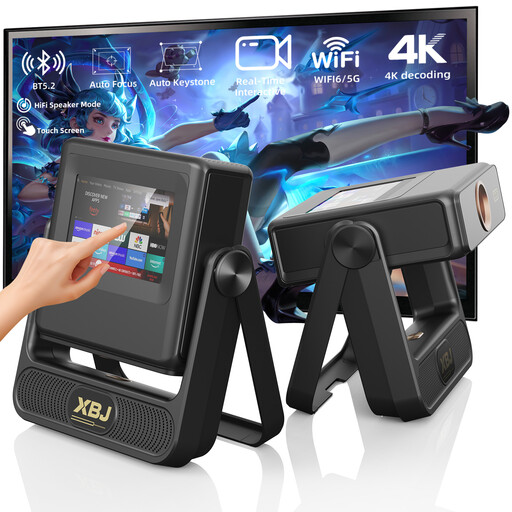 No image available
Consider this model if a built-in Android system and automatic setup suit your regular documentary viewing, provided the planned image fits your room.
Native 1080P resolution with 4K support, rather than native 4K; 900 ANSI lumens, autofocus, automatic keystone and Wi-Fi 6 are stated in the product name.
Confirm your intended apps, the model’s throw calculation and its colour specifications if faithful artwork colour is a priority.
 No image available
Consider this model if you want a projector with built-in smart features and automatic alignment for regular viewing, after checking that its image will fit your available position.
The product name states native 1080P resolution with 8K support, not native 8K; it also lists 900 ANSI lumens, Android 14, 180° rotation and automatic keystone.
Check the exact throw calculation for your intended image size, your streaming-app requirements and the model’s colour information before choosing it for artwork-heavy films.
Measure the usable lens-to-wall or lens-to-screen distance and decide how wide the image can be, then check the exact model’s throw ratio or manufacturer calculator. A fixed-throw model such as the BenQ GP520, which BenQ specifies at 1.2, suits the position only if that calculation works; zoom and lens shift can offer additional placement options on models that provide them.
No: check whether 4K refers to native resolution or merely a supported input signal, and assess colour specifications separately. If artwork reproduction is central to your choice, look for documented colour coverage and calibration information for the exact model rather than assuming resolution establishes colour accuracy.
Choose brightness with your usual lighting in mind. Epson’s UK buying guide gives 2,500–3,500 lumens as a starting range for living rooms with some ambient light; it is not a guarantee for every room or model. When comparing products, check whether their figures use the same measurement standard.
A projector does not change the licensing distinction: GOV.UK says you need a TV Licence to watch or record live TV or use BBC iPlayer. Check the current guidance for the particular services and viewing activities you plan to use.