Dark-room astronomy viewers
You usually watch in the evening with lights and daylight controlled. You want to assess shadow separation and fine detail in star fields, rather than choose by brightness alone.


Choose for the room where you will watch: if you can control the light, prioritise dark-scene detail and a projector that fits your screen position; if you often watch before dark, consider brightness alongside ways to reduce light falling on the screen. ProjectorCentral advises that room light affects both the brightness needed and the black level you see, so headline lumen and contrast figures cannot settle the choice on their own.
You usually watch in the evening with lights and daylight controlled. You want to assess shadow separation and fine detail in star fields, rather than choose by brightness alone.
You sometimes watch before dark or with other lights on. You need to consider whether the picture remains viewable while accepting that ambient light weakens perceived blacks.
Furniture, seating or a fixed mounting position limits where the projector can go. Throw ratio, zoom, lens shift and connections may determine whether a model works in your room.
For astronomy programmes, start with the viewing light and available projector position, then check picture formats and longer-term ownership needs against the exact model.
| Concern | What to check | Who this matters to |
|---|---|---|
| Dark scenes and detail | Check the native resolution or exact 4K designation and relevant HDR support. Assess dark scenes in comparable reviews or a demonstration, not by headline contrast ratio alone. | When I can darken the room, I want to distinguish faint detail against star fields rather than just make the image brighter. Around 33% of consumers put dark-scene fidelity first. |
| Viewing with some light | Look for a clearly labelled brightness measurement, such as ANSI or ISO lumens, and consider the intended screen size and light falling on it. | If programmes are on before nightfall, I need the picture to remain viewable without expecting brightness to restore deep blacks. For around 25% of consumers, ambient-light viewability comes first. |
| Room fit and connections | Measure lens-to-screen distance and check the exact model's throw range, zoom, positioning controls and connections for your playback device. | With furniture or a mounting point already fixed, I need the intended image to fit and my programme source to connect. Room fit is the primary concern for around 25% of consumers. |
| Upkeep and support | Confirm the light-source type, any mode-dependent life claim, replacement arrangements and the seller's warranty and returns terms. | For regular viewing, I would rather plan for light-source upkeep and know where to turn if the projector develops a fault. Around 17% of consumers prioritise ownership considerations. |
ProjectorCentral explains that brighter rooms need more light output, but room light also raises the black level you perceive. A published brightness figure may not represent the output in your preferred picture mode.
Control light on the screen where possible, compare brightness figures with the same measurement label, and judge them against your intended image size.
ProjectorCentral cautions that published contrast specifications do not necessarily predict what you will see. Figures obtained by different measurement methods should not be treated as a direct cross-brand comparison.
Look for comparable dark-scene assessments or a demonstration, and consider reflections and lighting in your own room.
A projector's throw range and positioning controls determine whether it can make the intended image from the available location. A stand or mount must also be suitable for the projector's weight.
Measure from lens to screen, check the exact model's image-size guidance, and confirm the stand or mount's stated capacity.
An unsuitable position may mean changing the stand or screen and reworking the installation.
Playback options and connections differ by model, while access to a particular app can change. A smart-projector label alone does not establish compatibility with the service you use.
Check current app availability and the required HDMI and playback-device compatibility before deciding whether you need an external streaming device.
These model examples show different specifications worth checking; they are not a comparison of every projector made by each brand.
Epson United Kingdom lists the EH-TW7100 with 4K PRO-UHD, HDR10, 3,000 lumens, two HDMI ports, lens shift and optical zoom.
BenQ UK specifies the TK860i with 4K UHD, 3,300 ANSI lumens, HDR10 and HLG modes, three HDMI inputs, a 1.13–1.47 throw ratio and 1.3x zoom.
Optoma United Kingdom lists the UHD38x with 4K UHD, HDR and HLG compatibility, 4,000 lumens, two HDMI 2.0 inputs and a 1.5–1.66 throw ratio.
These projectors offer different stated resolutions, positioning features and playback options for watching programmes. Check the exact image size your room allows and seek comparable dark-scene evidence before choosing one for astronomy footage; the specifications below do not establish which produces the strongest star-field detail.
 No image available
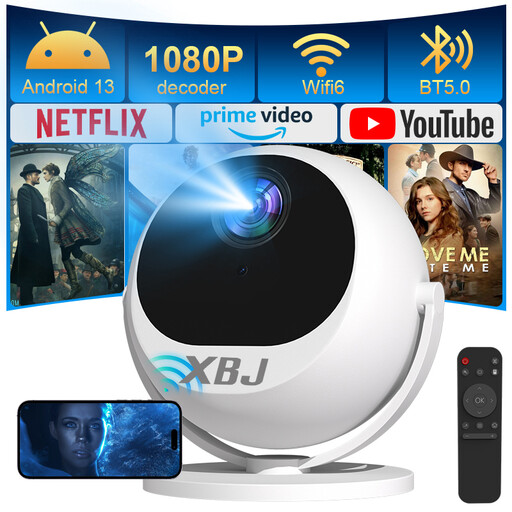
Consider this model if native 1080p and adjustable placement are priorities for programme viewing.
The product name states 180° rotation, auto keystone and HDMI and USB compatibility. Its 8K support claim does not mean native 8K resolution.
Confirm the usable brightness specification, intended image size and dark-scene performance before choosing it for a room with ambient light.
 No image available
This is a choice to examine if you want to point the image towards a wall or ceiling as well as use a conventional screen.
The product name lists 360° rotation, auto keystone, HDMI and Full HD 1080p, alongside a 500-lumen claim.
Check the image size achievable from your available position and assess dark scenes separately from the brightness claim.
 No image available
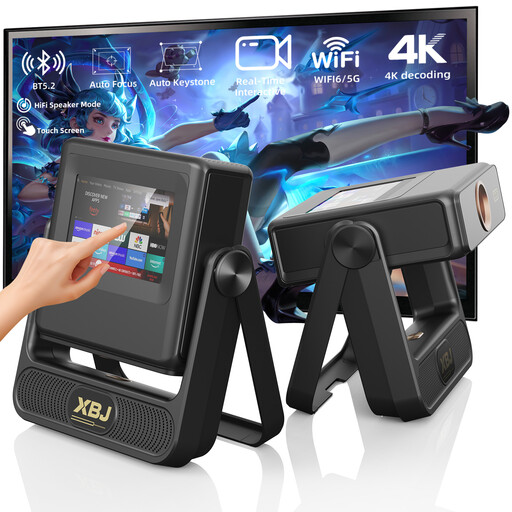
Consider this model if native 1080p and automatic alignment suit your programme-viewing setup.
The product name lists auto focus, auto keystone and an Android system. Its 4K support claim is distinct from its stated native 1080p resolution.
Confirm the brightness for this exact variant, current app compatibility and the image size possible from your chosen position; assess dark-scene performance separately.
 No image available
This portable model is worth checking if a compact programme-viewing setup matters more to you than a fixed installation.
The product name states 1080p FHD and 4K support; 4K support does not itself establish native 4K imaging.
Confirm your required HDR format and playback apps, along with the image size possible in your room and how dark scenes look under your viewing conditions.
Not if you can adequately control the room light. ProjectorCentral explains that darker viewing conditions need less projector light output, while ambient light both increases the brightness needed for a viewable picture and weakens perceived blacks. Consider the screen size and compare clearly labelled brightness measurements when lights-on viewing matters.
A headline contrast ratio alone is not a dependable cross-brand comparison for dark astronomy scenes. ProjectorCentral distinguishes between contrast measurement methods and cautions against reading published figures as a prediction of the picture you will see; use comparable reviews or a demonstration and account for your room light.
Measure the lens-to-screen distance, intended image size, lens height and any sideways offset. Then check the exact model's throw range, zoom and lens-shift limits to see whether it can make and position the image from that location.
Electrical equipment placed on the Great Britain market must meet the applicable requirements of the Electrical Equipment (Safety) Regulations 2016, according to the Office for Product Safety and Standards guidance. Check that the supplied projector is intended for the market where it will be used rather than assuming a plug adapter establishes compliance; Northern Ireland has separate guidance.
For qualifying faulty goods, the Consumer Rights Act 2015 provides a short-term right to reject with a minimum 30-day period, subject to its conditions, as explained by Legislation.gov.uk. This statutory remedy is distinct from a retailer's voluntary change-of-mind returns policy; keep your order details and tell the retailer about the fault.