Families with a dedicated movie room
If you can darken the room and leave a projector in place, focus on native resolution, image size and whether the available depth accommodates the model you want.


Choose the projector type to fit the room before settling on resolution. A conventional 4K model suits a darker room with enough projection distance; an ultra-short-throw model suits placement close to the wall; and a portable Full HD model suits occasional viewing when you can control the light. Whichever route you take, check the exact model’s native resolution, brightness, projection distance and playback connections against your family videos and room.
If you can darken the room and leave a projector in place, focus on native resolution, image size and whether the available depth accommodates the model you want.
Lamps or daylight make room lighting an important part of the choice. Compare each model’s rated brightness for those conditions, then check whether its position will work alongside your usual furniture.
For occasional viewing, straightforward placement, playback and audio may matter more than a permanent large-screen setup. Plan to control the room light and check how the projector will play your own files.
For family-video viewing, decide where the projector can sit before comparing the image and playback features that matter in that room.
Choose when: You can darken the room and place the projector at the distance specified for your intended screen size.
Allow for: Placement farther from the wall and a cable route to your video source; check what the exact model means by 4K.
Choose when: A cabinet close to the wall is more practical than a projector behind the seating area.
Allow for: Precise cabinet-to-wall positioning and a suitable projection surface. LG specifies different distances for 40-inch and 100-inch images from its PU615U.
Choose when: You bring out the projector for occasional family videos and can dim the room.
Allow for: Less resolution than a 4K route, and check power and file playback rather than assuming portable means cordless or compatible with every video.
| Concern | What to check | Who this matters to |
|---|---|---|
| Room fit and screen size | Measure the intended image width and available lens-to-screen distance; use the exact model’s projection-distance table or calculator. Check the view from the seats too. | If the projector cannot form the image from the available position, its other features will not fix the setup. Around 31% of consumers put room fit first. |
| Image detail | Compare native resolution, not just the resolution a projector accepts as input. Check that your video source can connect and play. | To show detailed footage on a large screen, I would want to know what resolution the projector actually displays; roughly 31% of consumers prioritise image detail. |
| Room lighting | Note whether you normally watch with curtains closed, after dark or with living-room light present; compare brightness figures on their stated measurement basis. | With lamps or daylight in the room, I need an image suited to those viewing conditions. Around 23% of consumers make room lighting their main concern. |
| Playback and setup | Check the connections for your camera, laptop or media player, the way your files will play, audio options and whether mains power is needed. | If I move the projector between rooms, I want to get our videos playing without an awkward collection of equipment; approximately 15% of consumers put playback and setup first. |
A projector can accept a higher-resolution signal while displaying it at a lower native resolution. The Magcubic HY350Max listing, for instance, says both “8K Supported” and “Native 1080P Full HD”.
Find the native-resolution specification before comparing models for large-screen detail.
The lighting you normally leave on affects how useful a brightness figure is. Epson’s projector guidance distinguishes controlled-light portable viewing, dark dedicated rooms and living rooms with some ambient light.
Start with your usual viewing conditions, then compare the exact models’ brightness labels and intended room use.
A stated maximum image size does not tell you whether your planned position can produce it. BenQ defines throw ratio using projection distance divided by image width; the relevant distance varies by model.
Measure the space and check the model’s distance table for your intended image width. For ultra-short-throw models, check the specified gap from the wall.
A different cabinet or mount may be needed if the planned position does not work.
Built-in apps and speakers do not establish that a projector has a battery or will play the videos stored on your particular device. LG specifies that its PU615U has no built-in battery.
Check the power supply, your playback method, the required ports and the audio connection before choosing a model.
Your setup may require a separate media player, cable, adapter or speaker.
Epson’s UK range includes portable Full HD, conventional home-cinema and ultra-short-throw models, so compare the individual projector rather than assuming the same setup suits each one.
BenQ has conventional home-cinema models worth checking if you can accommodate their specified projection distance.
LG’s PU615U CineBeam S is an ultra-short-throw option for a setup close to the wall.
These portable Full HD choices are relevant if you can control the light for family-video viewing. Compare their placement and playback requirements with your room and video sources; they are not substitutes for checking the conventional 4K or ultra-short-throw routes if those better fit your space.
 No image available
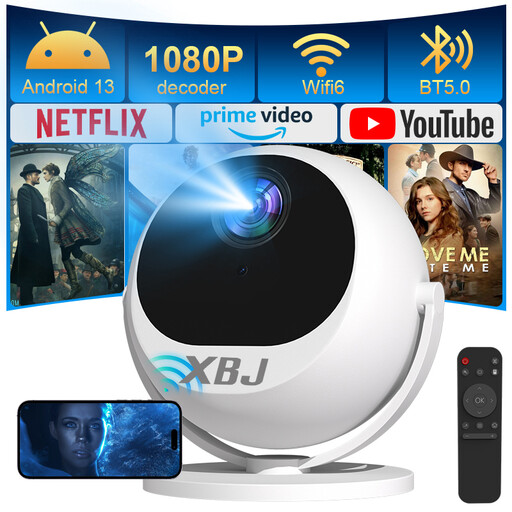
Consider this for family videos in controlled light if a moveable setup matters to you.
The listing states native 1080p Full HD, 900 ANSI lumens, auto keystone correction and 180° rotation. “8K supported” describes an accepted input, not the native display resolution.
Check the projection distance for your intended image size and whether your own files and devices will play as needed.
 No image available
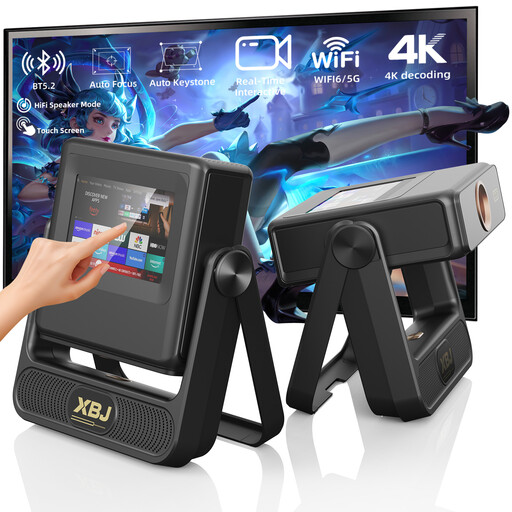
Consider this if you want to reposition a projector for occasional family viewing.
The title lists Full HD 1080p, 360° rotation, auto keystone correction and a 120-inch display claim. It describes brightness as 500 lumens without identifying that figure as ANSI or ISO lumens.
Check the distance needed for your planned screen size and compatibility with your video files and source devices.
 No image available
Consider this for occasional family viewing if its projection direction and playback options suit your setup.
The title states native 1080p, 4K input support, automatic focus and keystone correction, Wi-Fi 6 and compatibility with PS5 and Switch.
Confirm the applicable brightness and image-size specifications, the distance needed in your room and playback of your own videos before deciding.
 No image available
Consider this for occasional family videos if you want a portable Full HD smart projector and can check its fit for your room.
The title states 1080p Full HD and 4K input support; 4K support does not make it a native 4K model.
Check suitability for your normal room lighting, the distance required for your intended image and playback from your particular devices.
Measure from the planned lens position to the screen and check the exact model’s distance table or calculator for your intended image width. BenQ defines throw ratio as projection distance divided by image width; after checking projector placement, make sure the image size also works from your seats.
Choose a portable Full HD route when occasional viewing and easy movement between rooms matter most; consider a 4K home-cinema route when large-screen detail is a priority and your room accommodates its placement. Check native resolution separately from supported input resolution, and consider the resolution of the videos you will play.
Check the marking applicable to the projector’s destination rather than assuming one rule covers every UK delivery. In its 31 March 2026 product-marking table, the UK Department for Business and Trade lists UKCA or CE for electrical equipment placed on the Great Britain market, and CE, or UKNI together with CE, for Northern Ireland. Check the product and seller information for the destination that applies to your order.
Keep your order confirmation, delivery details, serial number, evidence of the fault and messages with the seller. GOV.UK explains that consumer law protects purchases made remotely and in person; for advice about a faulty purchase, it directs consumers to Citizens Advice in England and Wales, Advice Direct Scotland in Scotland, or Consumerline in Northern Ireland.