Viewers managing daylight
If you watch before sunset or leave kitchen lights on, decide how much light you can reduce before choosing an image size and comparing brightness claims.


Choose a projector for the light you can control and the distance available between the projector and the wall. A portable model suits short-film sessions in a dimmed room when you want to pack it away; if you often watch with the lights on, consider a model with higher stated brightness, and check short-throw placement if a table or walkway limits the available distance.
If you watch before sunset or leave kitchen lights on, decide how much light you can reduce before choosing an image size and comparing brightness claims.
If the dining table, chairs or walkway restrict projector placement, measure the usable projector-to-wall distance before comparing picture features.
If the projector must be put away after use, a manageable temporary position and straightforward access to sound and content may matter more to you than a fixed installation.
Settle lighting and placement first: a projector that cannot produce the image you want from a safe position will not become a better fit through extra streaming or resolution features.
| Concern | What to check | Who this matters to |
|---|---|---|
| Room light and image size | Note when you will watch, what light you can dim and your intended image size. Compare brightness figures using the stated measurement standard. | If I watch while daylight or kitchen lighting remains, I need an image I can still see at my chosen size; around 36% of consumers put room-light performance first. |
| Placement and throw distance | Measure the actual projector-to-wall position and check the exact model’s throw ratio against the image size you want. | A table or walkway leaves me little room to position a projector without getting in the way; for around 29% of consumers, fitting the layout is the primary concern. |
| Temporary setup | Check where the projector can stand safely, how its image is adjusted and what must be connected each time. | I want to watch a short film, then clear the dining space without a permanent setup; roughly 21% of consumers chiefly value easy setup and storage. |
| Film and content access | Check native resolution, the sound arrangement and whether your intended source or streaming service works with the exact model. | Once lighting and placement are workable, I care most about seeing, hearing and playing my chosen films; around 14% of consumers make presentation and content access their main priority. |
A compact model can be convenient without producing the image you want in daylight. A larger projected image also spreads its light over more surface area.
Decide whether you can close blinds and dim lights before choosing between a portable model and one with higher stated brightness. Check the proposed image size as well as the brightness figure.
A 4K label cannot tell you whether the projector can sit clear of the table and walkway while making the image size you want.
Measure the usable projector-to-wall distance and check the exact model’s throw information. Consider a short-throw or wall-adjacent format if a conventional position will not fit.
Built-in platforms, speakers and software support differ by model. A smart-projector label alone does not confirm access to a particular film service.
Check the intended app or HDMI source, speaker arrangement and current software-support information for the model you plan to buy.
Depending on that setup, you may also need a separate streaming device or speaker.
Kitchen surfaces may put a projector near splashes, heat or obstructed airflow. The Joybuy Halo+ instructions specifically warn against excessive moisture, extreme heat and blocked ventilation.
Use a stable, dry position away from the hob and sink, keep vents clear and follow the instructions for your particular projector.
BenQ’s UK range offers a useful contrast between portable and short-throw home-entertainment formats.
Epson’s UK range includes portable models and projection-TV-style models for different placement plans.
XGIMI’s Halo+ is a portable option to consider for occasional sessions when room lighting can be controlled.
These portable models are choices for temporary kitchen-diner setups. They include native Full HD and native 720p options; none removes the need to check room light, throw distance and a safe place to operate the projector.
 No image available
Consider this for a temporary Full HD setup where you can control room lighting and check the intended projector-to-wall position.
The listing title states native 1080P, 900 ANSI lumens, Android 14, 180° rotation and automatic keystone correction. Confirm the image size at your available distance and access to your intended streaming services.
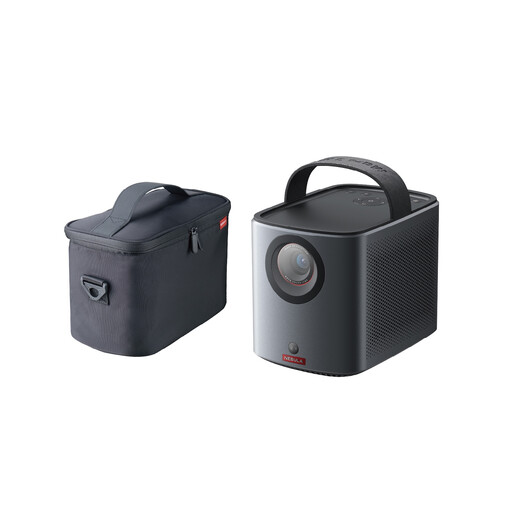 No image available
The carry case makes this bundle relevant if you need to put the projector away after a short-film session.
Check the model’s brightness, throw information and battery runtime against your room and viewing plans rather than relying on portability alone.
 No image available
Consider this portable model if you can measure a workable position and plan how you will connect your film source.
The listing title states native Full HD 1080P, 1,200 ANSI lumens and vertical and horizontal keystone correction. Check the image size at your available distance and whether your chosen streaming source needs an external device.
 No image available
The rotating format may help if you need to change projection angle between temporary positions, provided each position is safe and produces the image size you want.
The listing title states Full HD 1080P, 500 lumens and automatic keystone correction. Check the model’s throw information and your intended streaming-service access before buying.
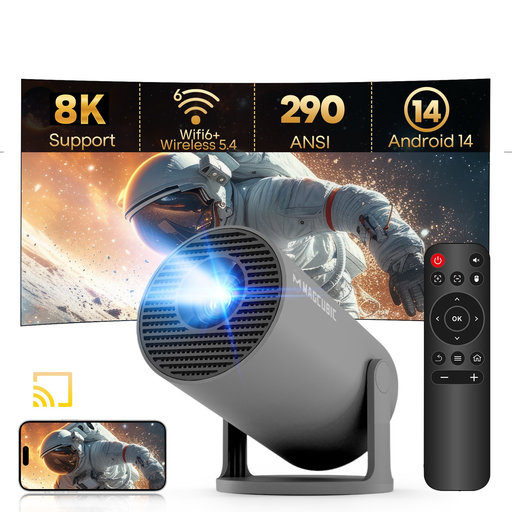 No image available
This is a compact option to assess for short sessions in a dimmed room, particularly when the projector must be stored afterwards.
The listing title distinguishes native 720p from 1080p support and states Android 14, automatic keystone correction and a 180° rotating stand. Check the available throw distance and keep the projector away from moisture with its vents clear.
Choose brightness in relation to the light you cannot dim and the image size you want. Epson’s UK buying guide places 2,500–3,500 lumens in its living-room-with-some-ambient-light category, while BenQ recommends considering 3,000 lumens or more for ambient light or a longer throw. These manufacturer reference points do not guarantee a particular result in your room, and differently labelled brightness measurements should not be treated as interchangeable.
Short throw is worth considering when a conventional projector cannot make your target image without occupying the table or walkway. Measure the proposed position and use the exact model’s throw information to check the resulting image size; short throw is a placement choice, not an automatic picture-quality improvement.
It can if the room can be dimmed and the particular model provides the sound and access to content you need. Epson specifies Google TV and integrated audio for its EF-71, while XGIMI specifies built-in speakers and battery operation for the Halo+. Confirm your chosen apps, subscriptions or HDMI source for the model you buy.
Use a stable, dry position away from splashes and heat, with ventilation unobstructed. The Joybuy Halo+ instructions specifically warn against excessive moisture, extreme heat and blocked vents; follow the instructions for your own model and keep its power lead clear of walking routes.
App access and software support depend on the exact projector and service. Before buying, check current app availability and the manufacturer’s support information; an HDMI source may be another way to play content if it is compatible with your projector and chosen service.