If the projector will stay beside the screen, look for a model whose horizontal lens-shift range fits that position; optical adjustment avoids relying on digital keystone correction. If you move it between rooms, horizontal keystone may be more convenient, but check its distance limits and the picture size after correction. If only your seat is off-centre, assess the screen and seating position instead: projector correction does not change your viewing angle.
Who each setup suits
Fixed off-centre home-cinema planners
If the projector will remain beside the screen centreline, check its stated horizontal lens-shift range and throw distance against the planned position. ProjectorCentral recommends choosing a suitable offset or lens shift when planning a position that would otherwise need keystone adjustment.
Flexible side-table movie watchers
If you put the projector away after a film or move it between rooms, horizontal keystone can help square a picture from a temporary position. Check whether correction is automatic or manual and whether its stated range applies at your projection distance.
Compact-room screen-size planners
If room depth is limited, establish whether the projector can produce your intended image size at the available distance before considering side-placement adjustments. ProjectorCentral’s throw-distance guidance relates image size to the lens and zoom range.
What matters when choosing
Fixed placement with lens shift
Choose when: The projector will regularly sit off the screen centreline and its optical horizontal shift can reach the planned image position.
Allow for: The exact model’s shift and throw ranges must both fit the installation; a shift percentage cannot be compared directly with a keystone angle. Epson lists ±47.1% horizontal lens shift for the EH-LS12000B.
Movable placement with keystone
Choose when: You want to set up from a side table or another temporary position and adjust the picture each time.
Allow for: Digital alignment works within the projected image area, so correction can reduce usable picture size. BenQ specifies automatic horizontal correction of ±30° for the GV50 within 2 m; that condition does not apply to other models.
Centred placement
Choose when: A shelf, mount or furniture change can put the projector nearer the screen centreline.
Allow for: A centred position may be awkward in the room, and the available distance must still suit the intended image size.
| Concern | What to check | Who this matters to |
|---|
| Fixed side placement |
Compare the exact model’s horizontal lens-shift range with the planned side offset and screen size. |
If my projector will stay beside the screen, I want to position a square image without routine digital correction. Roughly 44% of consumers put fixed-placement image geometry first. |
| Quick temporary setup |
Confirm horizontal keystone, its automatic or manual range, and any projection-distance condition. |
When I move the projector between rooms, I want to square the picture without rebuilding a fixed installation. Around 33% of consumers prioritise flexible side placement. |
| Room depth and image size |
Measure the usable projector-to-screen distance and check the model’s throw range against your target image size. |
In a compact room, I need to know the picture will fit before deciding how to correct its position. About 23% of consumers place room-fit planning first. |
Placement mistakes to avoid
-
Treating lens shift and keystone as interchangeable
Optical lens shift moves the image position without keystone adjustment; digital keystone reshapes the image. ProjectorCentral advises planning the projector’s offset or lens shift to avoid unnecessary keystone correction.
For a permanent side position, check horizontal lens shift first. For movable placement, check the exact model’s horizontal keystone range and its conditions.
-
Checking correction before throw distance
Horizontal correction cannot make a projector produce your chosen image size from a distance outside its usable throw range.
Measure the available projector-to-screen distance and target image size, then check the model’s throw specification before assessing the side offset.
-
Assuming automatic alignment keeps the full picture area
XGIMI explains that its digital screen alignment adjusts inward from the default image edges. A strongly corrected picture may therefore occupy less of the original projected area.
Place the projector closer to the screen centreline where practical, and check that the corrected picture still reaches your intended screen boundaries.
Relevant brands to consider
Epson
For a fixed installation, Epson’s EH-LS12000B is an example with specified optical horizontal lens shift.
- Epson lists ±47.1% horizontal lens shift, alongside powered zoom and focus, for the EH-LS12000B.
- That range is specific to this model. Check its throw range and the shift needed for your mounting position; do not assume other Epson models have the same adjustment.
BenQ
BenQ’s GV50 illustrates a portable route with a flexible base and horizontal keystone correction.
- BenQ specifies automatic horizontal correction of ±30° within 2 m and manual correction up to ±40° for the GV50.
- Check which correction mode you would use and whether your planned distance meets its stated condition; these figures do not describe other BenQ models.
XGIMI
XGIMI describes automatic screen-adaptation features for its HORIZON projector range.
- XGIMI describes side-placement correction in its HORIZON materials.
- Confirm the exact HORIZON variant and its correction range before purchase. XGIMI also says digital alignment cannot expand beyond the default projected image area.
Projectors for flexible side placement
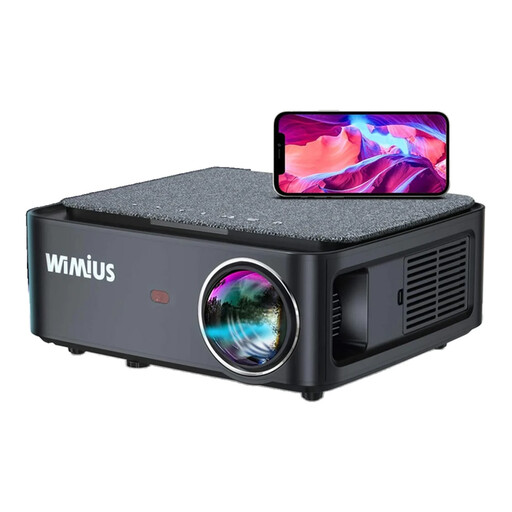
This Joybuy option lists horizontal keystone correction for a movable projector setup beside the screen. Check its throw distance and corrected image size against your room before deciding whether it fits.
 No image available
Wimius K1 FHD 1080p projector
For a temporary position beside the screen, the Wimius K1 lists horizontal and vertical keystone correction. Its product title also specifies FHD 1080p; check the throw distance, required side angle and picture size after correction for your intended setup.
Joybuy
Common questions
Should I choose horizontal lens shift or keystone for a projector beside the screen?
For a fixed side position, start with a projector whose horizontal lens shift reaches your planned image position; for a movable setup, horizontal keystone may be more convenient. ProjectorCentral recommends suitable offset or lens shift to avoid keystone adjustment, while digital correction should be checked against the exact model’s placement limits.
How far to the side can I place a projector?
The usable side offset depends on the exact projector, screen position and projection distance. Lens-shift percentages and keystone angles describe different adjustments, so compare your measured setup with the model’s own specifications rather than comparing those numbers directly. BenQ, for example, limits its stated GV50 automatic horizontal correction of ±30° to projection within 2 m.
Do I need to check throw distance before buying?
Yes: measure the available projector-to-screen distance and decide on your target image size before checking side-placement correction. The exact model’s throw and zoom ranges determine whether it can make that image size from your chosen position, as ProjectorCentral’s projection guidance illustrates.


