Side-seat documentary viewers
If your usual sofa seat is off to one side, assess your view of the proposed screen before choosing projector-placement controls. Those controls solve a different problem.


If you sit to one side of the screen, start with the seating and screen layout: horizontal keystone corrects an off-centre projector, not a viewer’s sightline. For detailed documentaries, check the exact projector’s resolution and HDR support alongside your viewing source; if the projector must also sit off-centre, compare optical lens shift with horizontal keystone and confirm the throw distance.
If your usual sofa seat is off to one side, assess your view of the proposed screen before choosing projector-placement controls. Those controls solve a different problem.
If labels, maps, natural-history textures or dark-space scenes matter to you, compare documented resolution, HDR support and colour specifications for the exact model rather than relying on a brightness figure alone.
If the projector needs to sit on a side table or another non-central spot, check how it makes a rectangular image from that position and whether the available distance gives you the screen size you want.
Decide where people will sit and where the screen will go before choosing a projector position. Only then can you tell whether horizontal image adjustment is needed as well.
| Concern | What to check | Who this matters to |
|---|---|---|
| Side-seat sightline | Mark the regular seats and screen position. If buying a screen, check its stated viewing-angle behaviour. | I want to see the whole documentary comfortably from my usual side seat, without assuming projector correction will change my viewing angle. Around 36% of consumers put that seating need first. |
| Documentary detail | Check the exact model’s resolution description, supported HDR formats and compatibility with your viewing source. | When maps, labels and dark scenes are central to what I watch, I want to know what the projector and my source can display. Roughly 29% of consumers prioritise documentary image detail. |
| Off-centre projector placement | Measure the projector position and throw distance; compare horizontal optical lens shift with digital keystone and its usable range. | If the projector must sit beside the screen centre, I need an adjustment method that works from that position. About 21% of consumers make placement flexibility their primary concern. |
| Room light and upkeep | Consider screen size and room light when comparing brightness ratings on the same stated basis; check the exact model’s light-source specification. | I may watch before the room is fully dark or use the projector frequently, so everyday operation matters to me. Around 14% of consumers put room-light tolerance and upkeep first. |
Keystone changes the shape of an image projected from an angle; it cannot establish whether a side-seated viewer has a comfortable view of the screen.
Sketch the screen, regular seats and projector as three separate positions. Look for horizontal projector adjustment only if the projector itself cannot be centred.
Horizontal keystone can help with side-table placement. BenQ’s installation guidance notes, however, that lens shift avoids the picture-clarity degradation associated with keystone correction.
If the projector will stay in place and fine detail matters, check whether the exact model offers enough optical lens shift before planning around digital correction.
A manufacturer’s brightness figure alone does not tell you how the image will look at your chosen size under your room lighting.
Check the model’s throw-distance information against the available position and intended image size, then consider how much light you can keep off the screen.
BenQ has documented options for two different placement needs: portable projection with digital correction and a home-cinema model with optical lens shift.
Epson’s EH-LS9000W is relevant to a more permanent home-cinema installation where powered lens controls may help with positioning.
ViewSonic’s PX701-4K is relevant when 4K/HDR specifications and digital aids for an off-centre setup are both on the shopping list.
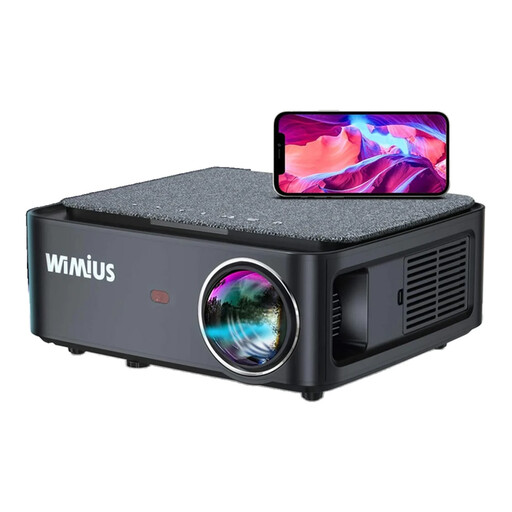
This projector is a choice to examine if the unit itself needs to sit off-centre: its listed horizontal and vertical keystone controls address placement, while screen position and seating still need separate attention.
 No image available
Consider this model if a side-table position makes horizontal image correction useful; it will not change the view from a side seat.
The product title lists FHD 1080p, 4K support, 1200 ANSI lumens and horizontal and vertical keystone correction. 4K support should not be read as native 4K resolution.
Before relying on correction for your layout, check its usable range and the permitted projector angle. Confirm that your intended image size works at the available throw distance, and check HDR support if your documentary source uses it.
Not if only your seat is off-centre. Horizontal keystone corrects the projected image when the projector is angled relative to the screen; for a side seat, assess the screen position and, if relevant, the screen’s stated viewing-angle behaviour. Compare horizontal projector adjustments if the projector must sit to the side too.
Look for sufficient optical lens shift when the projector will stay in an off-centre position and picture detail is a priority. BenQ’s installation guidance says lens shift moves the image without the clarity degradation that can accompany keystone correction; check the horizontal range on the exact model before choosing a mounting position.
They are worth considering when you have compatible material and playback equipment, but neither label alone settles how the image will look in your room. Check the model’s resolution description and HDR formats, then consider screen size, seating distance and room light.
Confirm the seller, delivery destination, product documentation and warranty contact for the exact listing. If conformity markings affect your decision, check the requirements applicable to the delivery destination rather than assuming that a UK-facing product title establishes them.