What matters when choosing?
For group tennis viewing, the throw type determines where the projector can go; brightness, source access and sound then need checking for the room you will use.
Conventional throw
Choose when: The room has enough depth for the intended image and guests can stay clear of the beam.
Trade-off: Placement behind the seating area can leave a beam across a busy room.
Short throw
Choose when: A conventional projector would need to sit too far back, but there is still space between the projector and wall.
Trade-off: A shorter throw does not remove the need for precise positioning and a suitable projection surface.
Ultra-short throw
Choose when: The projector needs to sit close to the wall rather than behind the audience.
Trade-off: Furniture position and wall or screen suitability become especially important.
| Concern |
What to check |
Who this matters to |
| Visibility in room light |
Set a realistic image size and establish whether daylight or lights can be reduced. Compare brightness claims with their stated units and conditions. |
If I host during the day, I want the court and ball to remain easy to follow at the size everyone can see. Around 33% of consumers put visibility in room light first. |
| Placement and beam path |
Measure lens-to-wall distance and check the exact model’s throw specification for your chosen image size. |
Guests may need to move around the room without crossing the picture, or there may be little depth behind the seats. For around 27% of consumers, workable placement is the primary concern. |
| Motion and match source |
Confirm how the broadcaster will connect and whether any sports or motion mode has a firmware requirement. |
I want the stream and any fast-action setting ready before play starts, rather than troubleshooting while people wait. Reliable access and motion setup come first for around 20% of consumers. |
| Sound and upkeep |
Check external-audio connections, operating noise and the light-source type, including replacement parts where applicable. |
Commentary must be audible to the group, while maintenance and projector noise matter during regular use. Around 20% of consumers give sound and upkeep their highest priority. |
Joybuy projectors for flexible setups
These projectors offer home-entertainment setups to assess for a tennis screening, including source connections and image adjustments. Check each one at your planned image size and room light level; their inclusion does not establish that they suit every group or cover the throw options discussed above.
 No image available
Magcubic HY350Max Smart Projector, Native 1080P, 900 ANSI lumens
Consider this model if you plan to connect a match source over HDMI and need to assess a shorter projector position. The listed resolution is native 1080P, with 900 ANSI lumens and auto keystone adjustment; check brightness and the image size achievable at your measured distance. Confirm access to your tennis service and an appropriate audio connection for the group.
View on Joybuy
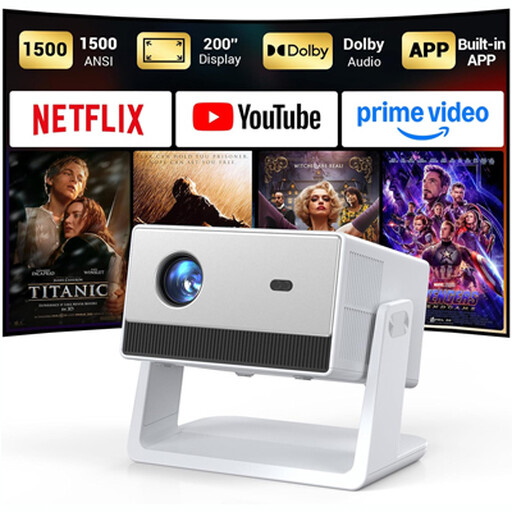 No image available
FunFlix Football World Cup GIFT Smart Projector, Native 1080P
Consider this model if a built-in-app option and a separate match-source connection both matter to your setup. It is listed as native 1080P with Wi-Fi and Bluetooth; confirm that your tennis service works through the route you intend to use. Check the focus method for this exact variant, the required throw distance and which items are included in the GIFT bundle before ordering.
View on Joybuy
 No image available
Wimius K1 Projector, FHD 1080P, 1200 ANSI lumens
Consider this model if you will use a separate match source and want image-position adjustments for a changing room layout. Its title lists FHD 1080P, 1200 ANSI lumens and vertical and horizontal keystone correction; its 4K support claim should not be read as a native 4K resolution claim. Check the throw distance at your chosen image size and plan how the broadcast and sound will reach the projector.
View on Joybuy
Common questions
What should I measure before buying a projector for group tennis viewing?
Measure the usable lens-to-screen distance and note where guests will sit or walk, then check the intended image size against the exact model’s throw specification. For comparison, Optoma specifies a 1.4:1–2.24:1 throw ratio for the UHZ66, while Epson states that the ultra-short-throw EH-LS800W can produce an 80-inch image from 2.3 cm from the wall.
Will a built-in speaker be enough for a large group?
A built-in speaker’s stated output alone cannot establish whether commentary will be audible throughout your room. Optoma lists a 15W speaker and HDMI eARC for the UHZ66, while BenQ lists a 5W speaker and eARC for the TK700; check how an external speaker, soundbar or receiver would connect if you expect a noisy gathering.
Should I check a projector’s sports mode before the match?
Yes, if that mode is part of your reason for choosing the model, check its operating requirements and try your intended source in advance. BenQ says the TK705i’s Sports Mode requires projector OS version V14.1.0.70 or later; that requirement is specific to the TK705i, not all projectors.
What can I do with an old projector when buying a new one?
Look for an electrical-equipment recycling or retailer take-back route rather than putting an old projector in ordinary household rubbish. GOV.UK guidance on waste electrical and electronic equipment describes recycling arrangements, and its distributor take-back guidance describes an opportunity for customers buying new electrical equipment to recycle old equipment through an appropriate retailer system.


