What matters when choosing?
For a group screening, establish the room’s light level and available projector position first. Then decide how much large-screen detail you want and how everyone will hear the film.
| Concern |
What to check |
Who this matters to |
| Picture in ambient light |
Check whether curtains or blinds can reduce light on the screen, then compare stated brightness ratings alongside your planned image size. |
If I cannot fully darken the living room, I need the animation to remain visible to everyone; around 31% of consumers put light handling first. |
| Large-screen detail |
Check native resolution, not just supported input formats, and consider the resolution of the films you will play. |
When outlines and subtitles matter on a very large image, I want to know what detail the projector can actually display; around 31% of consumers prioritise that detail. |
| Placement and image size |
Measure the projector-to-screen distance and check the model’s throw information and available optical adjustment. |
I may have to place the projector away from the centre of the room, so reaching the intended image size is my main concern; roughly 23% of consumers put placement first. |
| Shared sound and connections |
Check the input for your playback device and how you will connect or position speakers for the group. |
If several people need to hear dialogue clearly, I must plan the complete audio setup as well as the picture; around 15% of consumers make sound and connections their first priority. |
Projector brands to consider
These model examples show different specifications to compare for a group screening; check each model against your room rather than choosing on brand name alone.
Epson
Epson lists the EH-TW6250 as a 4K PRO-UHD home-cinema projector with 2,800-lumen white and colour output, 1.6× zoom and placement adjustments.
- Its stated zoom, lens shift and keystone correction give you several settings to check against a constrained projector position.
- 4K PRO-UHD is the model’s designation, not a reason to assume native 4K resolution. Check the image format you want and assess its manufacturer-stated brightness against the room’s light.
BenQ
BenQ specifies the TH685P as a native 1080p lamp projector with 3,500 ANSI lumens, 1.3× zoom, two HDMI inputs and audio output.
- The stated inputs and audio output make it possible to plan separate playback and sound connections.
- Its native resolution is Full HD rather than 4K. BenQ’s stated lamp life also depends on operating mode.
ViewSonic
ViewSonic specifies the PX749-4K with native 3840 × 2160 resolution, 4,000 ANSI lumens, 1.3× optical zoom and a stated 30–300-inch image range.
- Its stated resolution and brightness provide specifications to assess for a large image where fine detail and remaining room light both matter.
- The PX749-4K is lamp-based, and its stated image range does not establish that your chosen screen size will fit the distance available at home.
Joybuy projectors for Full HD viewing
These Joybuy models offer Full HD viewing options for an animated-film screening. Compare their listed features with your room’s light, the distance to the screen and your planned audio setup before choosing.
 No image available
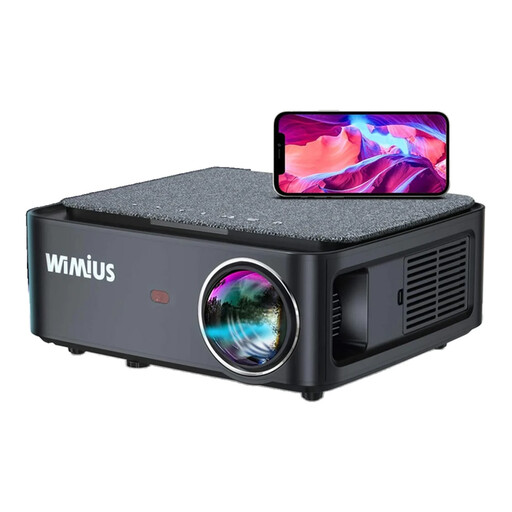
Wimius K1 Full HD Projector
Consider this model if your group will play Full HD films and needs HDMI connectivity and keystone adjustment. Check its native-resolution specification if displayed detail is a deciding factor.
The listing names a 1,200 ANSI-lumen rating, 4K input support, a 300-inch maximum image and vertical and horizontal keystone correction. Those labels do not establish how large or bright an image it will produce from your available position.
Check the required projector-to-screen distance and plan how the group will hear the film; the listed stereo audio does not establish whether it will suit your room.
View on Joybuy
 No image available
Magcubic HY350Max Smart Projector
Consider this model if native Full HD resolution and automatic keystone adjustment suit an occasional group setup. Confirm the image size you can achieve from the position available in your room.
The listing states native 1080p resolution, a 900 ANSI-lumen rating, Android 14, 180° rotation and HDMI and USB compatibility. Its 8K-supported label describes an accepted format, not its native display resolution.
Check the connections for your playback device and how you will provide sound for everyone; the listed features do not establish audio suitability for your group.
View on Joybuy
Common questions
Should I choose the highest brightness rating for a large group?
Not on brightness alone: choose a projector whose stated output you can assess alongside your intended image size and the light in the room. Curtains or blinds can help reduce light falling on the screen, but a rating does not guarantee the picture you will see at home.
When is 4K worth considering for animated films?
Consider native 4K when fine detail on a very large image is a priority and you have a suitable source. If Full HD detail meets your needs, check the room fit and other features too; a supported 4K input label alone does not establish native 4K resolution.
Can a built-in speaker serve everyone at a group screening?
Do not assume it will suit your room simply because the projector lists a speaker. Check how your playback device connects and whether the projector offers the audio connection you need for your planned speaker arrangement.
Where should I put the projector when guests are moving around?
Choose a position that produces your intended image size without putting the beam where guests are likely to look into it or repeatedly cross it. Measure the throw distance and plan the walking route and seating together; the Health and Safety Executive advises avoiding direct viewing of projector beams in its guidance for projected displays.


