Who a projector suits

Occasional family movie-night hosts

For households planning temporary large-screen films, sport and shared viewing rather than an all-day television replacement. Check blackout capability, seating distance, image size and whether the built-in sound can cover the room. Which? and Expert Reviews highlight room light, picture quality and sound as important differences between projector setups.

Small-room big-screen buyers

For people who want a large image with limited distance between the projector and wall. BenQ UK advises measuring the room and checking the exact model’s throw ratio or screen-size-at-distance information before choosing.

Flexible portable-viewing households

For buyers moving a projector between rooms or taking it away occasionally. Compact design, fast alignment and smart-platform access can be useful, but portable viewing is generally more practical in controlled light. Epson, Samsung and Expert Reviews describe these as key considerations for portable models.

What to check before buying

Home-cinema projector

Choose it when: You can darken the room, keep a stable placement position and match the model’s throw range to the image size you want.

Keep in mind: Room light, image size, focus, alignment and wall or screen condition all affect the result.

Portable projector

Choose it when: Moving between rooms or taking the projector away matters more than having a permanent cinema-style setup.

Keep in mind: Confirm app availability, brightness measurement, battery details where relevant and whether the speaker suits your room.

Television display

Choose it when: You want a display ready for regular daytime and everyday viewing without setting up each session.

Keep in mind: A television does not provide the same temporary cinema-scale image that projection can create.

Priority What to check Your needs
Room fit and throw distance Measure the usable lens-to-screen distance; set a target image width; compare it with the exact model’s throw ratio or screen-size-at-distance table. I want the image size I have in mind to fit the room without relying on digital correction to solve a placement problem.
Ambient light and brightness Consider room light and target image size together; check the stated brightness measurement and independent testing for the model. I want a picture that remains enjoyable at the time I actually watch, not just a high headline lumen figure.
Picture quality at large sizes Match resolution to image size and seating distance; compare picture testing for colour, contrast and motion rather than relying on a resolution label alone. I want films and sport to retain convincing detail when the image is much larger than a typical television.
Sound and streaming setup Check the specific streaming services you use, available connections and built-in speaker capability for the room. I want clear dialogue and access to my usual services without assuming that every smart projector includes the same apps or audio quality.

Common buying mistakes

  • Choosing a projector before measuring placement distance

    An advertised maximum screen size does not show whether the model can create that image from the distance available in your room. Keystone correction can assist alignment, but it does not change the projector’s physical throw requirement.

    Measure from the planned lens position to the wall or screen, choose an image width, then verify the exact model’s throw range, zoom range and screen-size-at-distance specification.

  • Treating a portable projector like a bright-room television replacement

    Ambient light and larger image sizes reduce perceived projection brightness. Expert Reviews notes that televisions generally offer more consistent brightness and image quality for frequent everyday viewing.

    Use portable projection mainly for controlled-light occasions unless independent testing and the exact model specifications support your intended bright-room use.

  • Assuming every speaker and smart platform works the same way

    Which? and Expert Reviews report differences in sound quality, setup, menus and app availability between projectors, so a streaming device or external audio may still be useful.

    List the services you use and assess the room’s audio needs before buying. Confirm the model’s app support and its connections for a streaming device or external speaker.

  • Comparing screen size without considering resolution

    Which? notes that Full HD can look less sharp at very large projected sizes, while 4K projector routes commonly involve higher spending and model-specific differences.

    Match resolution to the planned image size, seating distance and content, and compare independent picture testing rather than relying only on a 4K label.

Relevant brand references

Epson

Epson’s UK range includes 4K PRO-UHD home-cinema models and portable smart projectors, making it relevant when comparing a more fixed large-screen setup with a compact moveable option.

  • Epson’s UK listings describe dedicated home-cinema models alongside portable Full HD smart projectors with stated Google TV and Bose-branded sound on selected models.
  • Check the exact model for brightness, room-light suitability and sound capability; these details do not apply across the entire range.

BenQ

A home-cinema-focused reference for buyers prioritising film image settings, 4K detail and installation flexibility in a planned viewing space.

  • BenQ UK describes the W1800 with 4K resolution, HDR support, Rec.709 colour coverage, 1.3x zoom and 2D keystone.
  • BenQ’s guidance stresses room measurement and throw ratio, so confirm fit and specifications for the exact model rather than applying them across the brand.

Samsung

Samsung is relevant for households comparing portable smart projection with ultra-short-throw home-projector routes within one UK range.

  • Samsung’s UK range separates portable Full HD Freestyle models from 4K ultra-short-throw Premiere models; the Freestyle 2nd Gen is described with automatic focus and alignment, 360-degree sound and Tizen smart TV functionality.
  • Samsung states that network-based smart functions require an internet connection and a Samsung account, so check that the services you use are available.

Joybuy projector options

Joybuy portable-projector options for occasional films, sport and shared viewing in controlled-light home settings.
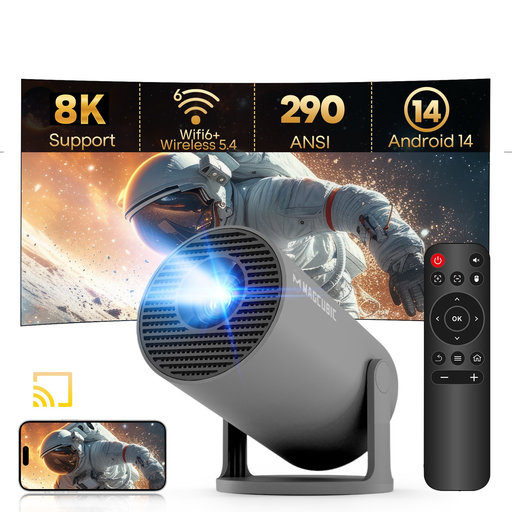
Magcubic HY300 Pro mini projector

Magcubic HY300 Pro Mini Projector, Native 720p

A compact option for moveable movie nights in controlled lighting.

Stated features include a 0.8:1 throw ratio, 0.6–2.5 m throw distance, native 720p resolution, 290 ANSI lumens, Android 14, HDMI, USB, Wi-Fi 6, Bluetooth 5.4, a 5W speaker and a 180-degree rotating stand.

For a very large image, compare the native 720p resolution with your seating distance. Confirm the streaming apps you need and assess whether the stated brightness suits your room and image size.

Joybuy
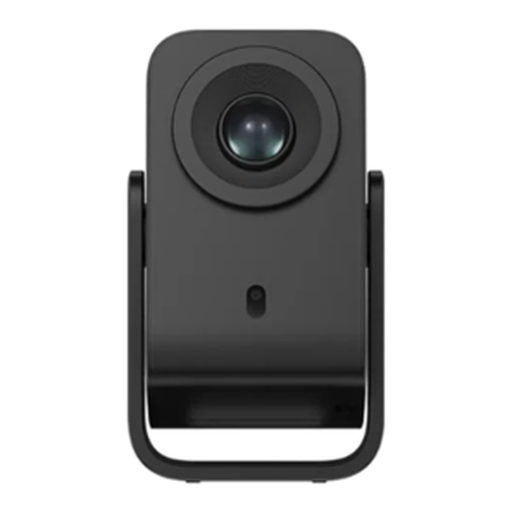
TCL C1 Smart Projector

TCL C1 Smart Projector, 1080p FHD

A portable choice for shared viewing where built-in streaming and automated alignment are useful.

The listing states native 1080p, 4K support, Google TV with Netflix and Google Cast, an 8W Dolby Audio speaker, autofocus, auto keystone, auto screen-fit, obstacle avoidance, HDMI, USB, Wi-Fi, Bluetooth, a gimbal and carry handle.

Measure the lens-to-screen distance before buying because model-specific throw information is not included here. The stated 230 ISO lumens should be considered alongside room light and intended image size.

Joybuy
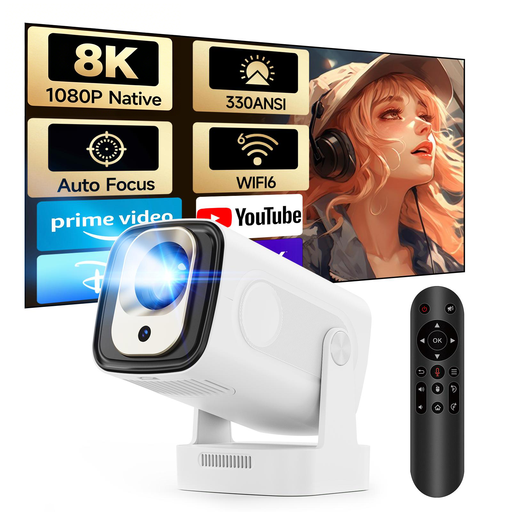
MAGCUBIC HY310 Auto Focus Android 14 Projector

MAGCUBIC HY310 Auto Focus Android 14 Projector

A moveable projector for occasional viewing where automatic alignment is a priority.

The listing states autofocus, automatic vertical keystone, Air Mouse control, voice control, dual Wi-Fi, firmware updates, built-in apps, a built-in speaker and 330 ANSI lumens.

Confirm the native resolution before purchase because the listing uses conflicting wording. Also check throw distance, required streaming apps and whether external audio is needed for your room.

Joybuy

Frequently asked questions

How do I check whether a projector will fit my room?

Measure the usable distance from the projector lens position to the wall or screen, decide the target image size, then check the exact model’s throw ratio or screen-size-at-distance table. BenQ UK defines throw ratio as throw distance divided by image width, but each model’s placement requirement must be checked separately.

What brightness is suitable for evening movie nights?

Treat brightness as a room-and-screen-size decision rather than a stand-alone ranking. Epson’s UK guide positions 500–1,500 lumens for portable indoor or controlled-light use, 1,500–2,500 lumens for dark dedicated home theatres and 2,500–3,500 lumens for living rooms with some ambient light; confirm the measurement basis and independent testing for the exact model.

Can a projector replace a television for daily viewing?

It can suit some households, but it is generally a stronger fit for planned cinema-style viewing than effortless frequent daytime use. Expert Reviews notes that televisions usually provide more consistent brightness, colour depth and image quality, while projection depends on room light, focus, alignment, surface and image size.

Do I need a soundbar or external speakers with a projector?

Not always, but sound should be assessed separately from image quality. Which? reports meaningful differences in projector sound quality; consider external audio if the built-in speaker cannot keep dialogue clear or fill the room for your usual group.

Can I assume a smart projector has every app I use?

No. Check the exact model and the services you require before purchase. Which? tests app availability, while Expert Reviews describes using a streaming stick where a projector lacks suitable features; Samsung also states that its network-based smart functions require an internet connection and a Samsung account.