For short-film viewing from a fixed side position, start by comparing projectors with horizontal optical lens shift: it moves the image without relying as heavily on digital correction. If you regularly move the projector, horizontal keystone correction may make setup easier, particularly alongside autofocus, but correction can reduce image size or affect sharpness. Check the exact model's adjustment range, throw distance and connections against your room and playback device.
Who is this setup for?
Viewers with a fixed side shelf
If the projector will stay off-centre for repeated short-film sessions, look for horizontal optical lens shift and check that the throw distance fits your intended image size. Epson lists both measurements for specific home-cinema models, not for its entire range.
Viewers who move the projector
A sofa-side table or changing room layout makes quick focusing and horizontal correction useful. BenQ describes side projection as a use for keystone correction, but the available range depends on the model.
Viewers who prioritise picture detail
If subtitles and image edges matter more to you than flexible placement, consider moving the projector closer to the screen's centre to use less digital correction. BenQ notes that keystone adjustment can affect sharpness and image size.
What matters when choosing?
Decide whether the projector will stay in one place, then check its horizontal adjustment and the image size possible at your available throw distance.
| Concern | What to check | Who this matters to |
|---|
| Side-position alignment |
Check the exact model for horizontal lens shift or horizontal keystone, and compare its range with your intended offset. |
If my projector must sit beside the screen, I need to bring the image into line without moving the furniture each time. Around 45% of consumers put alignment first. |
| Film image quality |
Check the picture at your intended angle, especially subtitles and edges; digital keystone can change image size and sharpness, according to BenQ and Epson. |
I would rather adjust the projector's position than accept distracting changes to a short film's image. Picture preservation comes first for around 33% of consumers. |
| Quick setup and playback |
Confirm the model's autofocus and horizontal correction, then check that your playback device and speakers can connect. |
When I move the projector between rooms, I want to start watching without a lengthy setup or an incompatible source. Around 22% of consumers prioritise that convenience. |
Side-placement mistakes to avoid
-
Assuming vertical keystone fixes a side angle
Vertical correction addresses a different alignment problem. A projector placed left or right of the screen needs a suitable horizontal adjustment.
Find the exact model's horizontal lens-shift or keystone specification and compare its range with your planned position.
-
Using heavy keystone correction without checking the image
Epson notes that keystone adjustment makes the image slightly smaller; BenQ also identifies possible changes to sharpness and image edges.
Place the projector as squarely as the room allows, then check subtitles, corners and high-contrast edges at the intended viewing position.
-
Applying a brand's setup guide to every model
Lens shift, keystone direction, autofocus and inputs are model-specific. A guide explaining a control does not establish that a particular projector has it.
Check the exact variant's placement range, throw-distance chart, connections and supplied accessories before ordering.
Relevant brands to compare
Epson
Relevant to a fixed off-centre setup when the chosen model has horizontal optical lens shift.
- Epson's UK comparison lists ±24% manual horizontal lens shift, ±30° manual horizontal keystone and two HDMI inputs for the EH-TW7000 and EH-TW7100.
- Those specifications apply to the named models; check their throw-distance fit rather than assuming another Epson projector has the same controls.
BenQ
Relevant to movable side-table setups where horizontal correction and straightforward focusing are priorities.
- BenQ's GV50 support guidance specifies automatic horizontal keystone correction of ±30°, subject to its stated setup conditions.
- BenQ cautions that keystone can affect picture characteristics; the GV50's correction range should not be assumed for other models.
Optoma
Worth comparing by exact model when you need controls for an off-centre installation.
- Optoma's projector setup guide treats lens shift, keystone and geometric correction as separate adjustments.
- Check the projector's own specification for horizontal adjustment; the general guide does not establish a model's range.
Joybuy projectors for side placement
This selection is for a side-table setup using horizontal keystone correction; it is not a selection of fixed-installation lens-shift projectors. Check how the correction performs at your intended position before choosing.
 No image available
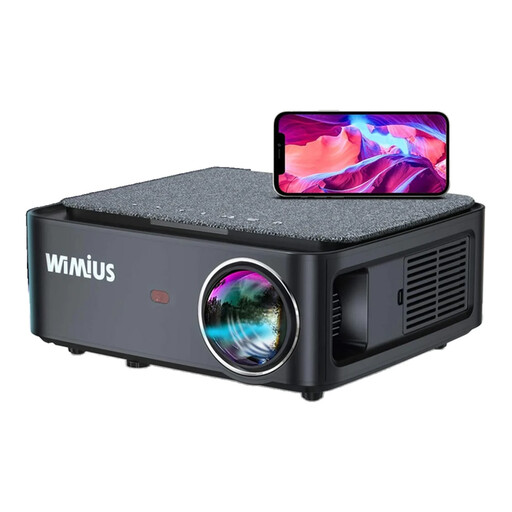
Wimius K1 FHD 1080P projector, 1200 ANSI lumens
Consider this model if a side position calls for horizontal keystone correction rather than a fixed lens-shift installation.
The product title lists vertical and horizontal keystone correction, FHD 1080P and 4K support; it does not mean the projector displays 4K natively. Check its throw-distance fit, the usable correction at your side angle and the connections needed for your playback device.
Joybuy
Frequently asked questions
Can I put a projector beside the screen?
Yes, if the exact model has enough horizontal adjustment for that position. Horizontal lens shift moves the image optically, while horizontal keystone digitally corrects its shape; check the specified range against your room.
Should I choose horizontal lens shift or keystone?
Compare horizontal lens shift first for a projector that will remain off-centre, because it reduces reliance on digital reshaping. Horizontal keystone can be more practical when you move the projector, although Epson and BenQ note possible changes to image size or picture characteristics after correction.
How do I check whether a projector fits my room?
Use the exact model's throw-distance chart with your planned image size, then check its horizontal adjustment at the proposed position. Epson lists a 1.32–2.15:1 throw ratio for the EH-TW7000 and EH-TW7100; that range does not apply to other projectors.
What should I check about the plug and electrical documentation?
Check that the listing and seller information match the place where you will use the projector, including its plug, power requirements and accompanying documentation. GOV.UK provides separate electrical-equipment guidance for Great Britain and Northern Ireland, so use the guidance for your destination rather than assuming the requirements are identical.


