Scenery-and-detail viewers
If coastlines, cityscapes and wildlife are what draw you to travel programmes, look closely at how a projector handles fine detail, colour and darker scenes on your intended screen.


For regular evening viewing, consider a 4K-capable home-cinema projector with image-positioning adjustments if scenery detail is your priority. If you cannot reliably control room light, investigate a model with higher rated brightness; if you move between rooms, a portable smart projector may suit your setup better. Whichever route you take, measure the projection distance and check how you will access your travel programmes.
If coastlines, cityscapes and wildlife are what draw you to travel programmes, look closely at how a projector handles fine detail, colour and darker scenes on your intended screen.
If the room is not consistently dark, consider its lighting and screen position before deciding how large an image you want.
If you watch occasionally or move between rooms, ease of image setup, access to your streaming services and built-in sound may matter more than a fixed installation.
Start with your viewing room and the detail you want from travel programmes, then check whether the projector can make your desired image from the available position and play your chosen service.
| Concern | What to check | Who this matters to |
|---|---|---|
| Scenery detail and colour | Check the exact model’s resolution approach and supported video formats. If possible, judge a familiar programme scene on a comparable screen. | If I watch for landscapes, architecture and wildlife, I want fine features to remain clear without assuming a 4K label can improve the source programme. Around 42% of consumers put scenery detail and colour first. |
| Room-light practicality | Check the model’s stated brightness unit and whether light will fall directly on your screen. | When I watch in a shared living room, I need an image I can use under its usual lighting rather than relying on a dark-room demonstration. Around 33% of consumers make room-light practicality their primary concern. |
| Placement and streaming | Measure lens-to-screen distance and intended image width; confirm access to your chosen service through an app or compatible input. | If I move the projector or set it up only occasionally, I need the picture to fit each space and the programme to be easy to start. Around 25% of consumers prioritise placement and streaming. |
A 4K-capable projector cannot add detail absent from the programme source, while light in the room can reduce perceived contrast. Which? also reports differences in picture quality between the home projectors it tests.
Check the exact model’s resolution approach and source connection, then assess a familiar scene in lighting similar to your viewing room where a demonstration is possible.
The image size a projector can produce from a given position depends on its model and lens. Placement adjustments do not remove the need for a suitable distance.
Measure from the planned lens position to the screen and note the image width you want. Use the exact model’s manual or projection calculator to check the fit.
A smart interface and an HDMI input offer different ways to reach a programme; neither, by itself, confirms that your particular service will work as you expect.
List the services you use and confirm app availability or the compatible streaming device and connection you will need.
Using a projector rather than a television does not change the TV Licence requirement for watching or recording live TV or watching on-demand BBC programmes on iPlayer, according to GOV.UK.
Check whether your household is covered before using the projector for either type of viewing.
Epson’s home-cinema models are worth considering when you plan a regular viewing position and want to adjust image placement.
The TK710 is a conventional-throw option to investigate for a living room where rated brightness is important.
The Freestyle 2nd Gen offers a portable smart-projector route for occasional viewing in different positions.
Optoma’s UHD38x documentation illustrates a conventional projector route for buyers considering a larger image where some room light is present.
These portable projector choices suit viewers considering flexible placement for travel programmes. Check each model’s fit for your room, lighting and streaming services rather than treating portable features as a substitute for those checks.
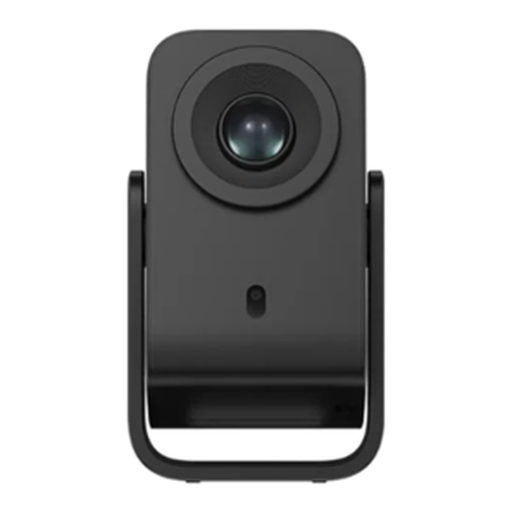 No image available
Consider this portable model if you want to move your travel-programme setup between spaces. Its title specifies 1080p FHD and 4K support; check the image size it can produce in your room and how you will access your chosen service.
 No image available
Consider this model if a portable setup with automatic image adjustment matters to you. The title specifies native 1080p, 180° rotation and automatic keystone correction; its 8K support wording does not mean native 8K output. Check the desired image size, room lighting and access to your streaming services.
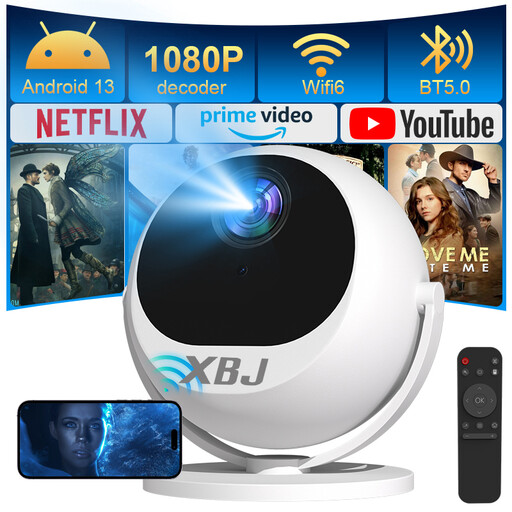 No image available
Its rotating design may suit a setup in which the projection direction changes. The title lists 360° rotation, Full HD 1080p, automatic keystone correction and Wi-Fi, Bluetooth and HDMI connectivity. Confirm the projection distance and your preferred way to stream before choosing it.
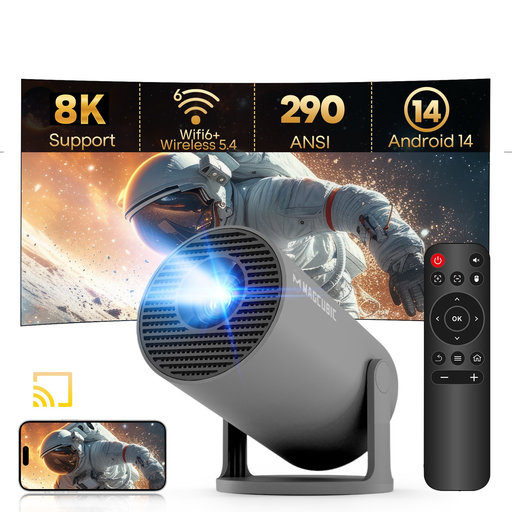 No image available
Consider this compact model if flexible placement matters more to you than native 1080p detail. Its title specifies native 720p, 1080p support, a 180° rotating stand, automatic keystone correction and Android 14. Focus requires manual adjustment; check the room fit and availability of your chosen apps.
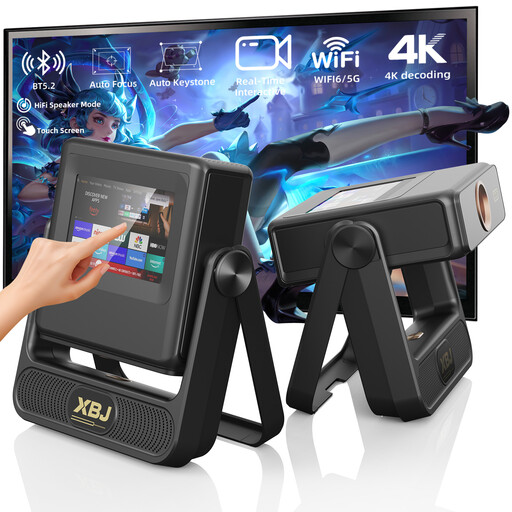 No image available
Consider this model if automatic focus and keystone correction would simplify a flexible setup. Its title specifies native 1080p and 4K support. Confirm the usable image size and projection distance, and check the exact brightness specification and your preferred streaming apps before deciding whether it suits your room.
Measure the planned lens-to-screen distance and the image width you want, then check the exact model’s manual or projection calculator. Epson says placement distance depends on the model, lens and image size; BenQ defines throw ratio as throw distance divided by image width.
No: some have a smart-TV platform, while others use an external source connected by HDMI. Samsung describes smart-TV functions on The Freestyle 2nd Gen, whereas Epson describes connecting streaming devices to the EH-TW7000’s HDMI inputs. Confirm that your particular service and account will work with the model you choose.
A projector does not change the requirement: GOV.UK says a TV Licence is needed to watch or record live TV and to watch on-demand BBC programmes on iPlayer. Check whether your household is already covered if either applies to the travel programmes you watch.
Check that the seller can identify the product and provide applicable conformity information for Great Britain. GOV.UK states that electrical equipment placed on the Great Britain market must meet the Electrical Equipment (Safety) Regulations 2016; it also says CE marking continues to be recognised alongside UKCA under the applicable regime.