Parents packing primary-school lunches
A convenient snack still needs to fit the rest of the lunch and the school’s rules. An adult sports-nutrition claim is not a reason on its own to choose a bar for a child.


For a routine school snack, start with fruit or vegetables rather than buying a protein bar multi-pack on the strength of its protein or low-sugar claim; NHS guidance favours fruit and vegetables for children’s snacks. If a bar would be useful occasionally, choose the pack only after checking the school’s rules, every intended flavour’s allergens, the per-bar nutrition and any sweetener warning.
A convenient snack still needs to fit the rest of the lunch and the school’s rules. An adult sports-nutrition claim is not a reason on its own to choose a bar for a child.
If an individually wrapped bar has a specific place in an occasional lunch, check its portion, ingredients, flavour and school suitability before committing to a box.
A bar bought for an adult’s work or gym bag is not automatically suitable for a child’s lunchbox. Keep the intended users’ bars separate where their ingredient needs or school rules differ.
Decide whether a bar has a useful place in the lunch, then check the exact product before choosing a pack size.
| Priority | What to check | Your needs |
|---|---|---|
| Snack choice | Consider fruit or vegetables for routine snacks. For a packaged snack, read its front-of-pack traffic-light label and the rest of the lunch. | I want a practical school snack, not a reason to replace other lunch foods with an adult-focused protein bar. NHS child-snacking guidance recommends fruit and vegetables and advises checking packaged-snack labels. |
| Allergens and school rules | Read the ingredients, allergen statements and any precautionary warning on each flavour’s current wrapper. Check the individual school’s packed-lunch and allergy policy. | If several people share a box, I need to know which bars can actually go into the lunchbox. Grenade identifies peanut-containing flavours, while Barebells lists milk and soya ingredients for its Cookies & Cream bar. |
| Portion and nutrition | Compare the nutrition per bar, including energy, sugars, saturated fat and salt; note the bar’s weight when comparing different sizes. Check the exact flavour, as Myprotein says its Layered Bar nutrition can vary by flavour. | A protein figure or a low-sugar claim alone does not tell me how this particular bar fits into the lunch. The NHS notes that lower- or no-calorie sweeteners do not necessarily make a food a suitable choice on their own. |
| Ingredients and tolerance | Read the ingredient list and any serving warning before packing an unfamiliar bar. PhD Smart Bar carries an excessive-consumption laxative-effect warning; Quest says tolerance of its sugar alcohols may vary. | I would rather try an unfamiliar flavour outside school than discover during the school day that its ingredients do not suit the child. |
| Pack format | Check how many bars and flavours the box contains. For a variety pack, inspect every flavour rather than assuming one wrapper describes them all. | A smaller pack or a flavour already tried makes more sense for a first purchase than committing to a large box that may go unused. |
An adult-focused bar may not suit the child’s tastes or tolerance, leaving much of the box unused.
Try the exact flavour first or start with a smaller pack. Check each flavour separately if choosing a variety box.
An unsuitable bulk purchase can leave unopened bars that the intended user cannot eat.
“Low sugar” and a protein figure describe only part of a bar’s nutrition. The NHS says sweeteners do not necessarily make a food a suitable choice on their own.
Read the per-bar nutrition and traffic-light label, then decide whether a bar serves the purpose better than another snack.
Grenade identifies particular peanut-containing flavours, and Barebells lists milk and soya ingredients for its Cookies & Cream bar. A brand name cannot stand in for the exact wrapper.
Check the current wrapper before packing each flavour, and follow the child’s allergy plan and the school’s rules.
PhD warns that excessive consumption of its Smart Bar may cause laxative effects; Quest says tolerance of the sugar alcohols in its bars varies.
Check the selected bar’s ingredients and serving warning, and try an unfamiliar product outside the school day first.
Pack formats and ingredients vary within a brand, so use these references to identify what to check on the product you intend to buy.
Grenade’s UK catalogue includes a 24-bar protein-bar bundle.
PhD lists Smart Protein Bar as a 12-pack of 64 g bars.
Myprotein’s UK bar range includes a Layered Bar variety box.
Barebells publishes flavour-specific information for its protein bars, including Cookies & Cream.
Quest shows a protein-bar variety pack on its US site; that listing does not establish UK availability or labelling.
Tesco is a retailer rather than a protein-bar manufacturer; its grocery listings include a Nature Valley Protein Peanut and Chocolate 8 x 40 g pack.
These two three-bar Trek flapjack packs and one four-bar Nature Valley protein-bar pack are small formats to assess for an occasional lunch. The Nature Valley flavour contains peanuts, so check the school’s rules before considering it.
 Image unavailable
The three-bar pack offers a smaller commitment if this flavour is new to the household. Check the current wrapper for soya and review the per-bar nutrition before packing it for school.
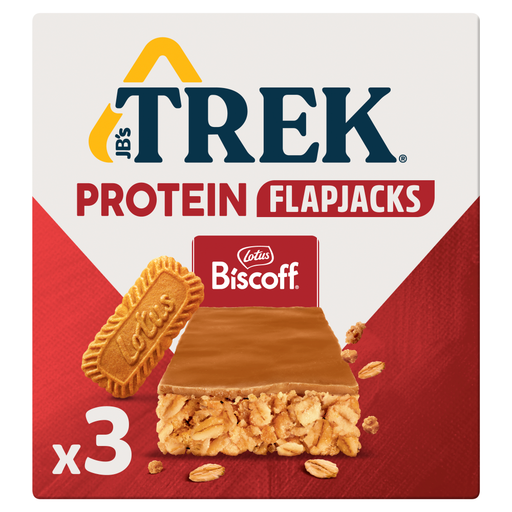 Image unavailable
This three-bar pack is another small-format option. Check the wrapper’s per-bar nutrition and its wheat and soya declarations; the product warning also mentions possible traces of peanuts, nuts and milk.
 Image unavailable
This four-bar pack contains peanuts, so it is not an option where the child’s allergy plan or school rules exclude them. Check the current wrapper for soya, milk and other allergen warnings, as well as the per-bar nutrition.
Check the individual school’s packed-lunch and allergy policy before packing one. For routine snacks, NHS guidance favours fruit and vegetables; if choosing a bar occasionally, check its exact wrapper, portion and ingredients rather than relying on a protein claim.
The Department for Education describes its school food requirements as applying to food and drink provided in state-funded schools in England. Southampton City Council’s guidance says there are no set standards for packed lunches brought from home; check your own school’s policy rather than treating that local guidance as permission for a particular bar.
No. The NHS says lower- or no-calorie sweeteners do not necessarily make a food a suitable choice on their own. Compare the exact bar’s portion, traffic-light label and per-bar nutrition with the rest of the lunch.
Ingredients and allergen statements can differ between flavours. Grenade identifies particular peanut-containing flavours, while Barebells lists milk and soya ingredients and possible trace allergens for its Cookies & Cream bar; read each current wrapper before it goes into a lunchbox.