Car boot sellers offering single snacks
Factory-packed bars give you countable portions without opening a multipack’s individual wrappers. Keep each wrapper with its bar so customers can read the ingredients, allergens and date marking.


For a car boot sale, choose a multipack or selection box only if you can offer each bar in its original, sealed wrapper. A selection box offers flavour choice, while a single-flavour case makes the number of portions easier to plan; for a dietary-specific option, check the exact wrapper rather than relying on a claim about the whole range. If you plan to sell refreshments as a food business, check registration and allergen-information duties with your local authority before the event.
The useful distinction at a refreshment table is not just flavour: it is whether each customer can inspect the portion they will receive.
Factory-packed bars give you countable portions without opening a multipack’s individual wrappers. Keep each wrapper with its bar so customers can read the ingredients, allergens and date marking.
Compare protein and sugar on the label of the exact flavour and bar size. A mixed box gives customers a choice, but its flavours may have different ingredients and warnings.
Make the individual wrapper available before a customer chooses. A vegan or gluten-free description does not, by itself, answer questions about peanuts, other allergens or precautionary statements.
Decide how much flavour choice the table needs, then compare the sealed portions and labels you would actually hand over. A dietary-specific pack is a separate choice, not a substitute for checking every bar.
Choose it when: Customers would benefit from a choice of flavours while each bar remains factory-wrapped.
Trade-off: Flavours and their allergen statements can differ, and the contents of some boxes may change.
Choose it when: You want a predictable number of the same bar and have checked that flavour’s label.
Trade-off: One flavour offers less choice and may not meet customers’ different dietary needs.
Choose it when: Its exact labels meet a dietary requirement you intend to cater for.
Trade-off: Suitability for one diet does not establish that a bar is free from other allergens.
| Priority | What to check | Your needs |
|---|---|---|
| Sealed portions | Check the number of bars, whether each has its own wrapper and whether the pack size suits the event. | I want to hand over one intact bar at a time, with its label still attached. |
| Flavour and nutrition | Compare flavours and the protein and sugar stated per bar. Check bar weight too: a 45 g bar and a 60 g bar are different portions. | Some customers may want a flavour choice; others may ask about the nutrition of the particular bar they pick. |
| Allergens and diet | Read each flavour’s ingredients, emphasised allergens and precautionary statements. Check vegetarian, vegan or free-from wording against the exact product. | I need customers to be able to inspect the bar they will receive, rather than relying on the outer box. |
| Warnings | Read the individual wrapper for sweetener or polyol warnings and any product-specific suitability information. | A customer considering a bar should be able to see its warnings before choosing it. |
| Outdoor handling | Follow the exact product’s storage instructions and keep wrappers dry and legible during display. | At an outdoor sale, I need somewhere to keep the bars away from conditions their packaging says to avoid. |
Ingredients and allergens can differ between flavours, so an outer selection-box label may not tell a customer enough about the bar in their hand. GOV.UK guidance says prepacked food must have an ingredients list on its packaging.
Keep each factory wrapper intact and available to inspect. Do not describe the whole assortment as suitable for a particular allergy.
Protein amount, dietary suitability, allergens and sweetener warnings vary by product and flavour. A vegan claim, for example, does not establish that a bar is peanut-free.
If you offer a dietary-specific alternative, identify it by its exact label and keep it distinguishable from the other stock.
Outdoor display may conflict with a product’s storage instructions. Myprotein specifies a cool, dry place away from direct sunlight for its Layered Bar Variety Box.
Check the instructions for the bars you buy and use a dry, shaded place for storage and display.
These brand and retailer examples illustrate different pack formats. Check the selected product and flavour rather than applying a range-wide description to every bar.
Grenade offers a 12-bar selection box as well as single-flavour protein bars.
PhD sells its Smart Bar in a 12-pack format.
Myprotein offers both a Layered Bar Variety Box and a Protein Snack Box.
Barebells has a selection-box format built around several flavours.
Quest describes protein bars and variety packs in its own range.
Tesco lists single bars and multipacks from different brands.
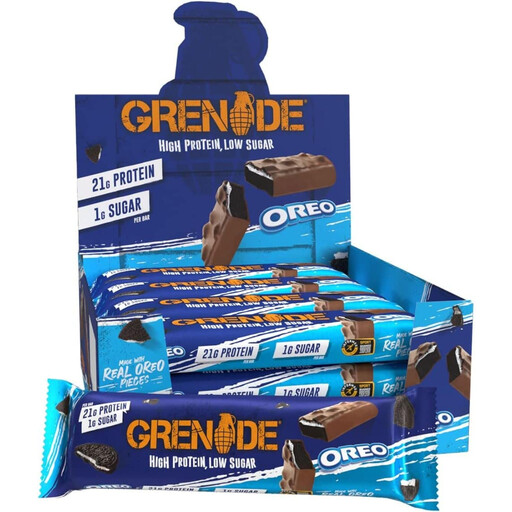
These Grenade multipacks are single-flavour options for offering individually wrapped protein bars at a car boot sale. Choose between their pack counts, bar sizes and flavours, then check the current wrapper for ingredients, allergens and warnings before offering individual bars.
 No image available
The four-bar format suits a smaller number of sealed, single-flavour portions. Check each wrapper for milk, gluten and soy information and the polyol warning before offering a bar.
 No image available
This case provides 12 portions of the same flavour for a table expecting more single-bar requests. Check the individual wrapper for milk, soy and wheat information and its polyol warning.
 No image available
A 12-bar case offers a single chocolate flavour in 50 g portions, rather than the 60 g Oreo bars above. The product information identifies milk and soy and includes a polyol warning; retain the wrapper for customers to inspect.
No image available
This 12-bar, single-flavour case uses 50 g portions. Its product information identifies milk and soy and includes a polyol warning, so keep the individual label available before a customer chooses it.
 No image available
The case contains 12 bars of one peanut-butter flavour, each listed as 50 g. Its product information identifies milk, soy and peanut and includes a polyol warning; make the exact wrapper available for allergen checks.
If your activity is a food business, check registration before trading; do not assume the event itself creates an exemption. Food Standards Agency guidance says to register at least 28 days before trading or starting food operations, and Food Standards Scotland says food businesses in Scotland must register at least 28 days before opening. Ask the relevant local authority how the requirement applies to your planned activity.
The wrapper lets a customer check the ingredients and allergens of the flavour they will actually receive. GOV.UK guidance says prepacked food must have an ingredients list on its packaging; keeping wrappers intact is particularly important when a selection box contains different flavours.
Do not make a blanket suitability claim for a mixed box. Grenade directs buyers of its selection box to individual packaging for full allergen information, and ingredients can differ by flavour. Let customers inspect the exact bar’s label before choosing.
Follow the instructions for the exact product and keep its wrapper dry and readable. Myprotein specifies a cool, dry place away from direct sunlight for its Layered Bar Variety Box; check other products’ packaging rather than assuming the same instructions apply to every bar.
No; check the exact product rather than the protein-bar category. Myprotein states that its Layered Bar Variety Box is not suitable for vegetarians, while Tesco describes Nakd Peanut Butter Protein Bars as suitable for vegans. Dietary suitability does not replace an allergen check.