Commuters and office workers with delayed lunches
A bar can be a portable snack when you cannot eat lunch at the usual time. If it stands in for lunch, think about what other foods you will have with it or later.


Choose a single bar by what you need while lunch is delayed: compare protein and fibre per bar for a more substantial snack, or check sugars alongside the rest of the label for a shorter gap. A protein bar is not automatically a balanced lunch, so plan other foods if it is taking the place of a meal, and check the exact flavour’s ingredients and allergen statements.
A bar can be a portable snack when you cannot eat lunch at the usual time. If it stands in for lunch, think about what other foods you will have with it or later.
Compare the serving on the exact flavour’s label if protein and sugars matter to your choice. Calories, fibre, ingredients and any consumption warning can also change which bar suits your lunch gap.
Read the ingredients and any precautionary allergen statement on the exact pack. A familiar brand name is not a substitute for checking a different flavour or recipe.
Start with the single-bar serving, then decide whether you need a snack until lunch or are relying on the bar as part of lunch.
| Priority | What to check | Your needs |
|---|---|---|
| Portion and format | Check the weight of one bar, the number of bars in the pack and whether the nutrition panel is per bar or for another serving size. | I want a single portion I can take to work without mistaking the multipack total for what one bar provides. |
| Protein and fibre | Compare both amounts per bar. Myprotein lists 20 g protein and 8.6 g fibre per 64 g Impact Protein Bar; the labelled flavour and serving matter. | If lunch is delayed, I want to know what the bar contributes, while keeping the rest of my lunch in mind. |
| Sugars and other label details | Read sugars and calories together, and check for consumption warnings. PhD lists 1.2 g sugars and 250 kcal per 64 g Choc Brownie Smart Bar and warns that excessive consumption may cause laxative effects. | A lower-sugar label catches my eye, but I also want a portion and ingredients that suit how I will use the bar. |
| Ingredients and allergens | Read the exact flavour’s ingredients, highlighted allergens and any ‘may contain’ statement. The Food Standards Agency explains that precautionary allergen labelling signals possible unintended allergen presence. | Before I put a bar in my bag, I need to know whether that particular pack fits my dietary requirements. |
A bar can cover a delayed meal, but it does not automatically provide the variety of foods described in NHS balanced-diet guidance.
Use it as a backup or alongside other lunch foods, rather than assuming its protein content makes it a whole meal.
Ingredients and precautionary allergen statements matter for the particular product. The Food Standards Agency says ‘may contain’ labelling communicates possible unintended presence of regulated allergens.
Read the pack’s ingredients and allergen statements before buying or eating it, particularly when changing flavour or recipe.
PhD’s Choc Brownie Smart Bar lists 1.2 g sugars and 250 kcal per 64 g bar. PhD and Myprotein also warn that excessive consumption of their cited bars may cause laxative effects.
Compare the full per-bar label, ingredients and warnings alongside sugars, especially before buying several bars for work or travel.
A product listing is not a promise that the same bar will be available when you next need it.
Confirm availability and delivery before relying on a particular pack for upcoming lunches.
These references describe product ranges and specific labels; they do not mean every flavour has the same nutrition or ingredients.
Grenade’s UK range includes Carb Killa and Soft Core protein bars.
PhD provides flavour-specific information for its Smart Bar range.
Myprotein’s range includes Impact Protein Bars alongside other bar formats.
Barebells lists Original, Soft and Vegan protein-bar lines.
Quest’s cited product information comes from its US storefront, not a UK pack label.
Tesco is a retailer with protein bars from multiple brands and in different pack formats.
These packs offer single-bar portions to consider for a short lunch gap or a delayed meal. Compare the exact pack labels before deciding what each bar contributes.
 No image available
Consider one 50 g bar for a short gap before lunch. Check the Double Chocolate pack’s nutrition, ingredients and warnings if you expect to use it regularly.
 No image available
The four-pack gives you 60 g bars to compare with other lunch-gap portions. Use the Oreo Flavour pack label to check protein, sugars, ingredients and any consumption warning.
 No image available
If lunch is delayed, compare the nutrition for one 40 g bar rather than the four-bar pack. Check the Salted Caramel Nut pack’s ingredients and allergen statements before putting one in your bag.
 No image available
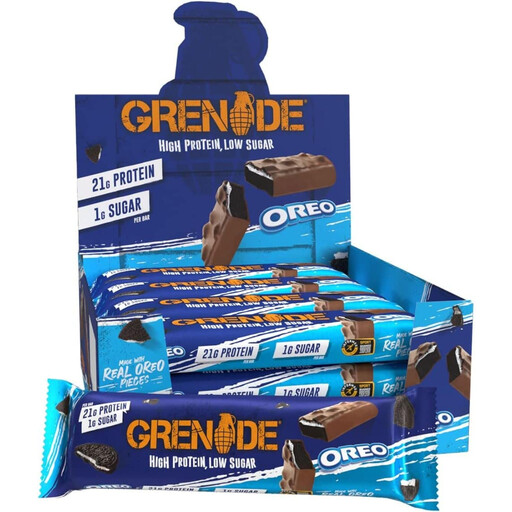
This is the 12-pack of 60 g Oreo Flavour bars, distinct from the four-pack above. If you plan to keep bars for several lunch gaps, check the per-bar label and warnings before choosing the larger pack.
 No image available
One 50 g bar is a portion to consider for a short break between meals. Read the Golden Caramel pack’s nutrition and ingredients rather than assuming they match the Double Chocolate variant.
Not automatically. NHS guidance describes a balanced diet as a variety of foods in appropriate proportions. A bar can be a portable backup when lunch is delayed, but if it takes the place of a meal, consider what other foods will make up that lunch.
Read the exact pack’s ingredients, highlighted allergens and any precautionary statement before eating the bar. The Food Standards Agency explains that statements such as ‘may contain’ communicate possible unintended presence of regulated allergens; do not assume another flavour has the same ingredients.
The sugar figure does not describe every ingredient or warning. PhD and Myprotein state that excessive consumption of their cited bars may cause laxative effects, while Quest says tolerance of its sugar-alcohol-containing bars varies. Check the warning on the bar you choose.
Compare both on the same single-bar basis, then look at the other details relevant to your lunch. For example, PhD lists 21 g protein and 250 kcal per 64 g Choc Brownie Smart Bar, while Barebells lists 20 g protein and 212 kcal per 55 g White Salty Peanut bar. Those different portions and figures alone do not settle which fits your ingredients or meal plans.