Runners choosing an after-training snack
A portable bar can fit between meals or after a session. Compare the protein in one bar alongside its carbohydrate, fibre and ingredients; a protein label alone does not describe the whole snack.


Choose a high-protein bar as a portable snack after training or between meals, comparing protein per bar with its carbohydrate, fibre, ingredients and allergens. For a prolonged run, plan carbohydrate and fluids separately: World Athletics gives a guide of 30–60 g carbohydrate per hour for exercise lasting 1–2.5 hours and up to 90 g per hour for events beyond 2.5 hours. Practise any food you intend to carry on a run rather than relying on a protein bar as your entire fuelling plan.
A portable bar can fit between meals or after a session. Compare the protein in one bar alongside its carbohydrate, fibre and ingredients; a protein label alone does not describe the whole snack.
During a prolonged run, carbohydrate intake is a separate question from which protein bar to carry. World Athletics expresses its endurance guidance in grams of carbohydrate per hour, so consider the planned duration and practise your food-and-fluid strategy in training.
Vegan or gluten-free wording does not answer every allergen question. The named bars discussed here contain or may contain peanuts, other nuts, soy or milk, depending on the product; check the current pack against your requirements.
Decide whether the bar is for a snack or for food during a run before comparing flavours and nutrition panels. Those uses call for different checks.
Choose this route: When you want portable food and can find a bar whose serving and ingredients suit you.
Keep in mind: A bar is a snack, not a complete meal or an entire training nutrition plan.
Choose this route: Build a carbohydrate-and-fluid plan around the run’s duration rather than choosing by protein content.
Keep in mind: A solid bar may contribute carbohydrate, but its texture, fibre, fat and ingredients make personal tolerance worth testing in training.
| Priority | What to check | Your needs |
|---|---|---|
| Long-run carbohydrate | Read carbohydrate per bar, then consider it against an hourly plan. World Athletics gives 30–60 g per hour for 1–2.5 hours of exercise and up to 90 g per hour beyond 2.5 hours; practise food and fluids together. | For a long session, I need a plan I can follow throughout the run, not just a bar labelled protein. |
| Protein per serving | Compare whole-bar weights and protein per bar. Manufacturer figures for the named examples are 10.2 g in a 40 g Nature Valley Peanut & Chocolate bar and 9 g in a 50 g TREK Cocoa Oat flapjack. | After training, I want to know what one bar provides, rather than comparing front-of-pack claims alone. |
| Ingredients and allergens | Check the exact flavour’s ingredients, dietary claims and any precautionary allergen wording on the current pack. GOV.UK says regulated allergens used as ingredients in prepacked food must be clearly labelled in the ingredients list. | If I avoid particular ingredients, vegan or gluten-free wording on its own is not enough for my decision. |
| Whole-bar nutrition | Compare carbohydrate, sugars, fibre and fat per serving as well as protein. Nature Valley lists 11 g carbohydrate and 4.4 g fibre per 40 g Peanut & Chocolate bar; TREK lists 22 g carbohydrate and 2 g fibre per 50 g Cocoa Oat flapjack. | I may prefer different foods before, during and after a run, so the full serving matters more than one nutrient in isolation. |
World Athletics’ prolonged-exercise carbohydrate guidance is expressed per hour. The named bars from Nature Valley, TREK, Eat Natural and nākd. list 11–22 g carbohydrate each, so one bar should not stand in for a duration-based plan.
Plan food and fluids for the session, and try any solid bar during training before deciding whether to carry it for an event.
Bars have different serving weights. The named manufacturer examples provide 6.2–10.2 g protein per individual bar, with weights ranging from 40 g to 50 g.
Compare the amount in the whole bar you would eat, then use per-100-g figures if you want a like-for-like comparison of the recipes.
A vegan or gluten-free claim does not mean a bar is free from peanuts, other nuts, soy or milk. The named products have different ingredient lists and precautionary statements.
Read the current pack’s full ingredients and allergen wording for the exact flavour, particularly if you need to avoid an ingredient.
TREK describes its High Protein range as providing 15 g plant protein, while its Cocoa Oat Protein Flapjack lists 9 g per bar. A range name does not establish the nutrition of another product.
Check the flavour, bar weight and nutrition panel on the pack you intend to buy.
These figures describe named products or ranges, not every bar made by each brand.
Nature Valley lists 10.2 g protein and 4.4 g fibre per 40 g Protein Peanut & Chocolate bar.
TREK’s Cocoa Oat Protein Flapjack lists 9 g plant protein per 50 g bar and is described as vegan.
Eat Natural lists 7.8 g protein and 13.4 g carbohydrate per 40 g Dark Chocolate & Peanut Protein Bar.
The nākd. Cherry Protein Bar is a 45 g fruit-and-nut bar listing 6.2 g protein and 17 g carbohydrate.
These multipacks offer protein-bar or flapjack options to consider as portable snacks around marathon training. Compare the exact flavour’s serving information and allergen wording; the bars are not a substitute for a long-run carbohydrate-and-fluid plan.
 No image available
A portable protein-bar option for after training or between meals. Nature Valley lists 10.2 g protein, 11 g carbohydrate and 4.4 g fibre per 40 g bar. Check the pack if you need to avoid peanuts, soy, milk or other nuts.
 No image available
A multipack to consider for portable snacks after training or between meals. Check protein and the rest of the nutrition panel per bar, and read the current allergen wording if you avoid peanuts, almonds, soy or milk.
 No image available
A vegan Cocoa Oat flapjack option for a portable snack. TREK lists 9 g protein, 22 g carbohydrate and 2 g fibre per 50 g bar. Check its soy ingredients and precautionary peanut, nut and milk wording against your requirements.
 No image available
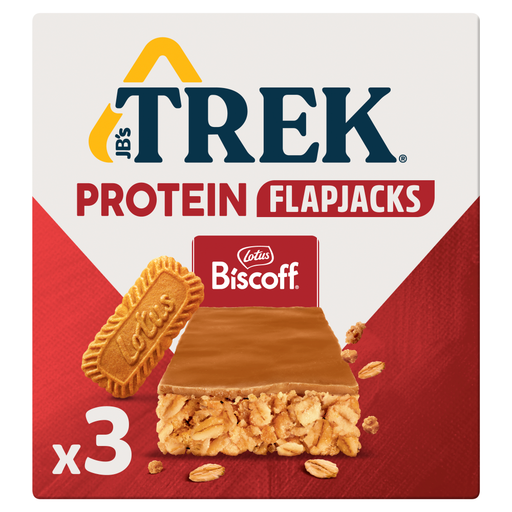
A flapjack multipack to compare for between-meal or after-training snacks. Check the exact pack’s protein, carbohydrate and fibre per bar; its wheat and soya ingredients matter if you avoid either of them.
 No image available
A protein-flapjack multipack to consider for a portable snack. Compare the exact flavour’s whole-bar nutrition with your other options, and check the current pack’s soya, peanut, nut and milk wording if relevant.
Do not rely on one as your entire fuelling plan. World Athletics gives carbohydrate guidance of 30–60 g per hour for exercise lasting 1–2.5 hours and up to 90 g per hour beyond 2.5 hours. The named bars from Nature Valley, TREK, Eat Natural and nākd. list 11–22 g carbohydrate each, so plan and practise food and fluids for the duration of your run.
It can be a portable snack after a session or between meals when the ingredients suit you. The joint position statement from Dietitians of Canada, the Academy of Nutrition and Dietetics and the American College of Sports Medicine emphasises matching the type, amount and timing of food and fluids to the athlete and activity; a bar is only one part of that wider plan.
Manufacturer figures for these specific flavours range from 6.2 g to 10.2 g per whole bar: nākd. Cherry has 6.2 g per 45 g bar, Eat Natural Dark Chocolate & Peanut 7.8 g per 40 g, TREK Cocoa Oat 9 g per 50 g and Nature Valley Peanut & Chocolate 10.2 g per 40 g. Check the flavour and serving weight when comparing another product.
Read the current ingredients list and any precautionary allergen statement for the exact product. GOV.UK says regulated allergens used as ingredients in prepacked food must be clearly labelled in the ingredients list; the named bars also warrant attention to peanut, other nut, soy and milk wording according to their individual packs.
No. Those claims address different requirements. For example, TREK’s vegan Cocoa Oat flapjack carries a precautionary peanut and nut statement, while the vegan nākd. Cherry bar contains peanuts. Check the full wording on the product you intend to eat.