Protein-focused snack planners
If you are using bars to contribute to a daily protein target, compare grams of protein in the entire bar. Pack sizes differ, so a front-of-pack description alone will not tell you what one snack provides.


Choose a protein bar by the amount of protein in the whole bar you plan to eat, then check its sugars, energy, fibre and ingredients against your other priorities. A lower-sugar bar may contain sweeteners, and a regular bar is not necessarily suitable for a plant-based diet; the exact flavour and pack matter.
The useful comparison depends on whether protein per snack, the wider nutrition panel or dietary suitability drives your choice.
If you are using bars to contribute to a daily protein target, compare grams of protein in the entire bar. Pack sizes differ, so a front-of-pack description alone will not tell you what one snack provides.
If you want a chocolate-style snack, read the sugars and energy figures alongside protein. Check fibre if it matters to your choice, and look at the ingredients for sweeteners rather than judging the bar by its sugar figure alone.
Check the exact flavour’s ingredients, allergen statements and any plant-based designation before buying. A regular milk-protein bar and a separately labelled plant-based bar should not be treated as interchangeable.
Start with the whole bar as your serving, then use the rest of its label to decide whether that serving fits your needs.
| Priority | What to check | Your needs |
|---|---|---|
| Protein per bar | Read the protein grams and serving weight for the complete bar. Compare bars on that basis before using per-100g figures to examine differences in concentration. | I want to know how much protein the snack I will actually eat contributes, particularly when bar sizes differ. |
| Wider nutrition | Compare energy, sugars and fibre for the same serving. For illustration, Barebells UK lists 20g protein, 1.4g sugars and 190 kcal per 55g Cookies & Cream bar; Myprotein lists 18g protein, 6.6g sugars, 8.3g fibre and 239 kcal per 60g Chocolate Orange Layered Protein Bar. These are different products and serving sizes. | A sugar figure alone does not settle my choice; I may also care about energy or fibre. Myprotein notes that its bar’s values can vary by flavour. |
| Ingredients and allergens | Read the exact product’s ingredient list, emphasised allergens, possible-presence statements and sweetener warnings. For a plant-based diet, check the specific product rather than the brand or range name. | I need to avoid ingredients that do not suit my diet. The Department for Environment, Food & Rural Affairs and Food Standards Agency guidance identifies ingredients, including allergens, as required information on prepacked-food labels. |
| Pack format | Check the number of bars, weight per bar and exact flavour before choosing a multipack. Recheck the product details when buying, as retailer listings can change. | If I am choosing several bars at once, I want to be sure the pack contains the flavour and serving size I compared. |
Protein grams and bar weights differ. For example, Myprotein lists 18g protein per 60g Chocolate Orange Layered Protein Bar, while Barebells UK lists 20g per 55g Cookies & Cream bar.
Compare the protein figure for the entire bar, then read the other nutrition figures on the same serving basis.
A lower listed sugar figure does not describe every ingredient. Barebells UK lists maltitol in its Cookies & Cream bar and warns that excessive consumption may have laxative effects.
Check the sweeteners and warning statements for the exact bar, particularly before choosing a multipack.
PhD presents Smart Bar Plant separately from its regular Smart Bar. A Joybuy listing for a regular PhD bar identifies milk protein, whey protein and bovine collagen hydrolysate in its protein blend.
If a plant-based product is essential, look for an explicit suitability statement and check that flavour’s ingredients and allergens.
These examples show why a brand name alone is not enough: compare the particular bar and flavour. The references below do not imply that every product mentioned is in the Joybuy selection.
Grenade offers protein bars in multipack formats.
PhD describes its regular Smart Bar and Smart Bar Plant as distinct ranges.
Myprotein’s Layered Protein Bar provides an example for comparing fibre alongside protein.
Quest describes its original protein-bar range using a protein figure of up to 21g per bar.
Barebells UK lists product-level nutrition for its Cookies & Cream protein bar.
Tesco is a retailer reference for comparing individual bars and multipacks, rather than a protein-bar manufacturer in this article.
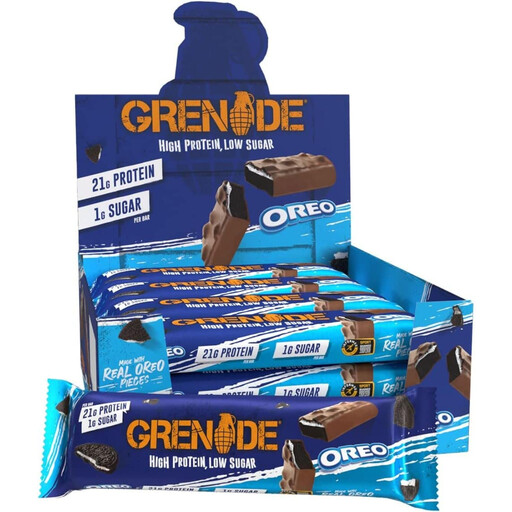
These Joybuy options comprise four Grenade multipacks in different flavours and one Nature Valley multipack. Compare their exact labels if protein grams, sugars, ingredients or allergens determine your choice.
 No image available
This Oreo-flavour multipack is one to compare if you want individual 60g bars for snacks. Check the exact pack’s nutrition panel for protein and sugars per bar, and its ingredients if milk, soy, wheat or sweeteners matter to you.
 No image available
Choose this format if you are comparing double-chocolate bars in 50g servings. Read the exact bar’s protein, sugars and fibre figures; check its milk, soy and sweetener information before choosing the multipack.
 No image available
This is the Golden Caramel flavour in a pack of twelve 50g bars. Compare its per-bar nutrition with the other flavours rather than assuming the figures match, and check the milk, soy and sweetener details on the exact pack.
 No image available
The Peanut Butter variant offers twelve 50g bars. If peanuts, milk or soy affect your choice, inspect this flavour’s allergen information closely; also check its per-bar nutrition and sweeteners.
 No image available
This smaller multipack contains four 40g Peanut & Chocolate bars. Compare protein and sugars for one complete bar against the larger formats, and check the pack’s peanut, soy and milk allergen information. If fibre matters to you, read its nutrition panel before choosing.
No. Check the grams for the entire bar rather than assuming a fixed amount from its description. Myprotein lists 18g per 60g Chocolate Orange Layered Protein Bar, while Barebells UK lists 20g per 55g Cookies & Cream bar.
Start with protein per whole bar to see what the snack you intend to eat provides. Per-100g figures can then help you compare bars of different weights on the same weight basis; neither figure replaces a check of the rest of the nutrition panel.
Yes. Barebells UK lists maltitol in its Cookies & Cream bar and warns that excessive consumption may have laxative effects. Read the ingredients and warnings for the exact flavour rather than relying on its sugars figure alone.
Check the exact product’s ingredients, emphasised allergens and possible-presence statements before purchase. The Department for Environment, Food & Rural Affairs and Food Standards Agency guidance identifies an ingredients list including allergens as required information for prepacked food; a range description cannot tell you whether every flavour has the same ingredients.
No. PhD presents Smart Bar Plant as a separate plant-based option, while a Joybuy listing for a regular PhD bar identifies milk protein, whey protein and bovine collagen hydrolysate. Check the suitability statement and ingredients of the specific bar you intend to buy.