Shoppers following a defined low-fat plan
Compare total fat per 100g before deciding whether a portion fits your plan. A protein-focused name does not establish that a popcorn is low in fat.


If you need popcorn to meet both published high-protein and low-fat benchmarks, neither Myprotein Protein Popcorn Sweet and Salty nor Waitrose Popcorn Maize qualifies. Legislation.gov.uk specifies at least 20% of energy from protein for a high-protein claim, while the Food and Allergy Information Association lists no more than 3g fat per 100g for a low-fat claim on solid food. The Myprotein variant lists 18g protein and 18g fat per 100g; the Waitrose kernels list 5.6g fat per 100g before the oil called for in their hob directions.
Compare total fat per 100g before deciding whether a portion fits your plan. A protein-focused name does not establish that a popcorn is low in fat.
Check protein and fat on the same per-100g basis. Myprotein lists 18g of each per 100g for its Sweet and Salty Protein Popcorn, according to its product information.
Kernels let you decide how much oil and seasoning to add. Waitrose Popcorn Maize lists 5.6g fat per 100g for the kernels, and its stated hob method adds vegetable oil.
Start with protein and fat per 100g so pack sizes do not obscure the comparison, then check the portion and preparation method you will actually use.
| Priority | What to check | Your needs |
|---|---|---|
| Protein | Compare protein per 100g and per serving. If a high-protein claim matters, check protein against total energy; legislation.gov.uk gives a threshold of at least 20% of energy from protein. | I want to know how much protein the portion contains, rather than rely on a protein-themed name. |
| Total fat | Read total fat per 100g. The Food and Allergy Information Association lists no more than 3g per 100g as the low-fat claim condition for solid food; compare prepared values where a pack provides them. | A small bag might suit my portion plan, but I still need to check its fat content. |
| Preparation | Check whether nutrition is stated for kernels or prepared popcorn. Read cooking directions and account for oil added at home. | If I pop kernels myself, I want to control how much oil and seasoning goes in. |
| Flavour and ingredients | Compare the exact flavour’s salt and sugars per 100g. Check its ingredient and allergen information against your requirements. | A fibre or wholegrain description will not tell me the fat, salt or sugar content of the flavour I am buying. |
Myprotein’s Sweet and Salty Protein Popcorn lists 18g protein and 18g fat per 100g. Its declared 18g protein and 430kcal per 100g put protein at about 16.7% of energy, below the 20% high-protein benchmark published by legislation.gov.uk.
Check energy, protein and total fat per 100g on the exact variant, rather than judging it by the product name or protein per bag.
A serving figure answers a different question from fat per 100g. Waitrose & Partners lists 16g fat per 100g for PROPER Salted Microwavable Popcorn and 21g per 100g as prepared for Butterkist Salted Microwave Popcorn.
Use the per-100g panel to compare products, then check the serving size you intend to eat.
Waitrose Popcorn Maize lists 5.6g fat per 100g for the kernels, while its hob recipe calls for vegetable oil. Microwave popcorn also has product-specific cooking instructions.
Measure oil added at home, and stay present while microwave popcorn is popping, as the reviewed PROPER and Butterkist pack information instructs.
Fat, salt and sugars vary between popcorn products. In its 2025 product assessment, Action on Sugar reported that 27% of the ready-to-eat popcorn products assessed exceeded voluntary maximum salt targets; that figure describes products, not shoppers’ preferences.
Read the nutrition panel for the particular flavour and pack, including total fat, salt and sugars.
These examples show why the exact product and flavour matter more than a brand-wide description.
Its Sweet and Salty Protein Popcorn is a protein-focused popcorn product containing whey protein isolate, according to Myprotein.
The reviewed PROPER products include ready-to-eat and microwave popcorn in different flavours.
Waitrose Popcorn Maize is an unpopped-kernel option for shoppers who want to choose their own preparation and seasoning.
The reviewed Toffee and Salted Microwave products have different nutrition profiles.
Tesco Groceries lists own-label, branded and microwave popcorn in its popcorn category.
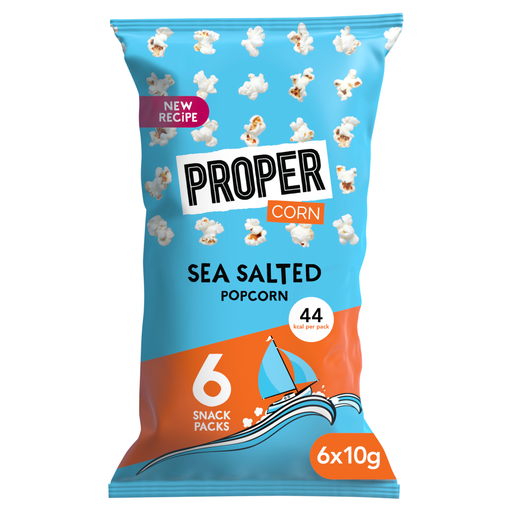
These Propercorn ready-to-eat packs offer different pack sizes for shoppers comparing popcorn portions. Check the exact pack’s fat and protein information before deciding whether it fits a low-fat plan.
 No image available
Six 10g bags provide a defined pack portion. Joybuy’s nutrition listing gives 8.6g protein and 17.4g fat per 100g; the fat figure is above the 3g-per-100g low-fat benchmark listed by the Food and Allergy Information Association. Check the current pack’s allergen information if it affects your choice.
 No image available
The 70g pack is a different portion format from the six-bag multipack. Compare protein and fat per 100g on its current label, and check the stated serving mass before using a per-serving calorie figure to compare portions.
Check two separate measures on the exact pack. Legislation.gov.uk specifies at least 20% of energy from protein for a high-protein claim, while the Food and Allergy Information Association lists no more than 3g fat per 100g for a low-fat claim on solid food. Protein grams alone do not establish both.
Not on the declared figures for the Sweet and Salty variant. Myprotein lists 3.8g protein per 21g serving and 18g protein alongside 430kcal per 100g; protein therefore supplies about 16.7% of energy, below the 20% benchmark published by legislation.gov.uk. The variant also lists 18g fat per 100g.
Do not assume they are. Waitrose Popcorn Maize lists 5.6g fat per 100g of kernels, above the Food and Allergy Information Association’s 3g-per-100g benchmark for a low-fat claim on solid food. Its stated hob method also uses vegetable oil, which adds fat to the prepared popcorn.
Check the prepared nutrition information rather than assuming so. Waitrose & Partners lists 16g fat per 100g for PROPER Salted Microwavable Popcorn and 21g per 100g as prepared for Butterkist Salted Microwave Popcorn. Follow the chosen pack’s cooking directions and remain present while it pops.
No; check total fat for the exact flavour. For example, Waitrose & Partners lists 20.4g fat per 100g for PROPER Sweet & Salty Popcorn. Read salt, sugars and allergen information too if those details affect your choice.