Who is this decision for?
The reason to change TVs depends as much on the games you play and the room you use as it does on your console.
PS5 or Xbox Series X players interested in higher frame rates
If you play games that support 4K at 120Hz or VRR, check the game, console settings, TV model and HDMI input together. PlayStation confirms PS5 support for 4K 120Hz output; Xbox Support explains how to set up 4K gaming at 120Hz on Xbox Series X with a compatible TV. Neither console name alone tells you what a particular game and TV will display.
Living-room players comparing OLED with LED or Mini LED
Room light, seating positions and dark-scene preferences can help narrow the display type. LG describes the contrast of self-lit OLED pixels, while Samsung positions its Neo QLED range for brighter viewing. Check the picture and gaming specifications of the particular model rather than treating either panel label as a guarantee.
Existing-TV owners considering a replacement
If the current picture and controls suit your games, inspect the console's display-capability information and the TV input in use before buying another screen. A settings change cannot add an output mode the TV does not support, but it may reveal a mode already available to you.
What should you check before choosing?
Start with the output modes you will use, then compare screen technology and size against the room. Automatic low-latency mode (ALLM) and VRR are worth checking on the exact model and HDMI input, not just on a range-wide feature page.
| Priority | What to check | Your needs |
|---|
| Console output |
Check 4K at 120Hz and VRR for the exact TV model and intended HDMI input. Confirm that the games you play support the modes you want. |
I play supported higher-frame-rate games and want to know which modes the console and this particular TV can use together. PlayStation confirms PS5 support for 4K 120Hz output; Xbox Support describes 4K at 120Hz setup for Xbox Series X with an HDMI 2.1-capable TV. |
| Control response |
Look for a gaming or low-latency picture mode, and check whether ALLM is supported on the chosen input. Confirm the TV's supported refresh modes rather than relying on a motion-feature name. |
Responsive controls matter to me more than a headline refresh-rate figure. Samsung says its 4K 120Hz Game Mode is available only on selected TV ranges, so I would check the specific model. |
| Picture and room |
Compare OLED and LED or Mini LED models in the light conditions you normally use. Measure the available space and check screen and stand dimensions alongside seating positions. |
For dark-scene viewing, I may favour the self-lit OLED contrast described by LG. In a brighter room, I would also compare LED or Mini LED models, without assuming their panel type settles the gaming-feature choice. |
| Installation |
Check cable reach, the planned HDMI input, stand width and mounting compatibility. Xbox Support advises a certified Ultra High Speed HDMI cable if a longer cable is required. |
The TV needs to fit my furniture or wall space, and the console cable needs to reach the right input. If I replace a TV, I also need to arrange an appropriate electrical-waste collection or recycling route. |
Which brand ranges are relevant?
These ranges illustrate display choices to investigate; a brand name does not confirm the features of every size or model.
LG
LG's UK OLED range is relevant when comparing self-lit displays and gaming features across different screen sizes.
- LG describes the contrast of self-lit pixels on its OLED models and discusses VRR and low-input-lag features in its gaming-TV guidance.
- Check the chosen model's ports and refresh modes. LG describes screen-protection functions on its OLED C5E product page, but those details should not be assumed for every LG TV.
Samsung
Samsung's OLED and Neo QLED ranges offer different panel routes to compare for the intended room.
- Samsung positions Neo QLED and Mini LED for brighter viewing and lists gaming connections and modes on selected TVs.
- Samsung says 4K 120Hz Game Mode is supported only on selected ranges. Confirm the ports and supported modes of the exact model.
Sony BRAVIA
Sony's BRAVIA range includes OLED and LED options for PS5 owners to assess by model.
- Sony's BRAVIA gaming guidance discusses 4K/120fps and VRR compatibility for supported setups.
- Sony says a supporting game is needed for 4K/120fps and that VRR results can vary by game. Verify the selected TV's functions and console settings.
Joybuy TV options to compare
These Joybuy options span smaller and larger OLED screens, QLED and LED models, and a large Mini LED screen for console-connected rooms. Compare each one against your space and required console modes; the listed screen or refresh feature alone does not confirm a particular 4K/120Hz input combination.
 No image available
Sony BRAVIA A90 XR42A90K 42-inch 4K OLED TV
A 42-inch OLED option if you are considering a smaller screen for your console setup. Check the intended HDMI input's supported resolution and refresh-mode combination, as well as the TV's physical fit, before choosing it for 4K/120Hz play.
View on Joybuy
 No image available
TCL 55P8K-UK 55-inch 4K QLED TV
A 55-inch QLED option to consider when planning a console-connected living-room screen. The title's 288Hz Game Accelerator name does not establish 4K console output at that rate; check which HDMI input supports the 4K/120Hz, VRR and ALLM combination you intend to use.
View on Joybuy
 No image available
TCL 75Q7C 75-inch 4K QD-Mini LED TV
A 75-inch Mini LED option where a larger screen fits the room and seating arrangement. Its title states a 144Hz native refresh rate; check the supported console output combinations on the intended HDMI input rather than treating panel refresh as confirmation of 4K/120Hz with VRR and ALLM.
View on Joybuy
 No image available
Samsung S85F QE83S85FAE 83-inch 4K TV
An 83-inch screen for a setup with space for a large TV. Check furniture, wall space and access dimensions, then confirm whether the intended HDMI input supports the console's required 4K/120Hz and VRR modes.
View on Joybuy
 No image available
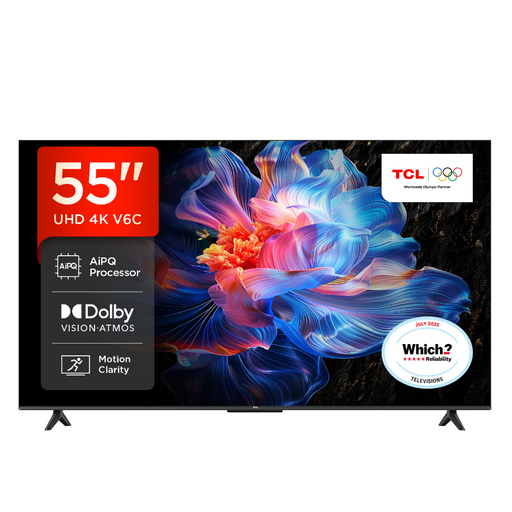
TCL 55V6C 55-inch 4K Direct LED TV
A 55-inch Direct LED option for comparing screen fit and console features. Its named 120Hz Game Accelerator mode is specified as FHD, so do not read it as 4K at 120Hz; check the exact supported resolution, refresh and HDMI-input modes for your console.
View on Joybuy
Common questions
Do I need HDMI 2.1 for PS5 or Xbox Series X gaming?
It depends on the output mode you want. PlayStation says PS5 supports HDMI 2.1 and 4K 120Hz output, while Xbox Support specifies an HDMI 2.1-capable TV for Xbox Series X 4K gaming at 120Hz. Check the game and the particular TV input too: neither an HDMI label nor console support means every game runs at 4K/120fps.
How can I check my existing TV before replacing it?
Use the console's connected-display information, then check the TV input and its settings. On PS5, look under Settings > Screen and Video > Video Output; on Xbox, use Settings > General > TV & display options > 4K TV details. A mode the TV does not support cannot be added through settings.
Do I need a new HDMI cable with a gaming TV?
Not automatically. Check whether your existing cable reaches the intended input and works for the output mode you need. If you need a longer cable for Xbox Series X HDMI 2.1 features, Xbox Support advises buying a certified Ultra High Speed HDMI cable.
Does console gaming itself mean I need a UK TV Licence?
Playing console games alone is not among the activities TV Licensing lists as requiring coverage. TV Licensing says you need to be covered if you watch live TV on a TV channel or streaming service, or use BBC iPlayer. Judge the requirement by what you watch, not simply by owning a TV or console.
What should I do with a TV I replace?
Check an electrical-waste collection or recycling route rather than putting it in general waste. GOV.UK explains that the UK's waste electrical and electronic equipment framework aims to reduce landfill and incineration; ask the retailer about take-back or check your local authority's arrangements.


