
24/7 Customer Support

Free returns

Same-day & Next-day Delivery

Quality Guaranteed

Unlock Your Welcome Offers: FREE Delivery | Up to 80% OFF | Free 30-day JoyPlus trial
Download the APP
By Joybuy Product Recommendation Officer
Bringing a new puppy home is an exciting time, but it often comes with the challenge of constant chewing. From your favourite shoes to the legs of the dining table, nothing seems safe from those tiny, sharp teeth. This behaviour is entirely natural; puppies chew to explore the world, relieve the discomfort of teething and combat boredom.
The market is filled with an overwhelming variety of puppy chews, treats and toys, making it difficult to know which are safe and suitable. This guide is designed to help you navigate the options, understand what to look for and find appropriate solutions for your young dog's needs, whether for teething, training, or dental care.
Before you buy, it helps to understand the key factors that make a chew suitable for a growing puppy. Keeping these points in mind will help you select products that are both safe and effective.
The most important consideration is safety. A chew that is too hard can fracture a puppy's delicate teeth, while one that is too soft can be destroyed and swallowed in minutes, posing a choking risk.
Different chews serve different purposes. Identifying your primary goal will help narrow down the choices.
For any edible product, from puppy training treats to dental sticks, the ingredient list is crucial. Natural dog chews for puppies with limited, recognisable ingredients are often a reliable choice. Puppy-specific formulas may also be fortified with essential nutrients like calcium to support healthy bone and tooth development. Always check for potential allergens if your puppy has known sensitivities.
Based on their features, ingredients and suitability for common puppy needs, here are some standout options for UK puppy owners.

Why It Stands Out: A multi-purpose toy that tackles boredom and teething in one.
This interactive toy is a practical tool for any puppy owner. Its hollow design can be filled with your puppy's favourite treats or kibble, turning a simple chew session into an engaging puzzle. This helps to provide essential mental stimulation and can make quiet time or crate training a more positive experience.
Pros:
Who is it for? This is an excellent choice for owners who need to redirect destructive chewing and keep their puppy mentally engaged. It is particularly useful for food-motivated puppies and can help slow down fast eaters when used with their regular kibble.
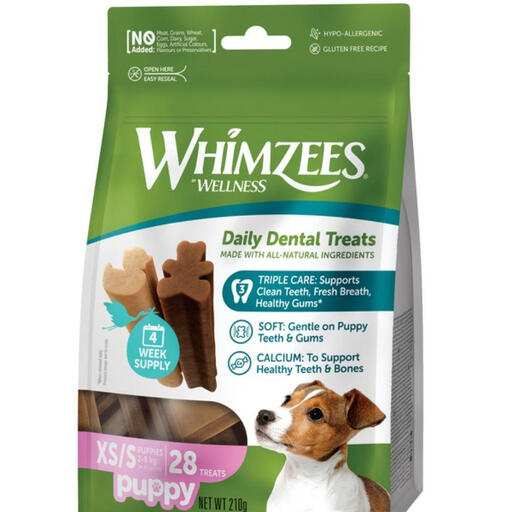
Why It Stands Out: A dental chew specifically engineered for a puppy's mouth.
Establishing good oral hygiene early is important. These dental chews are designed for puppies from 3 months old, with a softer texture that is gentle on developing teeth and sensitive gums. They help to mechanically clean the teeth while satisfying a puppy's natural urge to chew.
Pros:
Who is it for? Ideal for health-conscious owners of puppies (over 3 months and 2-9 kg) who want to introduce a daily dental care routine. These are a great way to promote good chewing habits while supporting oral health.
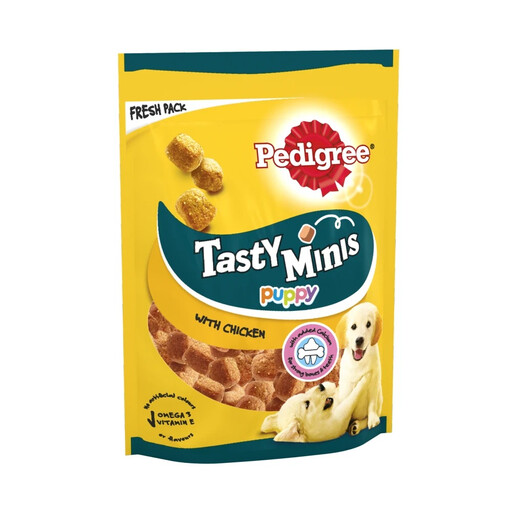
Why It Stands Out: A perfect high-value reward for training sessions.
Training is a core part of puppyhood, and having the right treat can make all the difference. These soft, bite-sized chicken cubes are designed specifically as puppy training treats. They are tasty enough to keep your puppy focused and small enough to be used frequently without spoiling their appetite.
Pros:
Who is it for? A must-have for any owner actively engaged in training a puppy aged 4 to 18 months. Their small size and appealing flavour make them an effective tool for positive reinforcement.
Every puppy has unique preferences for taste, texture and toy type. If the recommendations above are not quite what you are looking for, there are many other choices available.
Explore our complete collection of puppy dog treats to find the perfect match for your companion's specific needs and tastes.
At this very young age, a puppy's teeth are still tiny and fragile. The safest options are soft rubber toys, plush toys (with no small parts that can be chewed off and swallowed), or soft rope toys. Always supervise playtime closely. Most edible safe chews for puppies are recommended for those aged 3 months or older, so be sure to check the packaging for age guidelines.
Yes, as long as you choose a product specifically labelled as a puppy dental chew. These are formulated with a softer texture to prevent damage to their developing adult teeth. Adult dental chews are generally too hard and should be avoided. Always supervise your puppy with any dental chew to ensure they chew it properly.
The key is management and redirection. Puppy-proof your home as much as possible by removing or protecting tempting items. When you catch your puppy chewing something they shouldn't, interrupt them with a firm "no" and immediately offer them an appropriate and exciting alternative, like an interactive puppy toy filled with treats. Consistent redirection teaches them what is acceptable to chew on.