
24/7 Customer Support

Free returns

Same-day & Next-day Delivery

Quality Guaranteed

Unlock Your Welcome Offers: FREE Delivery | Up to 80% OFF | Free 30-day JoyPlus trial
Download the APP
Choosing puppy food can feel unnecessarily complicated. Packaging often highlights words such as “natural”, “superfoods”, “grain-free” or “high meat”, while the details that matter most are easy to miss. A suitable diet should match your puppy’s age, expected adult size, activity level and any known dietary sensitivities.
This guide explains the practical checks to make before buying, followed by our top recommendations for different household needs.
A recipe may promote chicken, turkey, vegetables or omega oils on the front of the pack, but this does not automatically mean it is nutritionally complete. Look for a clear statement that the food is a complete pet food for puppies or is suitable for growth. A complementary food should not replace your puppy’s main diet unless advised by a vet.
Wet puppy food contains a high proportion of water, often around 76–82%. Its protein percentage will therefore look lower than that of dry puppy food. For example, a wet recipe showing 8% protein is not directly comparable with a dry recipe showing 28–30%.
The format also affects cost and convenience. Puppy food pouches and puppy food tins are easy to portion and can help increase water intake, but a puppy may need several pouches or trays daily. Dry food is generally simpler to store and measure, particularly for larger puppies.
Grain-free puppy food is not automatically more appropriate than a recipe containing rice, oats, maize or wheat. Likewise, “hypoallergenic” is a product description rather than a guarantee that a puppy cannot react to it. If your puppy has persistent itching, vomiting, diarrhoea or poor weight gain, speak to a vet before changing diets repeatedly.
Puppies grow at different rates. Small breed puppy food usually has smaller kibble and feeding guidance for lower adult body weights. Large and giant breeds may need a formula specifically designed to manage growth and mineral intake.
Check the label for:
Do not rely on breed imagery alone. The feeding table and statutory product description are more useful than the marketing photographs.
The guaranteed analysis usually lists protein, fat, crude fibre, ash and moisture. These figures help you compare products within the same format.
For dry puppy food, also note the stated calcium and phosphorus levels, as well as omega 3 and omega 6 where provided. Products such as Burns Puppy Mini list 21% protein, 11% fat, 1.1% calcium and 0.9% phosphorus. Iams with Fresh Chicken Puppy lists 28% protein, 17% fat, 1.4% calcium, 1% phosphorus and 0.18% DHA.
DHA and omega oils are nutritional components, not promises of a specific medical or developmental outcome. They can still be useful comparison points when selecting puppy food with DHA or puppy food with omega 3 and 6.
Ingredients are listed in descending order by weight. Check the named animal ingredients, carbohydrate sources and any ingredients your puppy needs to avoid. A chicken puppy food is not necessarily suitable for a dog that reacts to poultry, while a turkey puppy food may offer a different protein source.
Introduce new food gradually over around 7–10 days, unless your vet advises otherwise. Measure portions rather than topping up the bowl throughout the day, and adjust the amount if your puppy is gaining weight too quickly or becoming underweight.
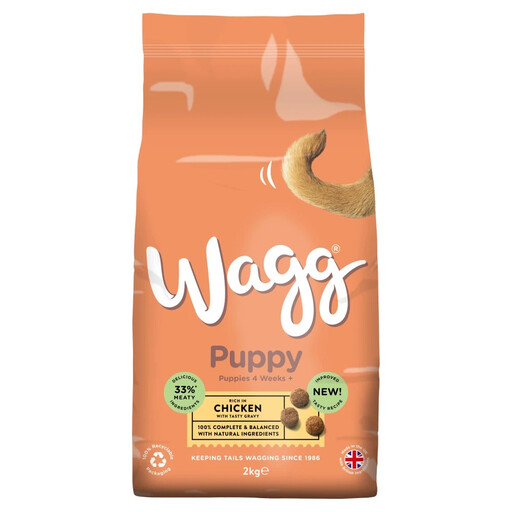
Why This Fits Their Persona: A practical 2kg pack suits first-time owners who want to introduce dry puppy food without committing to a large bag.
The product is identified as complete puppy food and provides feeding guidance from four weeks onwards, rather than relying only on front-of-pack claims.
Contains 28% protein, 10% fat and prebiotic chicory root. The kibble can be moistened during weaning.
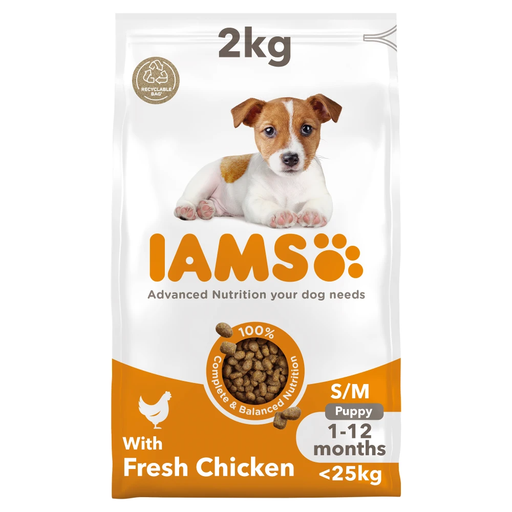
Why This Fits Their Persona: Suitable for owners comparing a detailed small- and medium-breed recipe with clearly listed nutrient values.
The pack specifies the intended age range, adult size category and a gradual 7–10-day transition, helping owners avoid an unsuitable switch.
Lists 28% protein, 17% fat, DHA at 0.18% and small-to-medium puppy kibble. It is wheat-free according to the supplied product information.
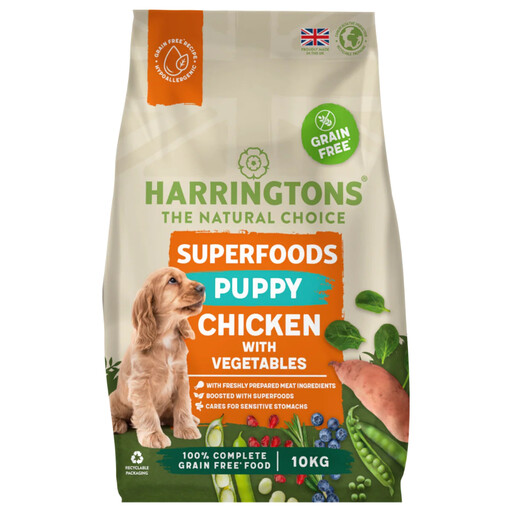
Why This Fits Their Persona: The larger bag is suited to households feeding a growing puppy daily and looking for a grain-free recipe with smaller kibble.
The grain-free claim is supported by a listed recipe based on chicken, sweet potato, potato, peas and beans. Owners should still check whether grain avoidance is actually needed.
Provides 30% protein, 14% fat, omega 3 at 1.5% and a 10kg pack size. It contains no grain, dairy or soya according to the supplied details.
We have compiled a complete, real-time list of products that fully satisfy these strict selection criteria and UK safety regulations.
Wet food can be useful for weaning, fussy eaters or owners who prefer single servings. Options include mixed puppy food pouches, trays and tins, such as the 12 × 100g Pedigree Junior selection, 12 × 100g Winalot pouches and 6 × 400g Morrisons tins.
Dry food is easier to weigh and store after opening. It may also be more economical per daily serving, although this depends on the feeding guide and pack price. Whichever format you choose, confirm that it is complete, follow the label’s portion guidance and keep fresh water available.
Young puppies commonly need three or four meals daily. From around six months, many can move towards two meals, but the correct schedule depends on size, age and individual needs. Follow the product guide and ask your vet if you are uncertain.
Many puppies move to adult food between 12 and 14 months, while larger breeds may remain on a junior formula for longer. Transition gradually and base the change on expected adult size, body condition and veterinary advice.
It can be, because wet diets often require multiple pouches, trays or tins each day. Compare the daily feeding cost, not just the price per pack. Mixed feeding can be convenient, but reduce the dry portion when adding wet food so total calories remain appropriate.