
24/7 Customer Support

Free returns

Same-day & Next-day Delivery

Quality Guaranteed

Unlock Your Welcome Offers: FREE Delivery | Up to 80% OFF | Free 30-day JoyPlus trial
Download the APP
Whether you're a road-tripping family, a tradesperson on a remote job site or a caravan enthusiast enjoying the great outdoors, the need for reliable mains power is a modern reality. Your vehicle's 12V battery is great for starting the engine, but it won't power your laptop, charge your drone or run a coffee machine. That's where a power inverter comes in.
This guide is designed to help you understand the key features of a pure sine wave inverter. We'll explain what to look for so you can confidently choose a model that safely powers your equipment, from sensitive gadgets to heavy-duty tools, turning your vehicle into a mobile power hub.
Making the right choice comes down to understanding your specific power needs. Consider these three key factors before you decide.
Inverters are rated by their power output in watts (W). You will see two numbers:
A heavy duty power inverter for a work van might need 2000W or more of continuous power, while a simple setup for charging a laptop may only require 300W. Always check the wattage labels on your appliances to calculate your needs.
There are two main types of inverters: modified sine wave and pure sine wave. While modified sine wave models are cheaper, they can cause issues with certain devices.
A pure sine wave inverter produces clean, stable electricity that is identical to the power you get from a wall socket at home. This makes it the only safe choice as an inverter for sensitive electronics. Laptops, televisions, digital clocks, medical equipment and many modern rechargeable tools can be damaged or malfunction when powered by a modified sine wave. A pure sine wave ensures your devices run smoothly, quietly and without risk of harm.
How you connect the inverter depends on its power output.
Here are a few standout options that cater to different needs, from heavy-duty applications to on-the-go convenience.
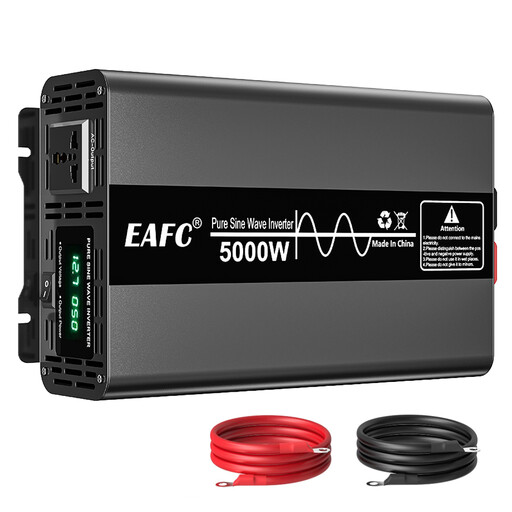
Why It Stands Out: With a substantial 2500W of continuous power and a 5000W peak, this inverter is built for demanding tasks. It delivers exceptionally clean power with low harmonic distortion, making it safe for even the most delicate equipment. Its robust construction and comprehensive set of safety protections (including over-temperature, overload and short circuit) provide peace of mind during heavy use.
Pros:
Who is it for? This is an ideal choice for caravan owners, tradespeople and anyone setting up a serious off-grid power supply who needs to run power tools, kitchen appliances or other high-wattage devices.
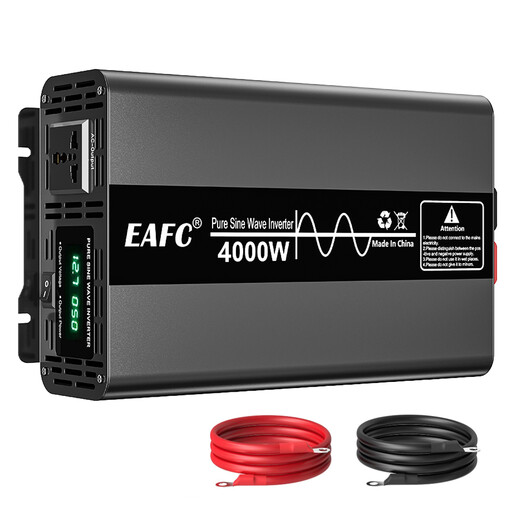
Why It Stands Out: This model offers a great balance of power and advanced technology. Its amorphous silicon core contributes to higher conversion efficiency, meaning less battery power is wasted as heat. The dual turbine cooling fans operate automatically to maintain performance under load, while the universal socket accepts standard plugs without needing an adapter.
Pros:
Who is it for? A versatile workhorse perfect for a camping power inverter or for use in a work truck. It can comfortably run a mix of electronics, small kitchen appliances and mid-range power tools.
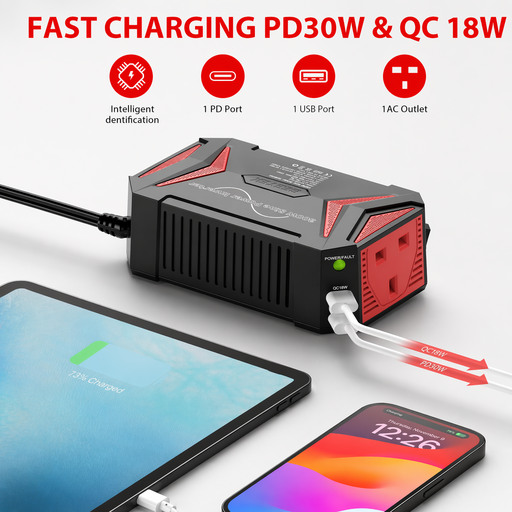
Why It Stands Out: For those who prioritise portability and device charging, this compact inverter is an excellent solution. It plugs directly into your vehicle's 12V socket and not only provides a 230V AC outlet but also features modern USB ports: a PD 30W Type-C and a QC 3.0 USB-A. This allows for fast charging of the latest smartphones, tablets and even some laptops without needing their bulky power bricks.
Pros:
Who is it for? The perfect car power inverter for commuters, sales reps and families on a road trip who need to keep laptops, cameras and phones charged and ready to go.
Everyone's power requirements are different. If the models above aren't quite what you're looking for, or if you need a different power capacity, there are many other solutions available. From small, portable units to powerful systems for complete off-grid living, finding the right fit is key.
Explore our full range of Power Inverters to find the ideal match for your vehicle and devices.
You can run almost any device that you would plug into a standard home outlet, as long as its wattage is within the inverter's continuous power rating. This includes sensitive items like laptops, TVs, CPAP machines, game consoles and camera chargers, as well as general appliances like lights, fans and small kitchen gadgets.
It is highly recommended. Modern caravans and campers are often equipped with electronics like flat-screen TVs, microwave ovens with digital controls and high-efficiency fridges. A pure sine wave RV inverter ensures these appliances function correctly, efficiently and without risk of damage, providing a reliable home-away-from-home experience.
To determine the right size, add up the wattage of all the devices you intend to use simultaneously. This information is usually found on a sticker or plate on the appliance itself. Choose an inverter with a continuous power rating that is at least 10-20% higher than your total calculated wattage. This provides a safety margin and ensures the inverter isn't constantly running at its maximum limit.