
24/7 Customer Support

Free returns

Same-day & Next-day Delivery

Quality Guaranteed

Unlock Your Welcome Offers: FREE Delivery | Up to 80% OFF | Free 30-day JoyPlus trial
Download the APP
As a cat owner, you know the signs all too well: clumps of fur on the sofa, a coat that looks duller than it should and the unpleasant discovery of a hairball on the carpet. Navigating the cat food aisle to find a genuine solution can be a challenge. Many products make bold promises, but not all deliver. Before you make a choice, it's important to understand the common pitfalls that can lead to a disappointing purchase.
dry cat food for a shiny coat must contain specific, high-quality Omega-3 and Omega-6 fatty acids to nourish the skin from within. Without these, you are simply paying for a promise, not a result.hairball control cat food will use a specific blend of fibres designed for this purpose.To make an informed decision, focus on the objective details on the label. Here are the core parameters that separate a well-formulated diet from an ineffective one.
Not all fibre is created equal. For effective hairball management, a food needs a sophisticated blend of soluble and insoluble fibres. Look for ingredients like dried beet pulp, dried vegetable fibre and chicory root. This type of cat food with fibre doesn't just add bulk; it helps to gently capture ingested hair and move it smoothly through the digestive tract, reducing the likelihood of hairballs forming in the stomach. A crude fibre content of around 4-6% is often indicative of a formula designed for this purpose.
A healthy coat is built from the inside out. The primary ingredient should always be a high-quality, named animal protein, such as in a chicken cat food for hairballs. This provides the essential amino acids necessary for strong, healthy hair follicles, which can help manage cat food for shedding. Equally important are Omega-3 and Omega-6 fatty acids. These are crucial for maintaining the skin's natural moisture barrier, leading to supple, healthy skin and a visibly glossy coat. Look for these listed clearly in the nutritional information.
Modern feline nutrition recognises the strong link between digestive health and overall wellbeing, including skin and coat condition. Formulations like the Purina Bifensis cat food range include beneficial ingredients to support the gut. This often involves prebiotics like chicory to nourish good bacteria and, in some advanced formulas, heat-treated probiotics (or postbiotics) like Lactobacillus. A balanced gut microbiome improves nutrient absorption, strengthens natural defences and contributes to a healthier appearance.
Based on these criteria, we have identified several products that align with the needs of different cat owners in the UK.

Why This Fits Their Persona: This is for the owner actively seeking a targeted, all-in-one solution for both hairballs and a lacklustre coat. It's a specialised diet designed to address these specific issues head-on.
It moves beyond vague claims with a 6.0% crude fibre content and lists Chicken (17%) as the number one ingredient, ensuring high-quality protein and a functional fibre blend.
Features the Bifensis formula with heat-treated Lactobacillus and prebiotic chicory to support gut health, which is directly linked to nutrient absorption for a better coat.
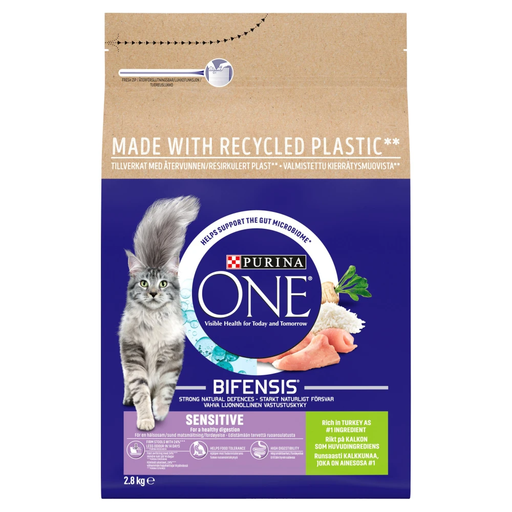
Why This Fits Their Persona: Ideal for owners of cats with delicate digestion or fussy appetites who still want the benefits of a diet that supports healthy skin and coat.
This formula is made with highly digestible ingredients like Turkey (18%) and rice, and contains no added wheat. It delivers coat benefits with specified Omega 3 & 6, not just generic fats.
It is specifically formulated for high digestibility to promote firm stools. According to Purina, it can lead to 24% less stool odour in 14 days, while also supporting skin and coat health.

Why This Fits Their Persona: A great choice for owners who prioritise natural, high-quality ingredients for general health maintenance, with a particular focus on coat condition derived from a premium protein source.
It uses premium Scottish salmon meal (30%) as a primary ingredient, a natural source of Omega-3, rather than relying on generic additives. The formula is also grain-free, avoiding common fillers.
The high salmon content provides a rich, natural source of Omega-3 fatty acids (≥0.8%) to nourish the skin and coat. The crunchy kibble also helps with dental hygiene.
We have compiled a complete, real-time list of products that fully satisfy these strict selection criteria and UK safety regulations.
While every cat is different, you can typically expect to see improvements in coat glossiness and a reduction in shedding within 2 to 4 weeks of consistently feeding a specialised diet. For hairball frequency, results can also appear in a similar timeframe as the fibre begins to work effectively. According to Purina's own observations on their Coat & Hairball formula, visible results may be seen in just 14 days.
A gradual transition is always recommended to avoid digestive upset. Over a period of 7 to 10 days, gradually mix the new food with your cat's old food. Start with 25% new food and 75% old food, and slowly increase the proportion of the new food until you have fully switched over.
Yes, for most healthy adult cats, a diet with a functional fibre blend is perfectly suitable for long-term feeding. It supports ongoing digestive health and helps manage hairballs continuously. However, if your cat has a history of specific digestive health issues or you have any concerns, it is always a good practice to consult with your veterinarian.