Multitrack editors needing a clearer timeline
If you regularly move between recorded takes, tracks and DAW panels, the question is how much of that workspace you can see while keeping waveforms and controls readable.


A 27-inch QHD monitor can provide enough room to align multitrack takes if your usual DAW layout remains comfortable to read. Choose 4K when you need more display pixels for tracks and adjacent panels, but check interface scaling and computer support; for either resolution, make sure you can position the screen properly and verify any USB-C laptop connection before relying on one cable.
If you regularly move between recorded takes, tracks and DAW panels, the question is how much of that workspace you can see while keeping waveforms and controls readable.
If your desk also holds an audio interface, storage and other peripherals, a compatible USB-C display connection may simplify the laptop setup. Its charging capability still needs to match your laptop.
If you edit for extended periods, check whether the stand or a compatible mount lets you place the screen at a suitable height and distance, not just whether the panel has enough pixels.
Choose the resolution around the DAW layout you actually use. USB-C and colour features can then be assessed separately; neither is a substitute for a readable timeline or a screen you can position comfortably.
Choose it when: Your tracks and waveform detail fit comfortably within a 2560 × 1440 DAW layout.
Trade-off: At the same screen size, QHD has fewer display pixels than 4K for tracks and adjacent windows.
Choose it when: You need more pixel-level room for a dense timeline and other DAW panels on one screen.
Trade-off: Check how readable your DAW remains at your preferred scaling and whether your computer supports the intended display mode.
| Concern | What to check | Who this matters to |
|---|---|---|
| Timeline space | Compare native resolution at the same screen size, then view your DAW at the scaling you intend to use. | When I work across many takes, I want enough visible room to inspect waveforms without losing sight of nearby tracks. Around 40% of consumers would put timeline space first. |
| Screen position | Check stand adjustments or VESA mounting against your desk and seated eye level. | For long editing sessions, I need to place the display where I can work comfortably rather than accept the stand's default height. Screen position would be the leading concern for around 30% of consumers. |
| Laptop connection | Match the monitor's USB-C display and power-delivery capabilities, and the required cable, to your laptop. | If I move my laptop between workspaces, I want fewer connections to manage without assuming that any USB-C port will charge it. Around 20% of consumers would prioritise the laptop connection. |
| Companion visual work | Check the exact model's stated colour space against the requirements of your video or graphics work. | I also prepare colour-sensitive visuals, so their requirements affect my monitor choice even though colour features do not align audio takes. That would be the primary concern for around 10% of consumers. |
A detailed panel is harder to fit into a long-session workspace if you cannot position it suitably. The Health and Safety Executive advises placing the screen directly in front of you, about an arm's length away, with its top level with your eyes.
Check the exact stand adjustments or VESA mounting specification rather than relying on product photos.
If the supplied stand does not suit your desk, positioning the screen may require a separate riser or compatible arm.
USB-C power delivery and display capabilities differ between monitor models. The connection also depends on the laptop and cable.
Compare your laptop's charging and external-display requirements with the monitor's stated capabilities, and confirm the cable needed for that arrangement.
Wide-gamut and calibration specifications concern visual work; they do not establish more accurate alignment of audio transients.
For audio-only editing, assess the usable timeline, screen position and connections first. Consider colour requirements if you also produce video or graphics.
A product page or search result does not establish live availability for the exact monitor revision you want.
Check availability, warranty terms and the full model number when purchasing. If a revision differs, compare its resolution, connections and stand before substituting it.
These model-level examples show how QHD, 4K, connectivity and stand options can differ; a brand name alone does not establish the specification of another model.
The PD2705Q illustrates a 27-inch QHD option with USB-C connectivity and an adjustable stand.
The UltraSharp U2724D illustrates an adjustable 27-inch QHD office display.
The 27UP850K-W illustrates a 27-inch 4K option with an adjustable stand and USB-C connectivity.
The ProArt PA279CRV illustrates a 27-inch 4K USB-C display whose colour features are relevant when audio editing is combined with visual work.
These monitors cover QHD and 4K workspace choices for a home-office DAW. Compare each exact model's connections and physical adjustments against your laptop and desk rather than treating similar resolutions as interchangeable setups.
 No image available
Consider this for a 4K DAW workspace if its Mac-focused features suit your computer.
The title specifies an IPS panel, USB-C and a height-adjustable stand. Check the required cable and your computer's display and charging compatibility before planning a one-cable setup.
 No image available
Its 4K resolution may suit a dense timeline; decide separately whether its smart-display features matter to your setup.
The title specifies IPS, Google TV and USB-C 65W power delivery. Check whether your laptop supports the intended display connection and whether 65W meets its charging needs.
 No image available
Consider this QHD model if your usual DAW layout does not call for 4K-level pixel detail.
Check its exact stand adjustments for your desk. If you want laptop charging through the monitor, confirm the regional USB-C configuration and power-delivery rating for this model.
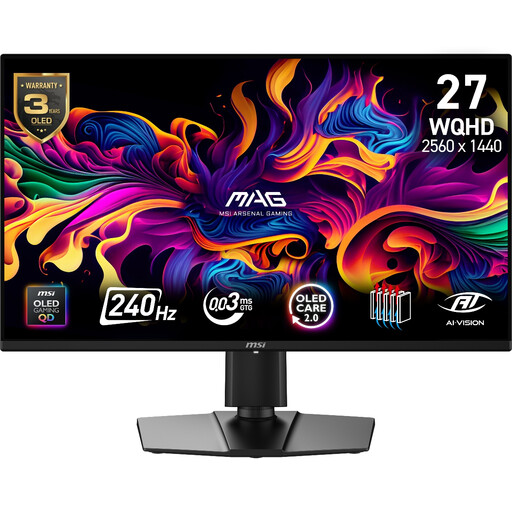 No image available
Assess this for a QHD timeline if you also have a reason to choose its QD-OLED panel; gaming features alone do not establish an audio-alignment benefit.
The title specifies 2560 × 1440 and 240 Hz. Check the screen's physical size against your available desk space and whether its USB-C charging meets your laptop's needs.
 No image available
Consider this for a 4K timeline when HDMI or DisplayPort suits your computer connection.
The title specifies 60 Hz and built-in speakers. Check your computer's 4K output and preferred DAW scaling, and confirm the exact connection arrangement if you need USB-C laptop charging.
No: a 27-inch QHD monitor can suit an audio-focused DAW setup when its timeline and controls remain readable. Consider 4K if you need more pixel-level room for tracks and adjacent windows, not because resolution itself improves audio timing accuracy.
Check the exact monitor's USB-C display capability and power-delivery rating against your laptop's external-display and charging requirements. Confirm the required cable too: LG specifies use of its included USB-C cable for the stated connection arrangement on the 27UP850K-W.
Place it directly in front of you, about an arm's length away, with the top of the screen level with your eyes, as the Health and Safety Executive advises. Check that the chosen stand or a compatible mount can achieve that position with your desk and chair.
Yes, it can: the Health and Safety Executive identifies people who work on display screen equipment at home daily for continuous periods of an hour or more as DSE users. If that describes your employed work, discuss your home-workstation setup with your employer rather than assuming a particular monitor specification is required for everyone.