
24/7 Customer Support

Free returns

Same-day & Next-day Delivery

Quality Guaranteed

Unlock Your Welcome Offers: FREE Delivery | Up to 80% OFF | Free 30-day JoyPlus trial
Download the APP
Buying one of the many QLED Smart TVs available in the UK can be confusing. Product listings often highlight quantum-dot colour, HDR, high refresh rates and smart platforms, but these terms do not tell the whole story.
A television with an impressive specification sheet may still be unsuitable for your room, games console or viewing habits. The practical approach is to compare the panel type, screen size, connections, smart platform and sound features together.
QLED describes the use of quantum-dot technology to enhance colour reproduction. It does not automatically mean the television has a 4K resolution.
For example, a compact model may be a Full HD QLED TV, while many 43-inch TV, 55-inch TV and larger models offer 4K Ultra HD resolution. Check the actual pixel count:
A 40-inch QLED TV for a bedroom may not need 4K, but a 75-inch or 85-inch TV benefits from the additional detail, particularly when viewed from a closer distance.
A television may list a native refresh rate, motion processing rate and gaming accelerator figure. These are different specifications.
A 144Hz TV or 165Hz TV can be useful for compatible PC gaming and fast-moving sports, but a console and HDMI connection must also support the required signal. Look for HDMI 2.1, VRR and ALLM if gaming is a priority. A model with a 50Hz or 60Hz native panel can still be suitable for films and everyday television, but it may not be the right choice for competitive gaming.
The operating system affects navigation, voice control, streaming services and catch-up viewing. Google TV, Tizen, VIDAA, webOS and TiVo OS each offer different interfaces and app libraries.
UK shoppers should check whether the services they use are available, including Netflix, Disney+, YouTube, Prime Video and UK live-TV options. A TV with Freely Smart TV functionality can provide live and on-demand channels over Wi-Fi, but your broadband connection still needs to be reliable.
QLED uses a quantum-dot layer to produce a wider range of colours. It is still commonly paired with LED backlighting.
A Mini LED TV uses many smaller LEDs and local dimming zones to control brightness across different areas of the screen. This can improve contrast between bright highlights and dark scenes. However, the number of dimming zones, processing system and panel design also affect the result, so do not compare Mini LED and standard QLED using the technology name alone.
An HDR Smart TV can display compatible high dynamic range content, but formats vary. Common standards include HDR10, HLG, HDR10+ and Dolby Vision.
Check the formats supported by your streaming services, games and film collection. Screen brightness also matters, especially in a bright UK living room. A specification such as 230 cd/m² indicates a relatively modest brightness level, while Mini LED models are generally designed for stronger highlight performance. Brightness figures should be treated as specifications rather than a guarantee of identical real-world results across all content.
Measure the available wall or furniture before ordering. Remember to check both the television dimensions and the stand width.
Useful starting points include:
For wall mounting, check the VESA pattern, wall strength, viewing height and cable access. Large-screen TV models can be heavy and may require two-person installation.
Built-in speakers vary considerably. A television with Dolby Atmos support may process compatible audio, but the effect depends on the speaker arrangement and room. A 2.1-channel system with a dedicated subwoofer can provide more bass than basic stereo speakers.
Also count the connections you need. Four HDMI inputs may be useful for a console, soundbar, streaming box and Blu-ray player. Check whether eARC is available if you intend to connect a compatible soundbar.
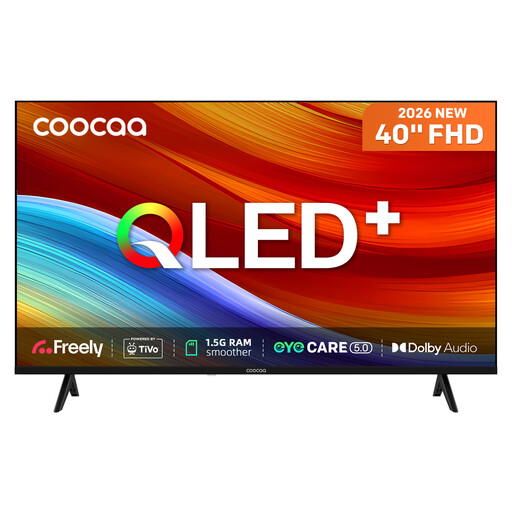
Why This Fits Their Persona: A compact option for a bedroom, studio or smaller lounge, with built-in Freely access over Wi-Fi and Full HD resolution.
Its listing clearly states Full HD rather than implying 4K, while HDR10, HLG and a triple tuner provide useful everyday flexibility.
40-inch screen, TiVo OS, Freely, Dolby Audio, two HDMI inputs and two USB ports.
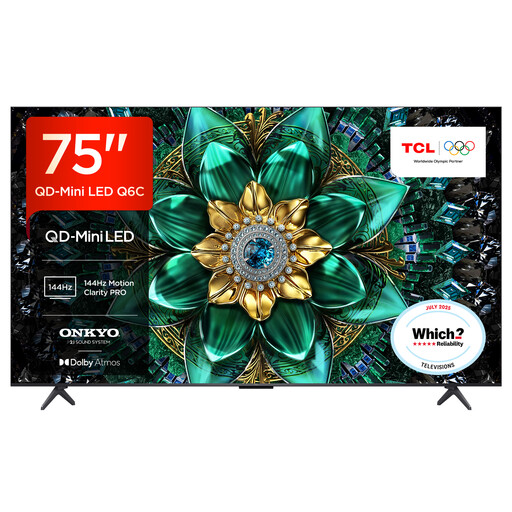
Why This Fits Their Persona: Suited to a spacious lounge where 4K detail, local dimming and a large viewing area are important.
The specification identifies QD-Mini LED, QLED, 4K HDR and up to 512 local dimming zones, making the backlight design clearer than a generic HDR label.
144Hz native refresh rate, Google TV, HDMI 2.1, Dolby Atmos and Onkyo audio on the 75-inch version.
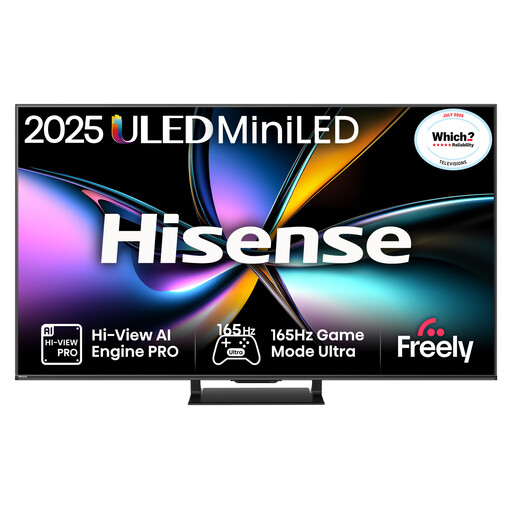
Why This Fits Their Persona: Designed for households combining films, sport and console or PC gaming on one screen.
Its gaming specification separates native 165Hz refresh, VRR, ALLM and HDMI 2.1 rather than relying only on motion-processing terminology.
4K Mini LED, Dolby Vision IQ, HDR10+ Adaptive, 2.1.2-channel Dolby Atmos audio and four HDMI 2.1 ports.
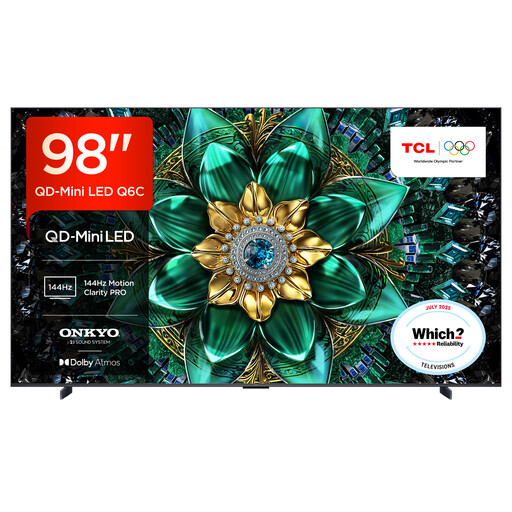
Why This Fits Their Persona: A substantial screen for wide seating layouts, film nights, sports viewing and a dedicated media room.
The product details state its dimensions, 4K resolution, QD-Mini LED design and mounting compatibility, helping buyers assess whether it fits their room before ordering.
144Hz VRR, four HDMI 2.1 ports, Google TV, Wi-Fi 6 and 40W Onkyo 2.1 audio with Dolby Atmos support.
We have compiled a complete, real-time list of products that fully satisfy these strict selection criteria and UK safety regulations.
They can be, but check the detailed gaming specification. For current consoles, prioritise 4K resolution, HDMI 2.1, ALLM and VRR. A 120Hz or higher panel is useful for compatible games, while 144Hz and 165Hz models are more relevant to gaming PCs and supported input sources.
Energy use depends on screen size, brightness, HDR content and viewing hours. Larger screens generally consume more electricity. Compare the product’s UK energy label and stated kWh figures, then use energy-saving modes where practical. A smaller 43-inch TV may cost less to run than a 75-inch TV, even when both use similar display technology.
Not always. Streaming services work over Wi-Fi or Ethernet, and some models include Freely for live and on-demand television through broadband. However, built-in tuners remain useful for aerial, cable or satellite reception. Check the tuner type and the availability of the services you intend to use before removing an existing aerial connection.