Choose the keyboard around the part of quest-map design that most affects your work: typing position, repeated shortcuts, room for other tools or dedicated keys for numeric entry. Start with the workstation: the Health and Safety Executive advises placing the keyboard just below elbow height and centrally with the screen. Then weigh a familiar ergonomic layout against the setup involved in a programmable board, or a compact layout against the dedicated keys you use.
Who is this for?
Standing-desk comfort prioritiser
If you spend long stretches typing map labels, descriptions or notes, begin with keyboard position rather than its shape alone. The Health and Safety Executive advises keeping the keyboard just below elbow height and central to the screen; check that the arrangement works at the desk heights you use.
Shortcut-heavy map designer
If you repeatedly switch tools, layers or symbols, programmable keys may matter more than a familiar office layout. Keychron and Kinesis describe remapping or programmable functions on the models discussed below; check that your map software and operating system support the commands you intend to assign.
UK-layout and numeric-entry user
If you often enter coordinates or quantities, decide whether you need a dedicated numpad before choosing a compact board. Keychron lists a full-size UK-ISO Q6 Max and a compact UK-ISO K3 Max variant, so check the exact layout and size offered on the listing.
What matters when choosing?
These keyboard designs solve different parts of the same desk setup. Choose a layout for the work you do most often, then check whether it fits your standing and seated positions.
Familiar split ergonomic keyboard
Consider it when: You want a familiar full-size layout with some adjustment for seated and standing use. Logitech describes a curved split keyframe, integrated numpad and palm-lift positions on the ERGO K860.
Trade-off: Its one-piece, full-size design takes more desk width than a compact board, and it is not the route to choose for extensive QMK/VIA remapping.
Compact programmable keyboard
Consider it when: You want space beside the keyboard for a mouse or map references and are prepared to configure shortcuts. Keychron describes the UK-ISO K3 Max as a low-profile 75% board with QMK/VIA support.
Trade-off: Check how you will reach keys that a full-size layout keeps dedicated, particularly if you enter numbers frequently.
Full-size programmable keyboard
Consider it when: Dedicated numeric keys are central to entering coordinates or quantities, but you also want remapping. Keychron lists a full-size UK-ISO Q6 Max with QMK/VIA support.
Trade-off: Allow enough desk width for the keyboard and your mouse or other map-design tools.
Adjustable contoured split keyboard
Consider it when: Separating and angling the two halves is a priority and you are willing to learn a different key arrangement. Kinesis describes independently adjustable modules and programmable functions on the Advantage360.
Trade-off: The unfamiliar contoured layout takes adaptation; its shape is not a treatment for pain or a replacement for adjusting the workstation.
| Concern |
What to check |
Who this matters to |
| Typing position |
Can you place the keyboard just below elbow height, centrally with the screen, at the desk heights you use? |
If extended typing while standing leaves me adjusting my shoulders or reaching awkwardly, workstation fit comes first; around 33% of consumers would put typing position first. |
| Shortcuts and layers |
Check remapping support for your operating system and map software, and how you will access your frequent commands. |
When I repeatedly change tools or enter labels, I want my usual commands within easy reach; roughly 27% of consumers would prioritise shortcut workflow. |
| Desk space and connections |
Measure the keyboard-and-mouse area and check which connection options suit your devices. |
I need room for a mouse, tablet or reference sheets alongside the keyboard; about 20% of consumers would make workspace flexibility their primary concern. |
| UK layout and numeric keys |
Confirm the exact variant says UK-ISO if needed, and decide whether a dedicated numpad earns its desk space. |
If coordinates and quantities are a regular part of my work, I want the right key positions and ready access to numbers; around 20% of consumers would put layout and dedicated keys first. |
Mistakes to avoid
-
Expecting a keyboard to fix the whole desk setup
Keyboard shape cannot compensate for a workstation that puts the keys too high or makes you twist towards the screen. The Health and Safety Executive advises considering the whole workstation, including equipment and furniture.
Adjust the desk and screen arrangement, then choose a keyboard you can place just below elbow height and centrally with the screen.
-
Choosing a compact layout without checking your keys
A 75% board leaves more desk width available, but it does not provide every dedicated key found on a full-size board. That matters if your map-design routine relies on navigation or numeric entry.
Note the commands and keys you use regularly. Choose the compact layout only if accessing omitted keys through layers suits that routine.
-
Assuming any ISO variant has a UK layout
Keychron lists UK-ISO alongside other regional ISO variants. The word ISO alone does not identify the key labelling you will receive.
Check the selected product configuration and its layout image for UK-ISO before ordering.
-
Treating an ergonomic shape as treatment
A specialised split keyboard changes the typing arrangement and takes time to learn. The NHS notes that repetitive activities such as typing can be associated with repetitive strain injury; a keyboard specification cannot establish a treatment outcome.
Assess how the keyboard fits your workstation. If symptoms persist or worsen, seek appropriate medical advice and, where relevant, raise the workstation setup through your workplace process.
Brands to consider for these keyboard designs
Logitech
Logitech offers familiar office-oriented ergonomic designs, including the ERGO K860 and Wave Keys.
- Logitech describes a curved split keyframe, integrated numpad and palm-lift settings for seated or standing use on the ERGO K860.
- The Wave Keys has a wave-shaped layout and cushioned palm rest, but neither design is presented here as a substitute for extensive firmware-level customisation.
Keychron
Keychron offers both compact and full-size UK-ISO mechanical keyboard variants relevant to shortcut-heavy work.
- Keychron lists QMK/VIA support and wired, Bluetooth and 2.4 GHz connection options for the K3 Max and Q6 Max models discussed here.
- Check the exact switch and regional-layout variant before ordering; a compact K3 Max also changes access to keys that a full-size Q6 Max keeps dedicated.
Kinesis
Kinesis makes specialised split contoured keyboards for people willing to adjust their key positioning and learn a different layout.
- Kinesis describes separable, rotatable modules, three tenting heights and programmable functions on the Advantage360.
- Its contoured arrangement requires more adaptation than a conventional keyboard; consider that learning time alongside its adjustability.
Joybuy product choices for a compact desk setup
These wireless keyboards are relevant if you want to keep desk space available for map-design tools. Check their exact layouts and shortcut-software compatibility against your workflow; neither product choice replaces positioning the keyboard at a suitable height.
 No image available
HyperX Alloy Rise 75 Wireless Keyboard UK
Consider this for map-design work if you want a wireless keyboard while keeping room for other desk tools. Check the exact physical key layout and whether its key-assignment software works with your operating system before relying on custom shortcuts. Test whether its position and angle suit your standing-desk setup.
View on Joybuy
 No image available
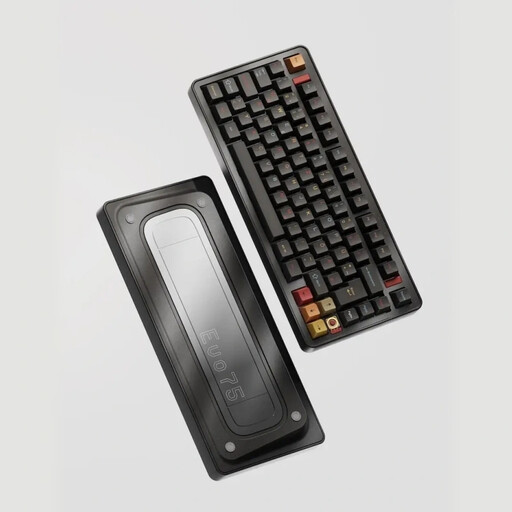
Ticktype EVO75, US layout, Creamy Rye switches, Spray-coated Nebula
Consider this for a shortcut-led map-design setup only if a US layout suits your typing and symbol entry. Its product name specifies tri-mode wireless use, hot-swappable switches, VIA compatibility and an 8000mAh battery. Check operating-system support for the key-mapping functions and whether its position works at your desk height before depending on either for daily work.
View on Joybuy
Common questions
How should I position a keyboard at a standing desk?
Place it just below elbow height and centrally with the screen, as the Health and Safety Executive advises. Check the arrangement when standing and sitting rather than assuming that a keyboard shape alone will make both positions work.
Do I need an ergonomic keyboard because I work standing up?
No particular keyboard shape follows from standing alone. Start with the height and position of the whole workstation, then consider a split, wave-shaped or adjustable board if its layout suits how you type; manufacturers’ comfort claims do not establish how it will fit every user.
Should I choose a UK-ISO or US-layout keyboard?
Choose the physical layout that fits your usual typing and symbol-entry habits unless you intend to change them. Check the exact variant shown on the listing: a keyboard family may include several ISO versions, while a US layout places some keys and symbols differently from UK-ISO.
Can an ergonomic keyboard treat wrist or hand pain?
A keyboard’s features do not establish that it will treat pain. The NHS notes that repetitive activities such as typing can be associated with repetitive strain injury; seek medical advice if symptoms are not improving or are getting worse, and consider a workplace workstation assessment where applicable.


