Who needs which type of airflow?
Start with where the air needs to go: towards one seated position, around a longer work session or beyond the desk.
Desk-bound hobbyists
If tools, a work mat or a monitor already occupy the desk, check the fan’s base dimensions and whether its head can be aimed without moving the whole unit. A compact tabletop format is most relevant when airflow is needed near one seat.
Quiet-session makers
For painting, building, reading or recording over longer sessions, adjustable low-speed airflow may matter more than a maximum-output claim. Compare noise figures only with their stated operating modes.
Small-room circulation seekers
When air needs to move beyond the chair, consider horizontal movement, vertical aiming and whether the fan belongs on the desk or elsewhere in the room. A wider-moving airflow pattern does not, by itself, establish how a model will perform in your room.
What should you check before choosing?
Decide where the fan can sit and how far its airflow needs to move, then assess noise at the setting you are likely to use. The proportions below relate to consumers grouped by their main desk-circulation priority; each row describes a different primary need.
| Concern |
What to check |
Who this matters to |
| Desk space and direction |
Compare the base dimensions with clear desk space; check tilt and the route for the cord. |
If my work mat and tools must stay in place, I need a fan I can position and aim beside them. Roughly 36% of consumers put desk space and directed airflow first. |
| Distraction during long sessions |
Check which speed or mode applies to any stated sound level, and whether lower airflow settings are available. |
When I am concentrating or recording, I want a gentle setting without assuming the fan is equally quiet at full speed. Around 29% of consumers make low-distraction use their main priority. |
| Airflow beyond one seat |
Look for horizontal movement, vertical aiming and a placement height that suits the room. |
If air needs to move around more than my chair, a fixed stream aimed at me may not meet that need. For roughly 21% of consumers, wider circulation comes first. |
| Safe placement and cleaning |
Review the model’s cleaning instructions and guard design; assess hobby materials that could create a hazardous atmosphere. |
With loose materials near my workspace, I need a stable position and a practical way to keep the fan clear. Around 14% of consumers prioritise maintenance and suitability for their hobby materials. |
Brands to consider
These ranges illustrate different desk and room-placement options; the features described apply to the named models, not every fan from each brand.
Meaco
Meaco offers desk and pedestal air circulators relevant to a choice between keeping the fan beside the work area and moving it off the desk.
- Meaco specifies 12 speeds and automatic horizontal and vertical oscillation for the MeacoFan 1056. It describes airflow up to 24 m and noise as low as 29 dB; neither figure should be read as applying to every setting.
- The MeacoFan 1056P moves the unit onto an adjustable pedestal, stated as 820–955 mm high, but its floor base and cable still need a suitable position.
Dyson
The Dyson Cool CF1 is a bladeless desk-fan option for consumers prioritising its exposed-surface design and directional controls.
- Dyson specifies manual tilt and 70° oscillation for the CF1, along with a 1.8 m cord.
- Dyson’s 29 dBA Quiet Mode figure differs from its stated 42 dBA maximum sound level; compare the mode you expect to use.
Vornado
Vornado lists compact personal fans, tabletop circulators, pedestal fans and larger room-circulation models.
- The range gives consumers formats to compare when deciding between desk placement and a separate room position.
- Vornado’s cited catalogue is US-facing. Confirm the appropriate electrical version, warranty and local availability for any particular model before buying.
Joybuy desk-fan choices
These portable desk-fan choices suit consumers considering airflow close to a hobby workstation. Check direction, noise and running time separately if the fan also needs to serve longer quiet sessions or circulate air farther across the room.
 No image available
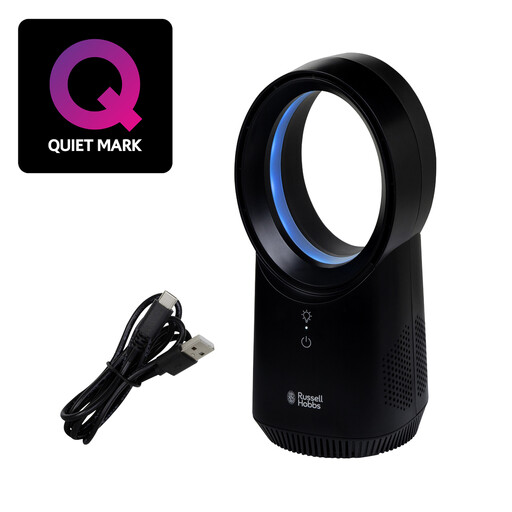
Russell Hobbs RHBLDLUSB25B Compact Wireless Bladeless Desk Fan, Black
Consider this for a desk where a rechargeable, bladeless fan can sit near the work area. The listed variant has three speed settings and USB charging; check its dimensions, directional movement, noise at each speed and runtime against your intended use.
View on Joybuy
 No image available
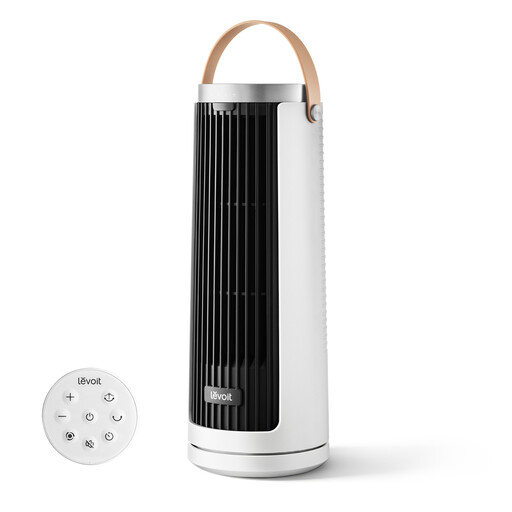
Levoit Windi Mini Plus Portable Tower Fan
Consider the portable tower format if you want a fan positioned on the desk without a conventional round head. The listed variant has USB Type-C recharging and multiple airflow modes; check its dimensions, aiming or oscillation controls, sound conditions and battery runtime before choosing it for long sessions.
View on Joybuy
Frequently asked questions
Can a desk circulator replace extraction for hobby fumes or dust?
No: moving room air does not establish that fumes or process dust are being captured or removed. The Health and Safety Executive distinguishes general ventilation from controls for harmful substances; assess the materials and process separately rather than relying on a desk fan as extraction.
Is an ordinary fan suitable if my hobby produces flammable vapours or combustible dust?
Do not assume it is suitable. The Health and Safety Executive says electrical equipment in potentially explosive atmospheres must be specially designed and constructed to reduce ignition risk; establish the hazards and obtain competent advice on appropriate equipment before use.
Does a 29 dB claim mean a fan stays that quiet at every speed?
No. Meaco describes 29 dB as a low figure for the MeacoFan 1056, whereas Dyson specifies 29 dBA for the Cool CF1 in Quiet Mode and 42 dBA maximum. Check the stated speed or mode and measurement basis before comparing sound claims.
How should I move or clean a desk fan?
Unplug it first and follow its model-specific instructions. The Honeywell HT900E instructions call for a stable surface and warn users to keep fingers, hair and loose clothing away from its grille and blades; another model may have different cleaning requirements.
What electrical-safety rules matter for a mains fan supplied in Great Britain?
Electrical equipment supplied in Great Britain is subject to requirements under the Electrical Equipment (Safety) Regulations 2016, according to the Office for Product Safety and Standards. Check the documentation and suitability of the exact product being offered; Great Britain guidance should not be assumed to describe the rules applicable in Northern Ireland.


