Shared-room simulation players
If you play long sessions near flatmates, switch sound deserves attention alongside the game controls. Corsair’s shared-space guidance notes that the complete keyboard construction affects what others hear.


For economic-simulation play in a shared student room, start with a compact keyboard that retains the keys you use and has a non-clicky switch option. Check the exact UK layout and switch before ordering; wireless connections and programmable controls matter most if you switch devices or regularly use the same shortcuts.
If you play long sessions near flatmates, switch sound deserves attention alongside the game controls. Corsair’s shared-space guidance notes that the complete keyboard construction affects what others hear.
If coursework, a mouse and a keyboard share limited space, a compact layout may help—but check which keys remain easy to reach. Keychron’s K2 Max illustrates a 75% UK-ISO option with remapping and several connection modes.
If you repeatedly use game or study commands, decide whether remapping existing keys is enough or whether you want separate macro controls. Keychron and Logitech G describe remapping options, while Razer’s BlackWidow V4 has dedicated macro keys.
For economic simulations in a student room, decide whether disturbance to others, desk fit or repeated commands would have the greatest effect on your choice.
| Concern | What to check | Who this matters to |
|---|---|---|
| Shared-room noise | Check the fitted switch and any sound-dampening construction; listen to the exact keyboard if possible. A damped case alone does not establish how quiet it will be. | When I play near flatmates in the evening, I want keystrokes that are less likely to disturb them; around 42% of consumers put room noise first. |
| Desk fit and key access | Compare the layout with the space available for your mouse. Check for the number pad, function row, arrows and UK key arrangement you use. | If my coursework and mouse share a small desk, I need space without losing important keys; around 33% of consumers prioritise desk fit and key access. |
| Shortcuts and connections | Identify commands you would remap, then check the exact model’s configuration method and connection options. | For repeated simulation commands or switching between study devices, I want controls that suit my routine; roughly 25% of consumers make control flexibility their main concern. |
Switch style, construction and typing force all affect the sound that reaches someone sharing your room. Sound-dampening features do not make a board silent.
Look for a non-clicky switch option and, if possible, listen to the exact switch and keyboard combination before choosing it for late-night use.
A smaller keyboard leaves more room for a mouse but may remove the dedicated number pad or put some commands on key layers.
List the keys you use in simulations and coursework, then compare that list with the exact layout image and manual.
Different regional variants can have different physical key positions and legends.
Check the selected variant for UK-ISO or UK Layout at checkout if that arrangement matters to your typing.
Remapping is useful only if it fits your actual commands and setup. Configuration may require software or a wired connection, depending on the model.
Pick two or three shortcuts you would use, then check how the exact keyboard lets you assign them.
Keychron’s K2 Max is a compact 75% option for buyers who want a UK-ISO variant and configurable keys.
The G515 range illustrates slim tenkeyless keyboards for buyers weighing desk space, switch feel and configurable controls.
Razer offers distinct options for buyers considering dedicated controls or a low-profile UK-layout tenkeyless keyboard.
These keyboards offer different ways to balance desk space, key access and connections for study and simulation play. Check each model’s layout and switch where shared-room noise or familiar UK key placement is important.
 No image available
Consider its 96% layout if you want a number pad without choosing a conventional full-size layout.
Confirm the fitted switch before choosing it for a shared room; sound-dampening construction alone cannot establish how it will sound in use.
 No image available
The 75% format is worth considering when your mouse and study materials need room beside the keyboard.
Confirm the physical UK key arrangement before ordering; the layout wording alone is not enough to identify the exact key placement. Check the fitted switch if room noise is a priority.
 No image available
Its 68-key format may appeal when desk space takes priority over a larger set of dedicated keys.
The title specifies Bluetooth 5.1 and wired use. Its US QWERTY layout differs from a UK arrangement, and the switch name alone does not establish its noise level.
 No image available
The 75% layout suits a desk where you want to leave space beside the keyboard.
The title lists wired, Bluetooth and 2.4 GHz connection modes and PBT keycaps. Check whether its US QWERTY layout suits you, and assess the fitted switch rather than treating sound-related wording as a noise measurement.
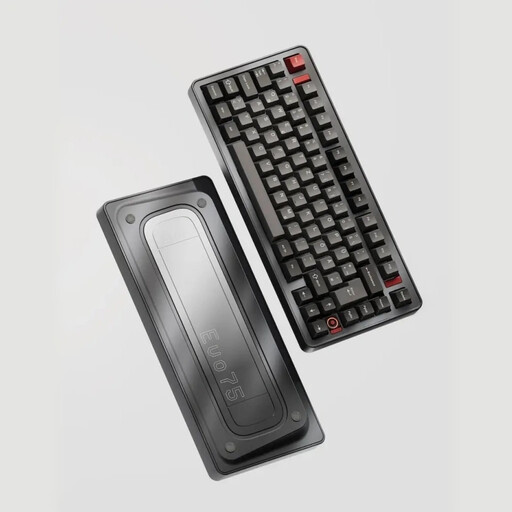 No image available
Consider the 75% format if desk space and switching connection modes matter to you.
The title specifies a full-aluminium, hot-swappable design. Check which software supports remapping on this SKU before relying on a particular app, and make sure its US layout suits your typing.
Start with non-clicky options if disturbing someone nearby is a concern. Corsair’s shared-space guidance describes linear mechanical switches as generally quieter than tactile ones, but the case, damping and how you type also affect the final sound; Razer describes its Orange option as tactile and quiet and its Yellow option as smooth and silent.
Choose a UK layout if you want the familiar UK key arrangement and legends. Keychron identifies a UK-ISO K2 Max option, while Razer offers a UK Layout choice for its Low-Profile TKL; check the selected variant in your basket because a product range may offer several layouts.
That depends on the keyboard and how its controls are configured. Keychron describes Launcher for remapping and macros and says a wired device connection is needed when using it; Logitech G describes G HUB for KEYCONTROL programming. Check the exact model’s setup instructions if configuring it without software or a cable matters to you.
Check a local electrical-recycling option or a retailer take-back arrangement before disposing of it. UK government guidance describes the Waste Electrical and Electronic Equipment framework as encouraging the recovery, reuse and recycling of electrical products; collection arrangements depend on the route available to you.