Noise-sensitive evening players
You play while someone nearby sleeps, studies or rests. Keypress noise and case rattle matter more to you than extra gaming controls.


If disturbing someone nearby is your main concern, start with a quiet-focused membrane keyboard rather than assuming a damped mechanical model will be silent. A compact mechanical keyboard may suit you better if key feel or desk space takes priority, but check its noise, UK layout and access to the game commands you use before buying.
You play while someone nearby sleeps, studies or rests. Keypress noise and case rattle matter more to you than extra gaming controls.
You need room for a mouse but still use function keys or arrows in tactical games. A tenkeyless (TKL) layout removes the numpad while keeping those keys directly accessible.
You repeat commands often enough to consider remapping. Check that the exact keyboard variant and its software support the controls you intend to change.
For tactical RPG play in a shared bedroom, decide whether avoiding disturbance, making room for the mouse or reaching recurring commands is your primary need. Then check the keyboard's layout and switch variant against that need.
| Concern | What to check | Who this matters to |
|---|---|---|
| Keypress noise | Check the switch type and any model-specific acoustic evidence; damping alone does not establish bedroom noise levels. | If someone rests nearby, I need keypresses that will not regularly interrupt them. Around 50% of consumers put lower noise first. |
| Desk space and key access | Check desk width alongside mouse space, then confirm direct access to the function row and arrows you use. | With little room beside my mouse, I want a narrower keyboard without hiding familiar game controls behind key combinations. Around 25% of consumers prioritise this balance. |
| Recurring commands | Identify the commands you would remap and check the exact model's software and connection options. | If I repeatedly reach for awkward bindings, I want shortcuts I can set up for my own game. Roughly 25% of consumers make command customisation their first concern. |
Switch design, stabilisers, case resonance and typing force can all affect what another person hears. A sound-dampening layer does not establish how quiet a keyboard will be in your room.
If someone may be sleeping nearby, avoid clicky switches and look for evidence about the exact model's sound, rather than relying on its switch category or damping description alone.
A smaller keyboard may move function or navigation keys behind key combinations. That can make frequently used tactical commands harder to reach.
List your regular bindings before choosing a size. Consider TKL if removing the numpad gives you enough mouse space while retaining a dedicated function row and arrow cluster.
UK-ISO and US layouts can differ in physical key arrangement and legends, affecting typing habits as well as shortcuts.
Inspect the selected variant for an explicit UK or UK-ISO layout if that is what you normally use.
Programmability adds little if your usual commands are already comfortable or the game does not permit the controls you planned.
Identify a few awkward, recurring commands first, then check whether the keyboard's remapping method works with your game and preferred setup.
The UK-layout Apex 3 TKL is a compact membrane-style gaming option for players who put noise first.
The UK K70 CORE TKL offers a compact mechanical route with linear switches and two sound-dampening layers, according to CORSAIR.
The G515 TKL is a low-profile option for players considering keyboard height and programmable controls alongside desk width.
The V5 Max UK-ISO is a configurable option for players who value remapping, connection choices and later switch changes.
These compact gaming keyboards offer different ways to save desk space or adjust controls. For shared-bedroom use, check the exact variant's key access, layout and noise before treating any damping description as a quiet-room guarantee.
 No image available
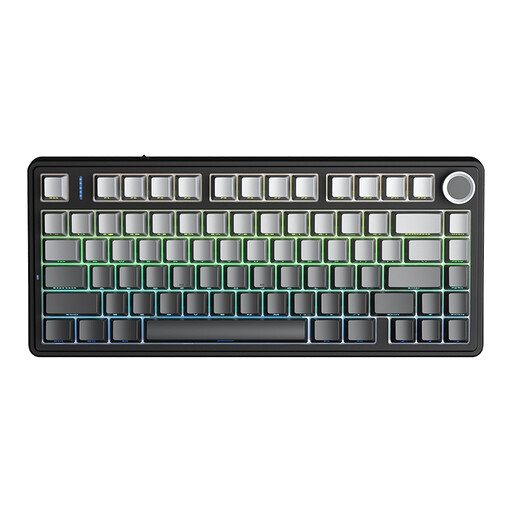
Consider its 75% format if you want a compact mechanical board for a small desk. The title lists Bluetooth, 2.4 GHz and wired connections, plus hot-swappable switches; check whether its US QWERTY layout and key access suit your bindings, and assess noise separately.
 No image available
The 75% format may appeal if mouse space matters more than a full-size layout. Its title specifies wired, Bluetooth and 2.4 GHz modes and PBT keycaps; check the installed switches, control layout and US QWERTY arrangement, and assess its noise for your room.
 No image available
Its 65% format is worth considering when desk width is tight. The title identifies an analogue gaming keyboard and UK layout; check how you would reach function-key bindings on this compact model and whether its keypress noise suits someone resting nearby.
 No image available
This compact mechanical option may suit a desk where you want a display and knob as well as keyboard controls. Its title lists a TFT display, five-layer padding and hot-swappable Star Vektor switches; inspect the exact key layout and selected language variant, and do not assume the padding makes keypresses quiet.
 No image available
The 80% format is an option if you want a compact keyboard but need to inspect its exact key clusters before settling on bindings. Its title specifies tri-mode connectivity, a gasket mount and a US QWERTY layout; check the function and arrow keys you need, and assess noise independently of the mount.
Yes, particularly when lower keypress noise matters more than mechanical feel. RTINGS describes membrane-based switch types as generally among the quieter options, but the sound of any particular keyboard still needs checking if someone sleeps nearby.
A TKL layout keeps a dedicated function row and arrow keys while removing the numpad. Check your own bindings first: if you use numpad commands regularly, that space saving comes with a control trade-off.
Choose a listing that explicitly identifies the UK or UK-ISO variant, then inspect the selected keyboard image and layout details. English legends alone do not distinguish it from a US arrangement.
No: a wired connection may be simpler for a PC that stays in one place. If reducing cable clutter or switching devices matters to you, check the exact wireless modes, receiver and charging arrangements before choosing that route.