Shared-room timetable checkers
If you check departures and route changes while a flatmate studies or sleeps, key noise and the space your keyboard occupies may matter more than a number pad.


For timetable checks at a small desk, choose a compact keyboard with an explicitly quiet-key design if shared-room noise and space are your main concerns. Prioritise Bluetooth device switching if you type across a laptop and phone or tablet; choose a full-size layout instead if regular number entry makes a dedicated number pad worth the extra desk width. Check the exact key layout, connection method and device compatibility before buying.
If you check departures and route changes while a flatmate studies or sleeps, key noise and the space your keyboard occupies may matter more than a number pad.
If you move between a timetable in your laptop browser and an app on your phone or tablet, switching between paired devices can be more useful than repeatedly pairing the keyboard.
If you also enter fares, times or budgets into a spreadsheet at a fixed desk, a dedicated numeric section may justify a larger keyboard.
Decide first whether shared-room noise, switching devices, desk space or frequent number entry is your main constraint. A compact keyboard can address the first three needs, but its layout may be less convenient for repeated numeric input.
Choose it when: You use more than one compatible device and need room beside your laptop for notes or a mouse. Logitech says its Pebble Keys 2 K380s switches between three devices.
Trade-off: Check the exact layout if you regularly enter figures; compact keyboards may omit a dedicated number pad.
Choose it when: You mainly use one compatible computer at a fixed desk and regularly enter times, fares or spreadsheet figures. HP specifies a full-size, three-zone layout for its 230 keyboard.
Trade-off: HP lists the 230 at 440 mm wide, and its 2.4 GHz connection uses a USB receiver rather than direct Bluetooth pairing.
| Concern | What to check | Who this matters to |
|---|---|---|
| Quiet typing | Look for an explicit quiet-key description and, for a mechanical model, check the switch variant. Key noise does not account for mouse clicks or impacts on the desk. | If I check departures while someone else is sleeping, I want less key clatter without giving up the space I need to work. Around 36% of consumers would put quiet shared-room use first. |
| Device switching | Check how many devices can be paired, how switching works and whether your operating systems are supported. | Moving between a laptop timetable and a phone or tablet app is easier for me if I can change the active device without pairing again. Around 29% of consumers would make device switching their main concern. |
| Desk space and portability | Compare the keyboard’s width and weight, then check which keys its compact layout leaves out. | With a laptop and study materials already on my desk, I need a keyboard that leaves usable room and is practical to carry. For around 21% of consumers, desk space and portability would come first. |
| Number entry | Confirm that the layout includes a dedicated numeric keypad, and measure the desk space it will occupy. | Entering fares, departure times and budget figures repeatedly makes a separate number pad useful to me. Around 14% of consumers would prioritise number entry. |
A receiver-based 2.4 GHz keyboard needs a suitable USB connection, whereas Bluetooth pairing has its own device and operating-system requirements.
List the devices you use for timetable checks, then confirm their ports, Bluetooth support and the keyboard’s stated compatibility.
A smaller keyboard can leave more desk space but may omit the numeric section you use for frequent fare or spreadsheet entry.
Check the pictured and specified key layout, especially the number pad, rather than relying on the word compact.
Logitech offers the MX Mechanical Mini with Tactile Quiet, Clicky and Linear switch options. The model name alone does not tell you which sound and feel a particular variant has.
If shared-room noise matters, confirm the switch option on the exact item you select.
GOV.UK guidance says electrical products and batteries should not go into household rubbish when they are no longer wanted or working.
Use an appropriate electrical or battery recycling route when replacing them.
Its Pebble Keys 2 K380s and MX Keys Mini are relevant to compact desk setups; its MX Mechanical Mini offers a different switch-based choice.
The HP 230 is a full-size, receiver-based keyboard to consider for regular number entry at a fixed desk.
Dell’s KM555 UK listing describes a compact, quiet keyboard and mouse combination rather than a keyboard-only product.
These keyboards offer compact layouts or wireless connections for a student-room timetable setup. Check each model’s layout and device compatibility against your own equipment; a wireless connection or mechanical design alone does not establish quiet typing.
 No image available
Consider this compact option if you move between devices when checking timetables. The title specifies a 78-key US QWERTY layout, Bluetooth 5.0/4.0, 2.4 GHz and USB-C connection modes, and support for four devices. Check whether its US key labelling suits your use.
 No image available
Consider its wired, Bluetooth and 2.4 GHz connection options if your timetable setup uses different devices. The title specifies a US QWERTY layout. Confirm the switch variant before judging its sound: the title names Reaper Switch, while the accompanying description names a different switch. Check operating-system compatibility and the key layout for your devices.
 No image available
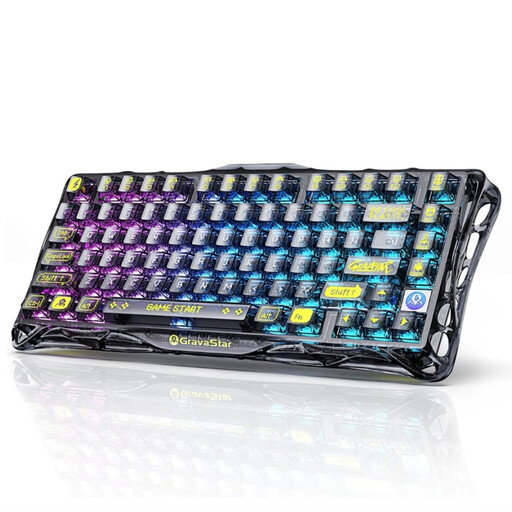
Its 75% layout is a choice to assess when desk width matters. The title specifies wired, Bluetooth and 2.4 GHz modes, RGB backlighting and PBT keycaps. Check the US key layout, operating-system compatibility and device-switching arrangements before choosing it for your setup.
 No image available
Assess this 75% model if you want a smaller keyboard for a fixed student-room desk. The title specifies a US QWERTY layout, Bluetooth 5.0, 2.4 GHz and USB-C modes, and Windows/Mac use. Confirm its dimensions for your desk and how device switching works if you compare timetables across screens.
 No image available
Consider this 75% wireless model if a smaller layout and switching between devices matter to you. Confirm its dimensions, exact key labelling and typing noise on the item listing before choosing it for a small, shared room.
Choose Bluetooth if you need to type across compatible devices and the keyboard supports the switching you want. A 2.4 GHz receiver model is more relevant when you mainly use one computer with a suitable USB port. Logitech says Pebble Keys 2 K380s switches between three devices; HP specifies a 2.4 GHz connection for the 230.
A number pad is useful if you regularly enter times, fares or budgets, but it need not drive the choice if you mainly search and read departures. HP specifies a full-size, three-zone layout for its 230; compare the space that layout needs with the room available on your desk.
Check the exact variant’s title, layout selection and technical specifications rather than relying on a product photograph or the retailer’s country. Dell labels a KM555 listing UK QWERTY, while other keyboards on this page explicitly specify US QWERTY layouts.
Use an appropriate electrical or battery recycling route rather than household rubbish. GOV.UK guidance says unwanted electrical products and batteries should not be put in household rubbish; check the collection options available to you.