Shared-study planners
If other people are reading or taking calls nearby while you prepare a training session, an explicit quiet-key claim matters more than choosing a keyboard for its switch feel alone.


For a shared study, start with a keyboard whose exact model has an explicit quiet-key claim; wireless connectivity or a slim design alone does not establish how it sounds. Then choose a compact multi-device layout if you move between planning devices, or a full-size layout with a number pad if you enter schedules and figures frequently. Check the UK layout, connection method and any mouse bundle before buying.
If other people are reading or taking calls nearby while you prepare a training session, an explicit quiet-key claim matters more than choosing a keyboard for its switch feel alone.
If calendars, slide notes and messages sit on different devices, check whether the keyboard can switch between your laptop, tablet and phone. Logitech states that its Pebble Keys 2 K380s can switch between three devices.
If you repeatedly enter session times, attendance figures or costs at one desk, a full-size layout with a dedicated number pad may matter more than portability.
Decide how much typing sound your study can tolerate, then match the layout and connection to the planning tasks you do most often.
| Concern | What to check | Who this matters to |
|---|---|---|
| Typing noise | Look for a quiet or silent-key claim for the exact keyboard model; check whether a claim for a combo covers the keyboard. | If others study nearby, I want my typing to cause less disturbance. Around 36% of consumers put low disturbance first. |
| Device switching | Confirm supported devices and operating systems, plus Bluetooth, receiver or wired connection options. | When my calendar, notes and messages are on different devices, I want to move between them without changing keyboards; around 29% of consumers prioritise device switching. |
| Numeric entry | Check for a dedicated number pad and the UK layout variant you want. | Repeatedly entering timings, attendance and budgets makes a number pad valuable at my desk. For around 21% of consumers, full-size numeric entry comes first. |
| Simple setup | Check whether a USB receiver needs a compatible port or adapter, and whether the product includes a mouse. | If I use one computer at a fixed desk, I want a connection that fits its available ports; straightforward setup is the primary concern for around 14% of consumers. |
Connection type and key height do not establish typing noise. Logitech's noise-reduction claim applies specifically to the MK295 combo, while its Pebble Keys 2 K380s has a separate quiet-key claim.
Check the sound claim for the exact model and switch configuration. If the room is especially quiet, seek a demonstration or sound evidence that helps you judge your own tolerance.
A smaller keyboard saves desk space, but frequent entry of session times, attendance and costs may make a dedicated number pad more useful.
List the planning tasks you perform most often before deciding between a compact board and a full-size one.
UK-English QWERTY, UK-ISO variants, Bluetooth and USB-receiver connections are not interchangeable details.
Confirm the exact layout, operating-system compatibility and the ports or Bluetooth support on every device you intend to use.
A receiver that does not fit an available port may require a compatible adapter.
A combo includes a mouse you may not need, and its receiver connection should not be mistaken for Bluetooth device switching.
Check the box contents and connection method; compare standalone keyboards if you already have a suitable mouse.
Its relevant models cover compact multi-device keyboards, full-size desk keyboards and a quiet keyboard-and-mouse combo.
The K5 Max is relevant when a full-size UK-ISO mechanical layout, connection choices and key customisation matter.
The Ody II is a full-size UK-English QWERTY wireless keyboard for a fixed desk.
These keyboards cover full-size desk setups and more compact layouts for training-session planning. Compare each model's stated sound features with its layout and connection options, particularly if you need UK keys or a number pad.
 No image available
Consider this for desk-based planning that combines numeric entry with use across several devices.
The listing specifies a UK 104-key layout with a number pad, Bluetooth and 2.4 GHz RF connectivity, and pairing with up to three devices. It describes the scissor keys as quiet; judge whether that claim meets your study's noise tolerance.
 No image available
Consider this if device switching and retained number keys matter more than having a UK key layout.
The listing describes a 99-key layout, Bluetooth, 2.4 GHz and wired modes, and support for up to five connected devices. Its reduced-noise wording is a product claim; check the US layout and whether its sound suits your study.
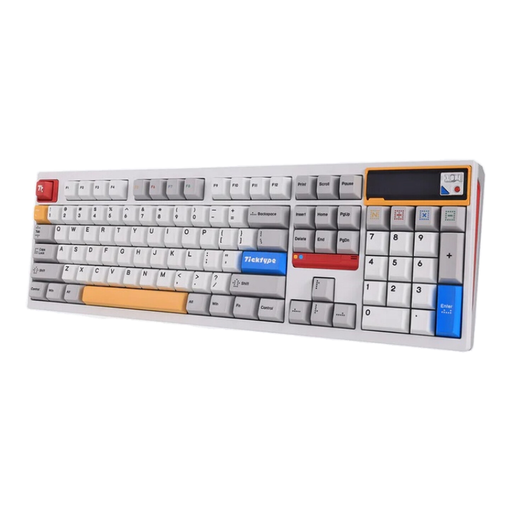 No image available
Consider this for a fixed planning desk if you want a full-size mechanical layout and several connection options.
The listing specifies 108 keys, Bluetooth, 2.4 GHz and wired USB-C connections, and Silent Tactile Switches. It claims quiet typing, but check the sound for this configuration and whether the US layout suits you.
 No image available
Consider this for a fixed desk if you need both a keyboard and a mouse and have a suitable USB connection.
The listing specifies a full-size 104-key keyboard and a single 2.4 GHz USB receiver. It claims quiet keystrokes; check that its US layout, included mouse and sound suit your needs.
 No image available
Consider this if a compact desk layout and a choice of connection methods matter more than confirmed number-pad access.
The listing specifies Bluetooth, 2.4 GHz wireless and wired connections, and claims noise reduction from five-layer padding. Check its US key layout, numeric-key arrangement and sound against your planning needs.
Choose a UK layout if you want familiar UK punctuation and key placement. The Trust Ody II listing identifies UK-English QWERTY, while Keychron offers UK-ISO K5 Max variants; confirm the exact variant rather than judging from a product photo.
No. Sound depends on the exact model and, for a mechanical keyboard, its switch configuration. Logitech makes separate quiet-key claims for the Pebble Keys 2 K380s and MK295; check sound evidence for the particular keyboard you plan to use.
It can if both devices support that keyboard's connection method and operating-system requirements. Logitech lists Bluetooth device switching for the Pebble Keys 2 K380s, whereas the Trust Ody II uses a USB wireless receiver; check your devices and available ports before choosing.
Keep electrical items and batteries out of household rubbish. GOV.UK guidance directs consumers to appropriate recycling collection points; check the collection options available for the keyboard and any removable batteries.