Quiet-study document editors
If you prepare, proofread or format concert programmes near other people, audible clicks may be your first reason to change mice. Check which buttons a quiet-click description actually covers.


Start with a mouse that explicitly specifies quiet clicks, then match its shape and connection to your hand and computer. A straightforward wired or receiver-based model may suit occasional programme editing; for longer layout sessions, hand fit and scrolling deserve closer attention. A quiet-click claim does not necessarily cover the wheel or every button.
If you prepare, proofread or format concert programmes near other people, audible clicks may be your first reason to change mice. Check which buttons a quiet-click description actually covers.
Arranging repertoire, performer details and page layouts can mean extended desk work. Hand size, handedness, reachable controls and mouse placement matter alongside click noise.
If you move through long drafts or work across compatible devices, consider scrolling behaviour, pointer adjustment and connection options after checking that the mouse meets your quiet-click needs.
For concert programme work in a quiet study, decide whether click noise, fit during longer sessions or navigation across drafts is your main concern; then check the connection against your computer.
| Concern | What to check | Who this matters to |
|---|---|---|
| Click noise | Look for an explicit quiet-click specification and check which buttons it covers. | When I repeatedly select text near other people, conspicuous clicks interrupt the quiet room. Around 42% of consumers put low-disturbance clicking first. |
| Hand fit | Check the stated hand-size and handedness options, and whether the controls are within easy reach. | During a long editing session, I want a shape that fits my hand without reaching or gripping awkwardly. Hand fit is the primary concern for around 33% of consumers. |
| Navigation and connection | Compare scrolling and pointer settings, then check Bluetooth support or the port needed for a receiver. | Moving between long drafts or compatible devices makes navigation and setup more important to me. Around 25% of consumers prioritise that workflow. |
A quietness claim may apply to particular click buttons, not the scroll wheel, side buttons or movement across the desk. HP, for example, describes its HP 280 Silent noise-reduction claim specifically for the left and right buttons.
Read the claim for the exact model and controls. If small sounds are especially distracting, consider whether the seller’s returns process gives you a practical way to assess the mouse in your study.
Receiver-based mice need a compatible connection on the computer, whereas some quiet models also offer Bluetooth.
Check your available ports and Bluetooth support before choosing a connection method.
A computer without a suitable port may require an adapter for a USB receiver.
Quiet mice vary in intended hand size and handedness. A vertical shape does not, by itself, establish that it fits your hand or desk arrangement.
Check the model’s fit guidance. For display-screen work, the Health and Safety Executive advises keeping the mouse within easy reach so it can be used with a straight wrist.
Electrical items and batteries need appropriate collection rather than disposal with ordinary household rubbish.
Use an electrical-waste or battery collection point, or check whether a like-for-like retailer take-back arrangement applies. GOV.UK provides guidance on recycling consumer electrical products and batteries.
Logitech offers several distinct quiet-mouse designs, from straightforward receiver models to hand-size-specific and vertical options.
The HP 280 Silent is a conventional wireless option using a 2.4 GHz receiver.
The Rapoo M660 Silent is a multi-mode wireless option for buyers comparing Bluetooth with receiver use.
These mice offer wired, USB-receiver and Bluetooth connection choices for quiet-study programme editing. Compare the stated click controls, connection and fit needs for each model rather than treating the selection as a ranking of quietness.
 No image available
Consider this model if you want a quiet-click mouse with a choice of Bluetooth or 2.4G connection while editing. Its title specifies adjustable DPI. Check whether its shape fits your hand and whether any wheel noise matters in your study.
 No image available
A wired choice for programme editing if your computer has a suitable USB port. The title specifies four buttons and 1000, 1200 and 1600 DPI settings; its quiet-click description covers the left and right buttons. Check wheel noise and hand fit separately.
 No image available
This USB-receiver mouse may suit editing if you also want adjustable pointer sensitivity: its title specifies five DPI settings. The quiet-click claim covers the left and right buttons. Confirm a suitable port, and note that its side buttons are stated to be unavailable on Mac.
 No image available
For a receiver-based quiet-click option, this model’s title specifies a 2.4 GHz USB receiver and 1600 DPI optical tracking. Check that your computer has a suitable port and assess wheel noise and hand fit for your workspace.
 No image available
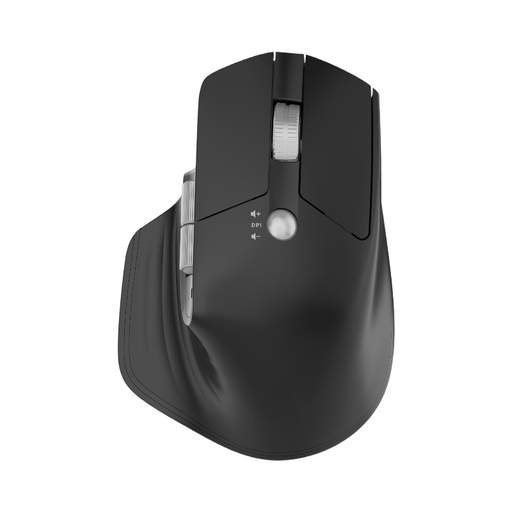
Consider this option if you want to choose between Bluetooth and 2.4G connectivity for programme work. Its title specifies one-touch DPI adjustment. Check compatibility with your operating system, hand fit and which controls the quiet-click wording covers.
Check which controls the claim covers on the exact model. HP describes its HP 280 Silent noise reduction for the left and right buttons, so that statement alone does not tell you how its wheel or other controls will sound.
Choose a connection your computer supports and that leaves the ports you need available. A receiver model needs a suitable USB port or adapter; for a Bluetooth model, check the computer’s Bluetooth support and the mouse’s stated requirements before purchase.
A vertical shape alone cannot guarantee comfort or resolve discomfort. Check hand-size and handedness guidance, and arrange the desk so the mouse is within easy reach; the Health and Safety Executive advises using it with a straight wrist. Seek appropriate professional advice for persistent symptoms rather than relying on a product claim.
Take unwanted electrical items and batteries to appropriate collection arrangements rather than putting them in household rubbish. GOV.UK advises using an electrical-waste collection point or recycling centre for electrical products; check local battery collection and applicable retailer take-back arrangements when replacing the mouse.