Quiet-space revisers
If someone else rests or studies nearby, a model with an explicit quiet-click claim is worth considering. Logitech makes such a claim for its M240 Silent; it does not apply to wireless mice generally.


For revision beside a roommate, consider a mouse that explicitly offers quiet clicks; a Bluetooth model also leaves a USB-A port free if your laptop supports it. A USB-receiver mouse is a straightforward alternative when you have a spare port. For longer sessions at one desk, check hand fit and size before prioritising extra controls, accepting that a larger mouse takes up more space.
If someone else rests or studies nearby, a model with an explicit quiet-click claim is worth considering. Logitech makes such a claim for its M240 Silent; it does not apply to wireless mice generally.
At a small desk, the available laptop ports can decide the connection method. Bluetooth leaves USB-A free, while a receiver mouse needs a suitable port or adapter.
If you spend extended periods sorting notes and reviewing cards, check the mouse’s size, shape and handedness. Logitech offers distinct M650 hand-size and left-handed variants, while Razer lists a right-handed vertical Pro Click V2 Vertical.
For revision cards in a student room, start with the need that matters most to you: quieter clicks, a workable laptop connection or a shape suited to longer desk sessions.
| Concern | What to check | Who this matters to |
|---|---|---|
| Click noise | Check whether the exact model claims quiet clicks; wireless connectivity alone does not establish this. | If I make cards while a roommate rests, I want my clicking to be less disruptive. Around 42% of consumers would put quieter clicks first. |
| Laptop connection | Check Bluetooth and operating-system compatibility, or confirm you have a usable USB-A port for a receiver. | When I switch study devices or have few free ports, I need a connection that works with my setup. Around 33% of consumers would make connectivity their main concern. |
| Hand fit | Check size, handedness and shape against your grip and the space beside your keyboard or notes. | During longer revision blocks, I would rather have a mouse that fits my hand than extra controls I will not use. Around 25% of consumers would prioritise hand fit. |
A 2.4 GHz receiver mouse such as Logitech’s M185 needs its receiver connected to the computer; Bluetooth does not occupy that USB-A port.
Inspect your laptop’s ports before ordering. If it has no usable USB-A port, consider a compatible Bluetooth model or check whether you already have a suitable adapter.
Otherwise, you may need to obtain and carry an adapter.
Requirements differ by model. Microsoft specifies Windows 10 or 11 and Bluetooth 4.0 or later for its Bluetooth Mouse.
Check the exact mouse’s operating-system and Bluetooth requirements against your laptop, tablet or other study device.
For basic revision-card navigation, hand-size options and shape may be more relevant than gaming-oriented controls. A larger or vertical design also takes up more desk and bag space.
Choose around your main need, then check the stated hand-size and handedness guidance if you are considering a comfort-focused model.
Oxfordshire County Council’s guidance treats electrical items and battery-powered devices as electrical waste rather than general waste.
Check your local council’s route for small electricals and its instructions for recycling removable batteries separately.
Its documented range includes compact Bluetooth, USB-receiver and hand-size-specific mice relevant to a student desk.
The HP 250 Dual Mode is a full-size option for someone who wants both Bluetooth and a USB-A receiver.
The Microsoft Bluetooth Mouse is a compact, receiver-free option for a compatible Windows computer.
The Pro Click V2 Vertical is a specialised desk-based option for someone considering a right-handed vertical shape.
These mice cover quiet-click listings, USB-receiver and dual-mode connections, plus a vertical shape for desk-based study. Choose by your device’s connection options and the feature you need most.
 No image available
Consider this model if you want a choice of wireless connections and a mouse advertised with quieter clicks for shared-room revision.
The title lists 2.4G+BT connectivity, adjustable DPI and one AA battery. Check compatibility with your study device; the quiet-click description is a product claim.
 No image available
This receiver-based option is worth checking if your laptop has a suitable USB-A port and you want a model advertised with quiet clicks.
The title specifies a 2.4 GHz USB receiver, 1600 DPI and Windows/Mac compatibility. Treat the quiet-click wording as a product claim, not a measured noise comparison.
 No image available
Consider it for receiver-based navigation if you have a suitable USB port; its listing also claims quieter main clicks.
The title lists five adjustable DPI settings. If you use a Mac, note that the listing says its side buttons are unavailable on macOS.
 No image available
Its vertical shape is an option to assess if you mainly revise at one desk and prefer that style of grip.
The title lists 2.4 GHz dual-mode connectivity, six buttons and an adjustable 1600 DPI sensor. Check its stated Windows 10/11 or macOS 13.6-and-above compatibility, and confirm click noise if quiet use is essential.
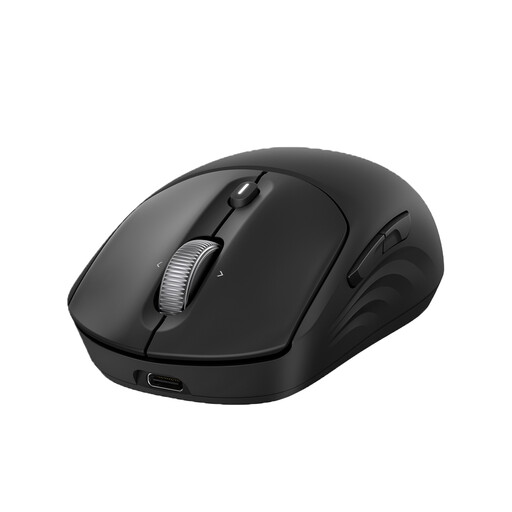 No image available
This is an option if you want to choose between Bluetooth and a USB receiver for your study setup.
The product information describes an ambidextrous shape and both connection modes. Confirm compatibility with your device and check the click-noise description if you share a quiet room.
Choose Bluetooth if your laptop supports the mouse and you want to leave USB-A free; choose a receiver model if you have a usable port and prefer to plug in its receiver. A dual-mode mouse gives you both options when you need them.
Quiet clicks are worth prioritising when someone nearby is resting or studying, but they are not a requirement for every room. Check the exact model’s claim rather than assuming all wireless mice click quietly.
Start with the maker’s hand-size and handedness guidance where available, then consider how much desk and bag space the mouse will use. Logitech, for example, distinguishes its M650, M650 L and M650 L Left variants by hand size and handedness.
Check your local council’s small-electricals collection or recycling-centre instructions rather than putting the mouse in general rubbish. Oxfordshire County Council classifies battery-powered electrical items as electrical waste; follow local instructions for any removable battery as well.