
24/7 Customer Support

Free returns

Same-day & Next-day Delivery

Quality Guaranteed

Unlock Your Welcome Offers: FREE Delivery | Up to 80% OFF | Free 30-day JoyPlus trial
Download the APP
A quiet portable fan can make a noticeable difference in a warm bedroom, stuffy home office or rented flat where floor space is limited. However, product listings often focus on impressive speed counts or battery claims while leaving out the details that affect everyday use.
Before buying, look beyond the headline specification. A fan that is quiet at its lowest setting may be considerably louder at maximum power. A “cordless” model may still need frequent charging, while a compact design may provide personal airflow rather than cooling an entire room. The right choice depends on where you will use it, how long it needs to run and whether portability matters more than airflow coverage.
Noise ratings are usually measured under specific conditions, often at the lowest speed. A fan listed at 28dB may be suitable for sleep or study at that setting, but higher speeds can create more audible airflow and motor noise.
Check whether the listing explains the operating mode attached to the noise figure. For bedrooms, useful features include several speed settings, a sleep mode, a timer and stable construction that does not rattle on a bedside table.
A rechargeable fan may advertise “up to” a particular number of hours. Actual runtime depends on speed, oscillation, display lights and battery condition. Maximum airflow normally uses more power than a low setting.
If you need cooling throughout a working day or overnight, compare the stated runtime with your intended speed. A USB-C fan is also more convenient for charging from a laptop, power bank or compatible wall adaptor, but check whether a charging cable and mains adaptor are included.
A small desk fan directs air towards one person. It does not lower room temperature in the same way as an air-conditioning system. A compact tower fan may spread airflow more effectively, while a pedestal fan can provide greater height and reach.
Consider the room layout, not just the fan’s size. A narrow bedroom may suit a tower fan, whereas a desk fan is more appropriate for close-range cooling during work or study.
For a bedroom fan, look for a clearly stated low-noise or sleep setting. Decibels use a logarithmic scale, so small numerical differences should not be treated as a complete measure of perceived comfort. Motor type, blade or outlet design, surface stability and the character of the airflow can all affect how distracting a fan feels.
If possible, choose a fan with at least three or four speed levels. Fine adjustment helps you use a lower setting at night and stronger airflow during the day.
A cordless fan is useful in rooms where sockets are inconvenient, during travel or outdoors near a seating area. A rechargeable fan should state its charging connection and approximate runtime. USB-C offers broad compatibility, but charging speed and included accessories can vary.
For regular use, check:
For household running costs, compare wattage rather than relying on general “energy-saving” wording. A lower-power fan will usually consume less electricity when operated for the same number of hours, although airflow output and room suitability also matter.
Measure the available space before selecting a desk fan, pedestal fan or tower fan. A compact fan should still have a stable base and enough clearance around its air inlet and outlet.
Adjustable height is valuable when the same product needs to work beside a bed, on a desk and near the floor. Oscillation can distribute airflow across a wider area, while a fixed fan may be preferable when you want a steady stream directed at one person.
For UK households, also check the product instructions, charging requirements, plug arrangement and the relevant conformity markings supplied with the product. Keep electrical fans away from water, radiators and damp areas, and disconnect them before cleaning.
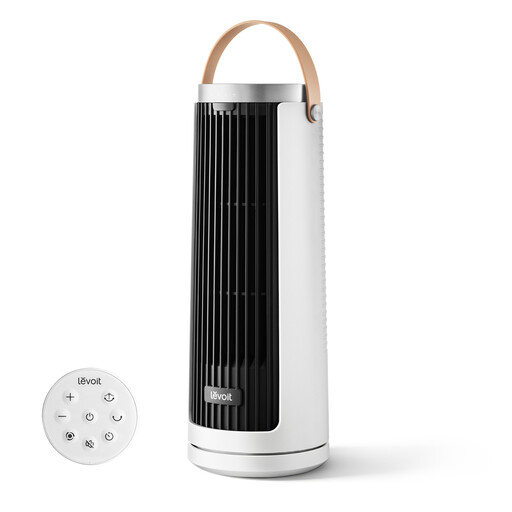
Why This Fits Their Persona: Its compact white tower format suits a desk, bedside table, study area or travel bag when personal cooling is the priority.
Multiple airflow modes provide more adjustment than a simple single-speed model, while USB Type-C recharging supports cordless use away from a socket.
Portable tower design; rechargeable battery and USB Type-C charging; low-noise operation.
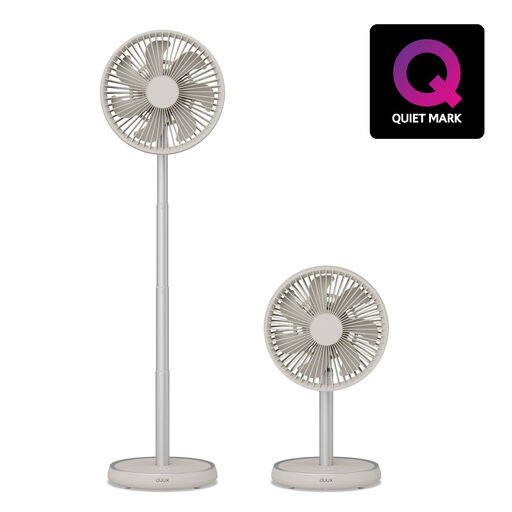
Why This Fits Their Persona: It is suited to shoppers wanting one adaptable fan for a home office, bedside table, small room, garden seating area or holiday accommodation.
The stated 28dB minimum noise level gives a clearer low-noise reference, while the adjustable height avoids buying separate desk and floor fans.
34–75cm height range; four cooling speeds; USB-C charging; stated battery runtime of up to 15 hours.
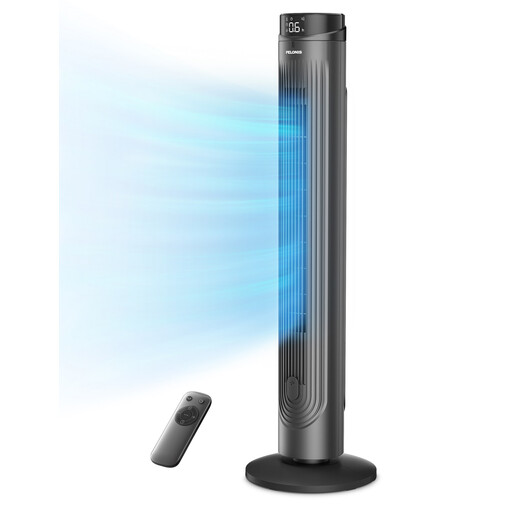
Why This Fits Their Persona: Its floor-standing format is appropriate for users who want wider room airflow, remote control and scheduled operation in a bedroom or living space.
The 12 speed settings allow more precise adjustment than basic models, while oscillation and a 24-hour timer address room coverage and overnight scheduling.
42-inch tower format; DC motor; remote control; LED display; oscillating operation.
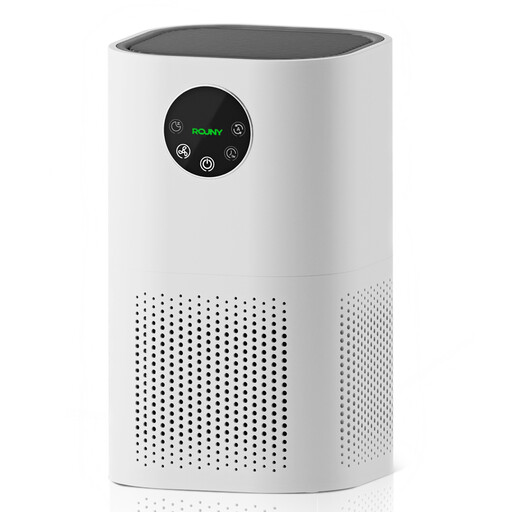
Why This Fits Their Persona: This is for households prioritising particle filtration and quieter bedroom or office operation rather than direct personal cooling.
It clearly separates air cleaning from fan-only cooling, with a stated CADR of 150m³/h, four fan speeds and a sleep mode rated at ≤25dB.
H13 True HEPA filter; stated 20–50m² coverage; air quality display; 2h, 4h and 8h timer settings.
We have compiled a complete, real-time list of products that fully satisfy these strict selection criteria and UK safety regulations.
Place the fan on a firm, level surface with clear space around the air intake and outlet. Do not cover the unit or position it directly beside curtains, bedding or heat sources. For a cordless model, fully charge it according to the supplied instructions before the first use.
Clean dust from the grille or outlet using the method recommended by the manufacturer. Disconnect mains power before cleaning, and do not use a fan near splashes, baths or excessive moisture. If the cable, battery housing or casing becomes damaged, stop using the product rather than attempting an unapproved repair.
It can be, provided the lowest setting produces enough airflow for you and the fan remains stable without rattling. Look for a stated low-noise mode, multiple speeds and a timer. Noise perception varies, so a decibel figure should be treated as a guide rather than a guarantee of silent operation.
Running cost depends mainly on power consumption and your electricity tariff. A simple calculation is: wattage ÷ 1,000 × hours used × electricity price per kWh. A battery-powered fan uses electricity during charging, while a mains-operated model may draw power continuously. Compare wattage and intended usage rather than relying only on terms such as “energy efficient”.
Choose a fan when your priority is moving air across your body and creating a cooling breeze. Choose an air purifier for home when your priority is filtering airborne particles. An air purifier can circulate air, but it is not a direct replacement for a cooling fan. Households with both needs may use each appliance for its intended purpose, following the placement and maintenance instructions supplied.