Quiet-room vinyl listeners
If you listen in a bedroom, study or shared home, plan where you will adjust the volume and how the turntable will connect to powered speakers, an amplifier or a headphone setup.


Choose the turntable around the records you own and the equipment that will control the listening volume. A built-in phono preamp can simplify connection to a suitable line-level input, but you still need a compatible speaker, amplifier or headphone setup; check for 78 RPM playback only if your discs require it.
If you listen in a bedroom, study or shared home, plan where you will adjust the volume and how the turntable will connect to powered speakers, an amplifier or a headphone setup.
If you are playing inherited records or coming back to vinyl, automatic operation or a factory-set turntable may reduce the handling and setup you need to learn at the outset.
If your collection includes older discs alongside LPs and singles, read each label or sleeve before choosing a deck. A record being vintage does not tell you whether it plays at 78 RPM.
Start with your records and the equipment you will listen through; then decide how much manual handling and connection flexibility you want.
| Concern | What to check | Who this matters to |
|---|---|---|
| Volume control and connections | Match the turntable’s phono or line output to the receiving input, and identify where you will adjust volume. | I want to play records without disturbing others, so I need a listening setup whose volume I can control. Around 36% of consumers put that complete connection and volume-control need first. |
| Ease of operation | Check for automatic operation or factory-set adjustments, and identify the fitted cartridge’s replacement stylus. | When I return to a record collection, I would rather avoid unnecessary tonearm handling and initial adjustments. For around 29% of consumers, straightforward operation is the primary concern. |
| Record speed | Read the speeds on your discs and check whether the exact turntable supports 33⅓, 45 or, if needed, 78 RPM. | My collection might include a 78 RPM disc, so I need to establish its speed before choosing a deck. Correct speed is the deciding need for around 21% of consumers. |
| Placement and future changes | For Bluetooth, check the receiving device; for later component changes, check connections and cartridge or stylus options. | Where a cable run is awkward or I expect to change my system, I want the connection and component options to fit that plan. Around 14% of consumers make this flexibility their first priority. |
A built-in phono preamp helps feed a suitable line-level input; it does not drive speakers or provide the volume control for your headphones.
Before ordering, trace the connection from the turntable to its receiving input, volume control and speakers or headphones.
You may also need compatible powered speakers, amplification or a headphone setup.
Audio-Technica specifies 33⅓ and 45 RPM for the AT-LP60X, while its AT-LP120XBT-USB also supports 78 RPM. The word vintage cannot establish which speed your records need.
Check labels and sleeves first; seek 78 RPM capability when a disc in your collection requires it, and confirm cartridge and stylus suitability for that disc.
Pro-Ject lists distinct E1 Phono and E1 BT configurations. Rega identifies the integrated moving-magnet phono stage as a Planar 1 Plus feature, so do not assume it is included with a standard Planar 1.
Check the full model name and its connections, included cartridge and power-supply details before choosing a variant.
A replacement stylus must match the fitted cartridge. Audio-Technica’s stated replacement interval for its ATN3600LC should not be applied to unrelated models.
Identify the exact cartridge and a compatible replacement stylus for the turntable you intend to buy.
Its range includes automatic, Bluetooth and manual turntables, but the relevant features differ by model.
The E1 range offers factory-set, belt-drive options for listeners who want a simpler initial setup.
Its Planar models are worth considering when building a conventional turntable, amplifier and speaker system.
The TT-S303 is presented by Yamaha as a turntable for pairing with a stereo amplifier or receiver.
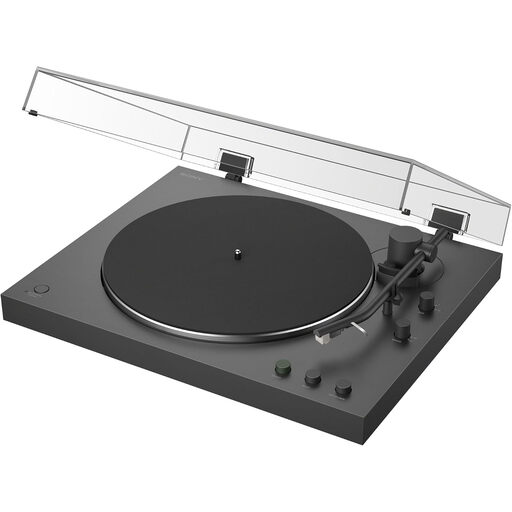
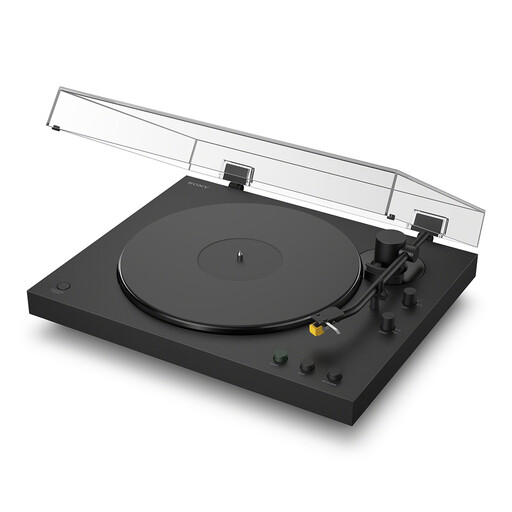
These Sony models offer automatic playback and Bluetooth connectivity. Match either one to your records and to a compatible listening system with accessible volume control.
 No image available
If you prefer less manual handling when playing a record, this model offers automatic playback.
Check that your intended Bluetooth receiving device has compatible playback and usable volume control. If you own 78 RPM discs, confirm speed support and the fitted cartridge’s stylus options before ordering.
 No image available
This model also suits listeners looking for automatic record playback and a Bluetooth connection.
Confirm the receiving device’s compatibility and volume control. Check speed support against your discs and identify a replacement stylus compatible with the exact fitted cartridge.
A turntable alone is not a complete quiet-listening system. Choose compatible powered speakers, an amplifier or a headphone setup with accessible volume control; a built-in phono preamp does not replace that equipment.
You do not need a separate one if your turntable’s integrated phono preamp feeds a suitable line-level input. If the turntable has no phono stage and the receiving equipment has no phono input, plan for a compatible separate stage. Rega identifies the integrated stage with the Planar 1 Plus, so check the exact variant.
Only if that particular disc calls for 78 RPM. Audio-Technica specifies 33⅓/45 RPM for the AT-LP60X and adds 78 RPM on the AT-LP120XBT-USB; inspect your record’s label or sleeve rather than judging its speed by age.
Follow the guidance for the stylus fitted to your exact cartridge. Audio-Technica gives an approximate life of 300–500 hours for its ATN3600LC replacement stylus; that figure is not an interval for other stylus models.
Check the marking applicable to the market where the electrical equipment is placed. Department for Business and Trade guidance dated March 2026 lists UKCA or CE for Great Britain, and CE or UKNI together with CE for Northern Ireland. A marking on a listing alone does not establish that an individual turntable complies; check the exact item’s documentation and power-supply details.