Noise-first shared-study typists
If you type beside other readers or study late at night, make keypress noise a primary selection criterion rather than assuming a wireless keyboard will be quiet.


For reviewing pronunciation notes in a quiet study, start with a low-profile or chiclet keyboard that has a model-specific noise-reduction claim; wireless connectivity alone says nothing about keypress noise. If you prefer mechanical keys, check the silent-switch variant and compatibility, and weigh any compact or multi-device layout against the keys and devices you use for note-taking.
If you type beside other readers or study late at night, make keypress noise a primary selection criterion rather than assuming a wireless keyboard will be quiet.
If your notes move between a computer and a tablet, check device switching as well as the physical key layout and the input methods needed for your characters.
If you spend extended periods reading and annotating, consider keyboard height, reach and desk position alongside typing noise. The Health and Safety Executive advises placing the keyboard centrally and just below elbow height.
Decide how important quiet keypresses are, then check whether the layout, input method and connection fit the way you edit notes.
| Concern | What to check | Who this matters to |
|---|---|---|
| Keypress noise | Look for a claim about the exact keyboard or its switches. Check mouse-click noise separately if you use a mouse nearby. | If I type beside other readers, I want my keypresses to disturb them as little as possible. Around 33% of consumers put low typing noise first. |
| Language input and devices | Check the printed layout, the input methods available on your operating system and the model's supported devices. | When my notes need language-specific characters or move between devices, I need the input method and switching arrangement to work for me; around 27% of consumers make this their main concern. |
| Long-session comfort | Check keyboard height and reach against your desk setup; the Health and Safety Executive advises a central position just below elbow height. | During a long annotation session, I need a position that lets me type without awkward reaching. Comfort comes first for around 20% of consumers. |
| Desk layout and connection | Decide whether you need a number pad, then check the required USB port, Bluetooth support or receiver connection. | With books and notes on my desk, I need the keyboard footprint and connection to fit the space and device I use. Around 20% of consumers prioritise that fit. |
Logitech's claim for the MK295 concerns combined keyboard-and-mouse noise, HP describes less noise from the HP 230's chiclet keys, and Keychron describes its silent switches. Those statements do not establish which complete keyboard will sound quieter in your study.
Shortlist the exact models that address your noise concern, then check their key mechanism, applicable return terms and model-specific user feedback.
Keychron specifies particular hot-swappable boards for its Silent K Pro switches; a switch set is not a complete keyboard.
Confirm your board model and switch compatibility before buying replacement switches. If you do not want to modify a board, look for a complete keyboard with the switch variant you want.
A smaller board can leave room for notes and a mouse, but the Logitech MX Keys Mini does not have the integrated number pad offered by its full-size counterpart.
Check the exact layout for the number pad, arrow keys and navigation functions you regularly use before choosing a compact model.
Lower typing noise does not address an awkward keyboard position. The Health and Safety Executive advises keeping the keyboard central and just below elbow height.
Set the screen and desk position first, then choose a keyboard footprint and height that fit that arrangement.
Relevant lines range from a full-size wireless keyboard-and-mouse combination to compact, low-profile keyboards for switching devices.
The HP 230 is a conventional full-size wireless option for a study desk.
Relevant for readers who want mechanical key feel and are considering a compatible silent-switch setup.
These models cover compact and full-size layouts, wireless and wired connection options, and mechanical keyboards with quietness-related descriptions. Match each model's keys and connection to your note-reviewing setup rather than treating quietness wording as a comparable sound rating.
 No image available
Consider this compact option if desk space and switching between study devices matter. Its listed configuration has 78 keys, a US QWERTY layout, and 2.4 GHz and Bluetooth 5.0/4.0 connection options; check that the physical key positions and your device's input method suit your notes. Assess the quiet-key claim against the noise level acceptable in your study.
 No image available
This full-size keyboard-and-mouse set suits a desk setup where you want a conventional layout and a stated quiet-typing design. It uses a 2.4 GHz wireless connection; check receiver compatibility and whether the US key positions work for your notes. Its quietness wording is not a measured comparison with the other models here.
 No image available
Consider the F75 if you want a compact mechanical layout and the choice of wired or wireless use. Its title specifies a 75% layout, wired, Bluetooth and 2.4 GHz connections, and PBT keycaps. Check the US key positions and whether its typing sound suits the room before relying on reduced-noise claims.
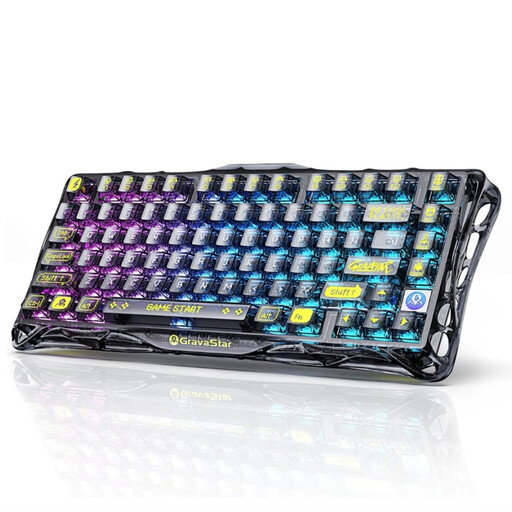 No image available
This mechanical model is worth checking if you want a hot-swappable keyboard with several connection methods. Its title specifies a US QWERTY layout and Bluetooth 5.0, 2.4 GHz and USB-C options. Confirm the actual layout size and pre-installed switch variant, as the available product details differ on those points; also check the support terms for this Chinese retail version.
 No image available
Consider this model if you want a full-size mechanical layout and the listed silent tactile switch variant. Its title specifies 108 keys, a hot-swappable design, tri-mode connectivity and a US layout. Check the key positions you need for pronunciation notes and whether the switch and complete keyboard sound suit your study.
Not necessarily: the input method can matter as much as the printed keys. Microsoft Support explains that Windows lets you manage and switch keyboard input layouts; check that your operating system and note-taking app support the characters you need, then choose physical key positions that suit your everyday typing.
No: typing noise and desk position are separate considerations. The Health and Safety Executive advises keeping the keyboard central and just below elbow height, so check its height and reach in your setup as well as its noise-related features.
Choose by the devices you use and whether you need to switch between them. HP lists a 2.4 GHz receiver connection for the HP 230, while Logitech says the MX Keys S can switch across up to three supported devices; a wired USB-C model avoids pairing but needs a suitable port and cable placement.
Check the battery type, what is included and the quoted battery life for the exact model. HP lists two AAA batteries and up to 16 months' battery life for the HP 230, but your replacement needs will depend on use.