
24/7 Customer Support

Free returns

Same-day & Next-day Delivery

Quality Guaranteed

Unlock Your Welcome Offers: FREE Delivery | Up to 80% OFF | Free 30-day JoyPlus trial
Download the APP
Choosing an R129 ISOFIX car seat can make installation more straightforward, but the label alone does not guarantee that a seat suits your child, vehicle or daily routine. UK parents, grandparents and carers often focus on the age range or a low price, then discover that the seat is difficult to fit, too bulky for their car or uncomfortable once the child grows.
Before comparing products, watch out for these common buying traps.
ISOFIX anchorage points are common in modern cars, but access and compatibility can vary. Some seats also require a top tether or support leg. A vehicle may have ISOFIX connectors but not the additional anchorage required by a particular seat.
Always check the vehicle fit list, the seat manual and your car handbook. If you regularly move the seat between cars, confirm compatibility for each vehicle rather than relying on the ISOFIX label alone.
A Group 0/1/2/3 car seat or multi-stage seat may cover a broad weight or height range, but children grow at different rates. An infant insert, harness and headrest must remain correctly adjusted at every stage.
A long age claim can be useful, yet it should not replace checking the manufacturer’s height, weight and installation limits. A seat suitable from birth may also be larger and heavier than a dedicated infant carrier.
A 360-degree rotating car seat may make loading a baby easier, particularly in a small or low car. However, it can be heavier and take up more room than a fixed seat. Similarly, a foldable car seat is practical for grandparents, taxis or occasional transfers, but storage convenience should not come at the expense of correct installation.
Prioritise the features you will use on every journey: straightforward fitting, accessible harness adjustment, washable covers and a suitable recline.
R129 is a child restraint approval regulation that uses a child’s height, alongside weight limits where applicable, rather than relying only on older group categories. i-Size seats are associated with R129 requirements and are designed around vehicle compatibility and side-impact assessment.
Look for the exact approval information on the product label and instructions. R129 certification is not a substitute for checking whether the seat is appropriate for your child’s height and your vehicle.
ISOFIX connectors attach to the vehicle’s anchorage points and can help reduce fitting errors. Some seats combine ISOFIX with a top tether, while booster seats may use ISOFIX to stabilise the shell but still require the vehicle’s three-point seat belt to restrain the child.
Never use a lap-only belt with a product that specifies a three-point belt. Confirm that installation indicators are showing the correct colour, where provided, and check the seat before every journey.
For younger children, a child car seat with 5-point harness should have straps adjusted snugly, without bulky coats underneath. A headrest with multiple height positions can help maintain a better fit as your child grows.
For booster mode, the vehicle belt should pass through the designated guides and sit correctly across the shoulder and lap. UK law generally requires children to use a child car seat until they are 12 years old or 135cm tall, whichever comes first. Always follow the product’s own limits, which may differ.
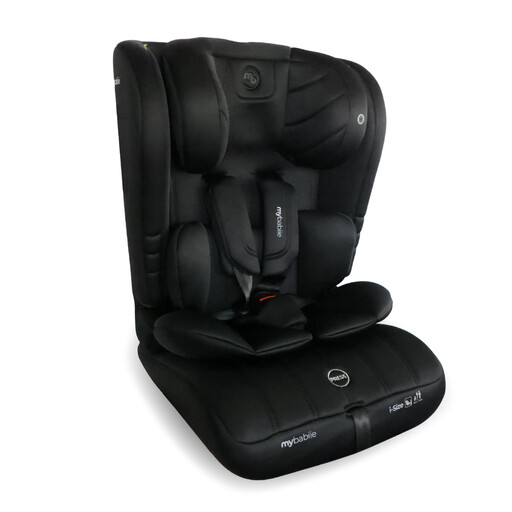
Why This Fits Their Persona: A practical option for families seeking one adjustable seat for the toddler and booster stages, without choosing a rotating mechanism.
It states the toddler-to-booster transition clearly, with ISOFIX fitting for the seat and a three-point vehicle belt for booster use.
R129 i-Size certification, adjustable headrest, multiple recline positions and a 5-point harness for toddler mode.

Why This Fits Their Persona: Suitable for families wanting an adaptable seat from birth through later booster use, with convenience features for regular journeys.
Its stated stages, harness limit and change to vehicle-belt booster mode make the long-term use plan easier to assess before purchase.
360-degree rotation, four recline positions, ten headrest heights, machine-washable covers and ISOFIX with top tether.

Why This Fits Their Persona: Useful for grandparents, childminders or families transferring a seat between vehicles and needing compact storage.
The foldable design addresses storage and transport, while visible ISOFIX indicators help confirm connection before use.
R129 i-Size certification, ten-position headrest, multiple reclines and conversion from a 5-point harness to high-back booster.
Before the first journey:
A padded car seat protector can help reduce marks and crumbs on vehicle upholstery, but it must not interfere with ISOFIX connectors, a support leg or the belt path. Check the protector instructions alongside the car seat manual.
We have compiled a complete, real-time list of products that fully satisfy these strict selection criteria and UK safety regulations.
Only if the product specifically states that it is approved for newborn use and provides an appropriate rear-facing configuration or insert. Many toddler-to-booster seats start at around 9 months or 76cm, so check the stated minimum height and weight before buying.
It depends on the seat’s approval range and your child’s size. Some adjustable models cover several stages, while an ISOFIX booster may be intended for children around 100–150cm. Stop using any mode when the child exceeds its stated limit, and follow UK child restraint law.
No. ISOFIX can simplify attachment, but the seat may still require a top tether, support leg or vehicle seat belt. Correct positioning, indicator checks and following the manual remain essential.