PC racer with a narrow rig
You need to position a QHD display near the wheel while checking whether its width, stand or VESA mounting arrangement fits the cockpit.


For a compact kart-racing cockpit, start with a 27-inch QHD monitor that fits your mounting position and supports a refresh mode your PC or console can use. Consider a 34-inch ultrawide if you want its wider 21:9 view and have measured enough clearance; for console play, check HDMI modes rather than relying on the monitor’s headline refresh rate.
You need to position a QHD display near the wheel while checking whether its width, stand or VESA mounting arrangement fits the cockpit.
You have space to consider a 34-inch curved display and value a 21:9 image enough to accommodate the wider panel.
You need to check the monitor’s HDMI modes against your console’s resolution, variable refresh rate (VRR) and 120 Hz output options.
Decide whether the screen physically fits before weighing up a wider image or a higher refresh specification. Then check the mode available through the input you will actually use.
Choose it when: cockpit width is tight and a 16:9 screen meets your viewing preference.
Trade-off: it does not provide the 21:9 image of an ultrawide; the usable refresh mode also depends on the model and connection.
Choose it when: you want a curved 21:9 view and have confirmed the panel, stand or mount will clear the rig.
Trade-off: the wider format needs more physical room; your PC must also be able to run your chosen game settings at the monitor’s resolution.
| Concern | What to check | Who this matters to |
|---|---|---|
| Fit and mounting | Measure the available panel width and screen position; check the exact model’s dimensions, mount pattern and permitted mount load. | With the screen close to the wheel, I need it to clear the cockpit frame and sit where I can see it comfortably. Around 33% of consumers put fit and mounting first. |
| Motion and VRR | Check refresh and VRR support at your chosen resolution and input, alongside the output your PC and game can deliver. | When I race on a PC, I care most about having a compatible high-refresh, variable-refresh setup rather than a panel specification I cannot use. For around 27% of consumers, motion and VRR are the primary concern. |
| Screen format | Compare 16:9 QHD with 21:9 ultrawide resolution, then measure the chosen monitor’s full width. | I would make room for a wider racing view, but only if the display fits my rig. Around 20% of consumers prioritise the ultrawide format. |
| Console connections | Confirm the monitor’s HDMI resolution, refresh and VRR modes against your console and cable. | If my console is the main source, I want its intended video mode to work through HDMI, regardless of the monitor’s PC refresh maximum. Console compatibility comes first for around 20% of consumers. |
ASUS lists the ROG Strix XG27ACS at up to 180 Hz through DisplayPort or USB-C, but up to 144 Hz through HDMI. Its maximum is not a promise for every connection.
Match your PC or console, cable and intended resolution to the exact monitor input before choosing on refresh rate.
A 34-inch ultrawide takes more horizontal space than a compact 27-inch format and may interfere with cockpit uprights or the intended screen position.
Measure the available width and use the chosen model’s dimensions with or without its stand, as appropriate. Check mount compatibility and load capacity separately.
A 180 Hz or 240 Hz panel rating does not establish the mode a console will output. PlayStation’s PS5 settings include a 1440p output test covering supported 60 Hz, 120 Hz and VRR modes.
Check your console’s video settings and the monitor’s HDMI capabilities together. For Xbox Series X at 4K and 120 Hz, Xbox Support specifies an HDMI 2.1-capable display and an Ultra High Speed HDMI cable.
A stated millisecond response time does not describe every aspect of motion performance or identify the refresh mode available at your chosen input.
Consider response time alongside the relevant refresh and VRR modes. If a model claims VESA AdaptiveSync certification, check that claim for the exact model rather than assuming it from a general adaptive-sync feature.
ASUS offers 27-inch QHD examples for a compact-cockpit shortlist: the flat ROG Strix XG27ACS and curved ROG Strix XG27WCS.
Samsung’s Odyssey G65B illustrates a curved 27-inch QHD route for PC racers considering a higher refresh specification.
Dell’s Alienware AW3425DW represents the wider-display route: a 34.2-inch curved QD-OLED monitor with 3440 × 1440 resolution.
These are smaller-format QHD monitors to consider if you are keeping screen width in mind. Their stated panel sizes do not replace a check of the exact dimensions, mounting arrangement and input modes your cockpit needs.
 No image available
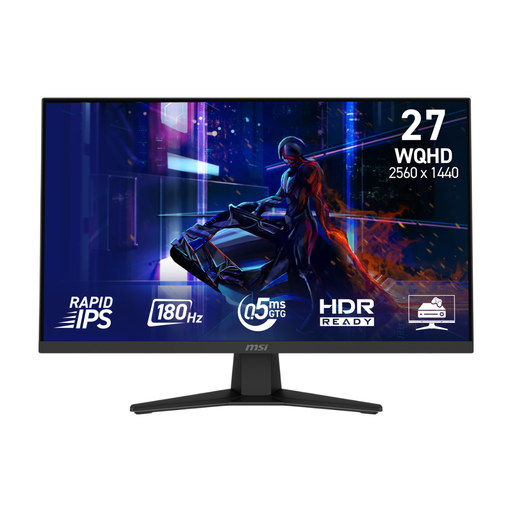
Consider this 27-inch format if you want to position a QHD screen near the wheel rather than use an ultrawide.
The product name specifies Rapid IPS, Adaptive Sync and a 180 Hz refresh rate. Check the dimensions, mounting arrangement and usable refresh mode for your chosen input before fitting it to a cockpit.
 No image available
This is a 27-inch option for a racer considering an OLED panel within a smaller-format setup.
The product name specifies 240 Hz. Confirm the monitor’s physical clearance and the refresh and VRR modes available through your intended connection.
 No image available
Consider this QHD model if you are planning a smaller-format PC racing display and can check the mount before installation.
The product name specifies QD-OLED and 280 Hz. Confirm the actual dimensions and weight for your rig, as well as the mode available through your chosen input.
 No image available
Its 26.5-inch panel size makes it a smaller-format candidate to measure against a compact cockpit opening.
The product name specifies 2560 × 1440 QD-OLED, 240 Hz, FreeSync Premium Pro and G-SYNC compatibility. Check the exact dimensions, mounting requirements and input-specific modes before choosing it for your rig.
 No image available
This 27-inch option is worth checking if a conventional-size QHD screen suits your cockpit position.
The product name specifies Fast IPS, 2560 × 1440 and 220 Hz. Confirm its dimensions, mounting compatibility and the refresh mode supported by your intended connection.
Start with a 27-inch format if width is limited; choose a 34-inch ultrawide if you want a 21:9 view and its exact dimensions fit. Measure clearance around the wheelbase and uprights, then check the stand or mount position rather than judging fit by diagonal size alone.
Not necessarily: a 240 Hz specification is most relevant when your PC, game settings and connection can make use of that mode. Check the refresh limit of the input you intend to use; ASUS, for example, specifies different HDMI and DisplayPort or USB-C limits for the ROG Strix XG27ACS.
Check the monitor’s HDMI modes against the output you intend to use. PlayStation provides a PS5 1440p output test for supported 60 Hz, 120 Hz and VRR modes; for Xbox Series X at 4K and 120 Hz, Xbox Support specifies an HDMI 2.1-capable display and an Ultra High Speed HDMI cable.
Use an appropriate electrical-equipment collection or take-back route rather than putting a monitor in general waste. UK government guidance on waste electrical and electronic equipment covers the regulatory framework; check your retailer’s current take-back information or your local authority’s household recycling arrangements for a practical route.