Braking-point practisers with a rigid rig
Drivers who want to practise a repeatable brake-pressure input and can secure their pedals to a cockpit or rigid pedal deck.


A load-cell brake is a sensible choice if you want to practise repeating brake pressure, provided you can mount it securely and set an effort you can sustain throughout a long session. Hall-sensor pedals remain an option when pedal-position adjustment and compatibility matter more to you; check the exact model and bundle before buying.
Drivers who want to practise a repeatable brake-pressure input and can secure their pedals to a cockpit or rigid pedal deck.
Drivers interested in load-cell braking who need to assess whether a floor-based pedal set can stay in position without a cockpit.
Drivers who value pedal spacing, plate height and output-curve adjustment, and need to confirm compatibility with their existing wheel-base or bundle.
Decide whether you want to practise a repeatable pressure input or work with pedal-position adjustment, then check whether the mounting and brake feel will suit an entire session.
| Concern | What to check | Who this matters to |
|---|---|---|
| Repeatable brake input | Check whether the brake measures force, how its resistance and travel can be adjusted, and whether it can be mounted securely. | When practising the same braking point lap after lap, I want an input I can reproduce at a manageable effort. Around 42% of consumers put repeatable brake input first. |
| Long-session fit | Check the available pedal-angle, plate-position, spacing and brake-feel adjustments against your seated position. | If my foot position or brake effort becomes uncomfortable during a long stint, I need settings I can sustain. For around 33% of consumers, physical fit is the primary concern. |
| Stable, compatible setup | Confirm mounting points or floor bracing, the required connection and compatibility with your exact pedal model and bundle. | Without a cockpit, I need pedals that stay put and work with my existing equipment. Setup and compatibility come first for around 25% of consumers. |
A stated sensor capacity does not tell you whether the brake effort, travel and seated position will be comfortable or repeatable for a full session.
Compare the exact pedal’s brake-feel adjustments and choose a setting you can use without changing posture, rather than choosing by the kilogram figure alone.
Heusinkveld specifies a very rigid base for Sprint pedals, while Sim-Lab says XP1 fit depends on the pedal deck and mounting points. Pedal movement can disrupt the input you are trying to practise.
Check your deck dimensions, mounting points and included hardware before ordering. At a desk, assess whether the pedal set’s floor-stability arrangement suits your room.
A suitable installation may require a separate baseplate or other mounting hardware.
MOZA Racing identifies SR-P Lite compatibility with the R5 Bundle and specifies its Performance Kit for SR-P Lite. The brand name alone is not enough to establish that an accessory will work.
Match the full pedal and accessory model names to your existing wheel-base or bundle before purchase.
Changing a spring, elastomer, travel setting or pedal position changes the physical input you are practising. Software settings may then need attention too.
Change one setting at a time, recheck calibration and, where the software allows it, save the revised profile before comparing braking points again.
Its XP1 range is aimed at drivers fitting adjustable load-cell pedals to a cockpit.
Its pedal ranges include a load-cell option designed for desk setups and a separate modular range.
Sprint pedals offer mechanical and software adjustment for drivers using a rigid rig.
SR-P Lite is a Hall-sensor pedal route with position and output-curve adjustment.
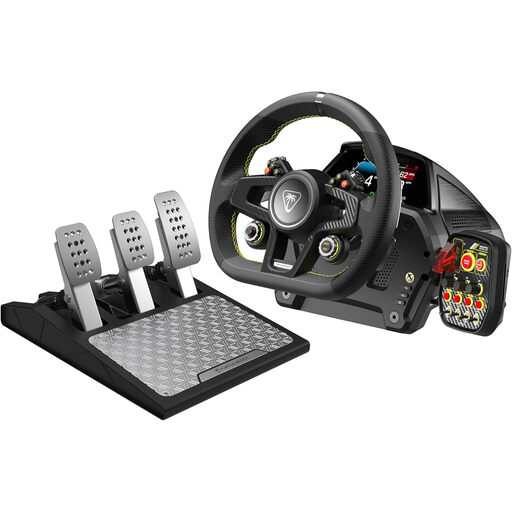
This choice is a combined racing wheel-and-pedal system for braking-point practice. Check whether its mounting and brake adjustments suit your setup and session length.
 No image available
For drivers who want a combined wheel-and-pedal system while practising braking points.
Secure it to a stable surface, and confirm the available brake-resistance and travel adjustments if you need to tune brake feel for long sessions.
No: a load-cell brake is the more direct choice if you specifically want to practise repeating brake pressure, while Hall-sensor pedals offer a different, position-based input. Whichever you choose, keep the settings consistent during practice and check compatibility with your setup.
Not solely because it is stiff. Choose a brake effort you can repeat comfortably with your seat, pedal angle and mount, and check which resistance and travel adjustments the particular model offers.
Yes, if the particular set has a suitable stability arrangement for your space. Logitech G describes wall braces for RS Pedals in desk setups; pedals specified for a rigid rig need their stated mounting requirements checked instead.
Recheck calibration and any brake-force, deadzone or output-curve settings before resuming braking-point practice. Heusinkveld describes those controls for its SmartControl software; use the controls available for your own pedal model.
Contact the seller and keep your order record and a description of the fault. GOV.UK explains that consumer rights apply to goods bought remotely or in person and that the Consumer Rights Act 2015 addresses faulty goods; the appropriate remedy depends on the circumstances.