Braking-point learner
You want to practise a repeatable brake input from lap to lap, so brake-force adjustment and calibration matter more to you than simply adding a third pedal.


For repeatable virtual braking practice, look for adjustable brake-force input and a pedal base that stays put under braking; a load-cell brake is one option if you can brace or mount it securely. In a shared bedroom, check how the setup moves and transmits noise in your room rather than assuming a heavier or stiffer pedal will be quieter.
You want to practise a repeatable brake input from lap to lap, so brake-force adjustment and calibration matter more to you than simply adding a third pedal.
You need to set up or put away pedals in a shared bedroom. A base that remains stable and a manageable brake-force setting matter, but mounting features alone cannot tell you how much sound or vibration will reach someone else.
You already have a wheelbase or play on a particular platform. Confirm the exact pedal connection and any adapter needed before choosing a set for its brake feel.
For braking-point practice in a shared bedroom, decide whether brake control, a stable temporary setup or connection to your existing equipment is your primary constraint.
| Concern | What to check | Who this matters to |
|---|---|---|
| Repeatable braking | Check for adjustable brake force or resistance and a calibration method; plan how to keep the pedal base still. | If I am learning where to brake, I want an input I can practise consistently without the pedals shifting. Around 42% of consumers put repeatable brake control first. |
| Shared-room setup | Check bracing or mounting options and whether your chair and floor remain stable when you press the brake. | When I need to pack the pedals away, a moving base or transmitted impact could disrupt both practice and the room. Around 33% of consumers prioritise a stable, lower-disruption setup. |
| Compatibility and upgrades | Confirm the connection to your PC, console or wheelbase and whether the exact pedal family needs a separate adapter or upgrade kit. | If I already own a wheelbase, I need the pedals to connect to it before considering a later brake upgrade. Around 25% of consumers make compatibility and an upgrade path their primary concern. |
A moving pedal base makes repeatable braking harder, even when the brake force itself is adjustable.
Identify what the base will push against, check whether your chair rolls backwards and choose a manageable brake setting. Consider documented bracing or mounting options if the setup cannot stay installed.
If the base or chair moves under braking, a rigid brace, pedal plate or suitable stand may become part of the setup.
MOZA distinguishes SR-P from SR-P Lite: its SR-P Lite Brake Pedal Performance Kit is compatible with SR-P Lite, not SR-P.
Match any kit to the complete pedal-family name rather than the brand or the appearance of the pedals.
A stated sensor capacity does not by itself establish a suitable brake setting for learning or for a temporary bedroom setup.
Check the available resistance and calibration adjustments, then use a setting that you can press without destabilising the pedals or chair.
Thrustmaster T-LCM is a three-pedal load-cell set to consider if you need brake adjustment within a compatible PC or console wheel setup.
Logitech G PRO Racing Pedals are a three-pedal load-cell option for buyers who want to adjust the brake feel and pedal positions.
MOZA SR-P pedals suit PC users considering a direct USB connection and either a floor-based or mounted arrangement.
Fanatec CSL Pedals offer a two-pedal starting point with a later load-cell brake upgrade.
Heusinkveld Sprint pedals are a PC-focused option for buyers with a dedicated full-frame rig and an interest in detailed adjustment.
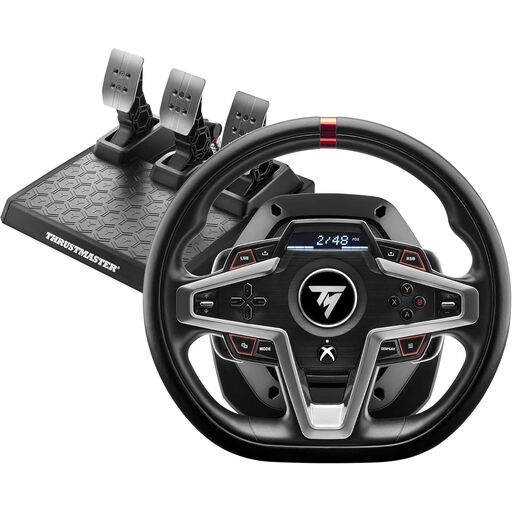
This wheel-and-pedals bundle is relevant if you also need a racing wheel. Check the identity of its included pedals before choosing it specifically for pressure-based braking practice.
 No image available
Consider this bundle if you need a wheel as well as pedals for racing practice on Xbox or PC.
The listing describes a three-pedal set but identifies it as T3PA while also describing a load-cell brake. Confirm the exact included pedal model and brake type with the seller before relying on pressure-based braking.
Check how you would secure the pedals and whether the setup would disturb anyone sharing the room.
No, but an adjustable pressure-sensitive brake gives you a way to practise brake-force input if the pedal base stays secure. Thrustmaster, Logitech G, MOZA and Heusinkveld describe this type of braking on the models discussed here; that does not establish a lap-time gain for any individual driver.
Some sets provide floor-use aids, but you still need to check whether the pedals and chair remain stable under braking. Fanatec says CSL Pedals can be braced against a wall or hard surface, while MOZA describes an anti-slip mat on SR-P pedals; neither feature establishes how quiet the pedals will be on your floor.
Check the exact pedal model against your PC, console or wheelbase rather than assuming every set connects in the same way. MOZA specifies direct PC USB connection for SR-P; Fanatec CSL Pedals need a compatible Fanatec wheelbase or, for standalone USB use, the separately available ClubSport USB Adapter or CSL Pedals Load Cell Kit.
No. MOZA’s compatibility information lists the SR-P Lite Brake Pedal Performance Kit for SR-P Lite, not SR-P. Check the complete pedal-family name before ordering an accessory.