Compact-rig consistency trainer
You use a small fixed cockpit and want to repeat your brake release before applying throttle. A stable deck and a manageable brake setting matter more to this practice than a high force rating.


For corner-exit practice in a compact cockpit, start with pedals that fit a secure deck and allow a brake release you can repeat comfortably. A load-cell brake suits a firmly mounted rig when you want pressure-based braking; a magnetic or Hall-sensor set may suit a tighter or less rigid setup. Check the exact wheelbase and platform connection before choosing either.
You use a small fixed cockpit and want to repeat your brake release before applying throttle. A stable deck and a manageable brake setting matter more to this practice than a high force rating.
You need pedals that fit your deck and may race on PC as well as a PlayStation or Xbox. Check how the exact pedals connect to your wheelbase and platform, rather than relying on the brand name.
You mainly race on PC and can mount the pedals securely. A USB-capable load-cell setup gives you a pressure-based braking route, provided its footprint and chosen brake setting suit the cockpit.
Check the available deck space and mounting arrangement before deciding how firm you want the brake to feel; then confirm the connection to your wheelbase and gaming platform.
| Concern | What to check | Who this matters to |
|---|---|---|
| Repeatable brake release | Compare pressure-based and travel-based brakes; check available brake-force or feel adjustments. | If I am working on the transition from braking to throttle, I need an input I can release consistently without shifting my position. Around 36% of consumers put repeatable braking first. |
| Fit and mounting rigidity | Measure usable deck width, depth and clearance; compare the mounting pattern and safe screw depth. | With little room around my feet, I need pedals that mount securely without obstructing their travel. For around 29% of consumers, stable fit is the primary concern. |
| Platform compatibility | Confirm the exact pedal, wheelbase and platform combination, including whether the connection is USB or through the wheelbase. | If I switch between PC and console, I need to know that the complete connection arrangement will work. Compatibility comes first for around 21% of consumers. |
| Manageable setup | Check included mounting parts and the adjustments needed for your preferred brake feel. | For short practice sessions, I want a setup I can mount and keep calibrated without repeatedly changing its configuration. Around 14% of consumers chiefly value that straightforward arrangement. |
A firm load-cell setting can move a flexible deck or seat, making brake release harder to repeat.
Secure the pedal deck first. Begin with a manageable setting and increase it only while the driving position remains stable.
A moving deck may call for additional bracing or a mounting plate.
Direct USB operation on PC does not establish that the same pedals will work with a console. Some console arrangements depend on a compatible wheelbase.
Check the documented connection path for the exact pedals, wheelbase and platform, including the required cables.
Bolts that protrude too far into a pedal base can cause damage. Thrustmaster and Logitech G specify different M6 depth limits for the relevant pedals.
Measure the deck thickness and follow the applicable pedal guide’s screw-depth limit; use washers where needed to keep within that limit.
The configuration you want may depend on optional parts or separately supplied cockpit hardware.
Check the contents of the exact pedal set against your intended mounting and brake-feel arrangement before ordering.
Thrustmaster lists some T3PM replacement and refresh components separately from the pedal set.
The T3PM is a three-pedal magnetic option for drivers considering an adjustable brake within the Thrustmaster wheel ecosystem.
MOZA Racing offers distinct Hall-sensor and load-cell pedal routes for PC-focused setups.
The CSL Pedals Load Cell Kit is an upgrade path for a CSL Pedals setup, rather than a standalone pedal set.
PRO Racing Pedals offer a modular load-cell arrangement for a cockpit where pedal spacing and feel need adjustment.
The XP1 is an adjustable load-cell route for drivers building around a securely mounted pedal deck.
This wheel-and-pedal bundle is a magnetic-pedal route for practising brake release in a compact cockpit. Check the complete bundle’s fit and connection against your existing setup before choosing it.
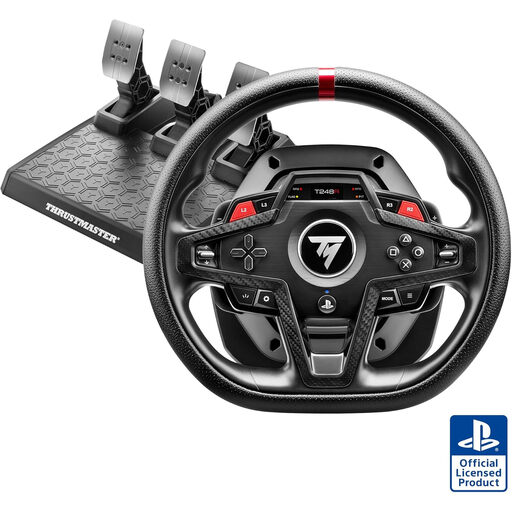 No image available
Consider this bundle if you want to practise with its included T3PM magnetic pedals and also need a racing wheel. Thrustmaster lists four brake-pressure modes for the T3PM. Confirm that the pedals and wheel fit your cockpit and that the bundle suits your intended platform and game; it is not a standalone pedal set.
A load-cell brake is worth considering if your pedals are securely mounted and you want to practise pressure-based braking. Set the force at a level you can release consistently without moving the deck or your driving position.
Measure the usable deck width, depth and clearance, then compare them with the exact pedal set’s dimensions and mounting template. Leave room for pedal movement, cables and a comfortable foot position.
No: a direct USB-to-PC connection does not establish console compatibility. MOZA Racing describes direct PC USB connection for the SR-P, while Fanatec says console use of its CSL Load Cell Kit with CSL Pedals requires a compatible Fanatec wheelbase or racing wheel.
Follow the limit for the exact pedal model. Thrustmaster’s T3PM manual says M6 screws must not extend more than 12 mm beyond the mounting support; Logitech’s PRO Racing Pedals guide allows a maximum M6 bolt depth of 10 mm inside the pedal unit.
Check which springs, elastomers or adjustment parts are supplied with the exact set and which are separate. Thrustmaster lists some T3PM replacement and refresh components separately, so the bundle contents matter if you have a particular configuration in mind.