Corner-exit consistency practisers
If your priority is repeating brake release and throttle application lap after lap, look for inputs you can calibrate and a pedal base that stays put under your intended braking force.


Choose pedals that let you repeat the transition from braking to throttle, but check that your seat and pedal mount remain stable at the braking force you intend to use. For long sessions, comfortable pedal position, useful adjustment and compatibility with your platform matter more than a high sensor-capacity figure on its own.
If your priority is repeating brake release and throttle application lap after lap, look for inputs you can calibrate and a pedal base that stays put under your intended braking force.
If your position becomes uncomfortable during extended practice, assess seat distance and pedal position before choosing adjustments to angle, spacing, travel or resistance. Asetek Racing’s pedal-position guidance links placement with comfort and braking control.
If you already use a desk, wheel stand, cockpit or console setup, establish how a pedal set will mount and connect before prioritising its sensor specifications. Connection requirements differ between the pedal lines described below.
Start with platform and mounting fit, then check whether the brake and pedal position can be adjusted to support repeatable inputs without an uncomfortable seated position.
| Concern | What to check | Who this matters to |
|---|---|---|
| Repeatable brake release and throttle input | Check how brake input is sensed and whether force, signal range or dead zones can be calibrated for your setup. | If I am practising the same corner exit repeatedly, I want braking and throttle inputs I can reproduce without shifting in my seat; around 36% of consumers put repeatable inputs first. |
| Long-session posture | At your intended braking force, check seat support, knee position and whether pedal distance, angle or spacing can be adjusted. | During a long stint, I need to reach both pedals without straining my ankle or losing back support. Comfortable posture comes first for roughly 29% of consumers. |
| Rig and platform fit | Confirm the exact platform, connection method, required equipment and mounting pattern; check that the pedal deck does not move under braking. | If my existing wheel, console or cockpit dictates what will connect and mount securely, those constraints decide the purchase; about 21% of consumers prioritise rig and platform fit. |
| Useful adjustment range | Identify which changes you expect to make, such as brake resistance, travel, pedal placement or adding a clutch, and check the required parts. | As my setup develops, I may want to change pedal feel or layout rather than replace everything; around 14% of consumers make that upgrade path their primary concern. |
A load-cell capacity or hydraulic pedal-force rating is a product specification, not a recommended setting. Excessive force can make seat movement, pedal-deck flex or an awkward position more apparent.
Begin at a force you can apply with your back supported and your hips stable. Increase it only if you can maintain that position and repeat the input through a session.
Fanatec says its CSL Pedals Load Cell Kit works only with CSL Pedals; console use also requires a compatible Fanatec wheel base or racing wheel.
Check your exact pedal model, wheel-base model, platform and required connections before ordering the kit.
Pedal adjustments cannot keep a moving seat or pedal deck still. Asetek Racing’s positioning guidance also identifies distance and angle as relevant to comfort and control.
Check the seat and mount first, then choose adjustments that address the specific problem you feel, such as reach, angle, spacing, travel or brake resistance.
These examples show different ways to meet the same corner-exit practice needs; their connection and mounting requirements remain model-specific.
The T-LCM is a complete three-pedal option for users considering PC or the PlayStation and Xbox platforms listed by Thrustmaster.
The CSL Pedals Load Cell Kit is an upgrade path for existing CSL Pedals owners seeking a pressure-measuring brake.
The CRP2 line offers mechanical adjustment for a PC-oriented pedal setup.
Sprint pedals are a PC-focused option for drivers with a full-frame rig who want to tune mechanical feel and software response.
The PC-compatible Invicta S-Series T.H.O.R.P. II is a specialist option for drivers specifically seeking a two-stage hydraulic brake and wide pedal-spacing adjustment.
This wheel-and-pedal bundle is a choice for starting corner-exit practice on its stated Xbox or PC platforms. It is not a standalone pedal upgrade.
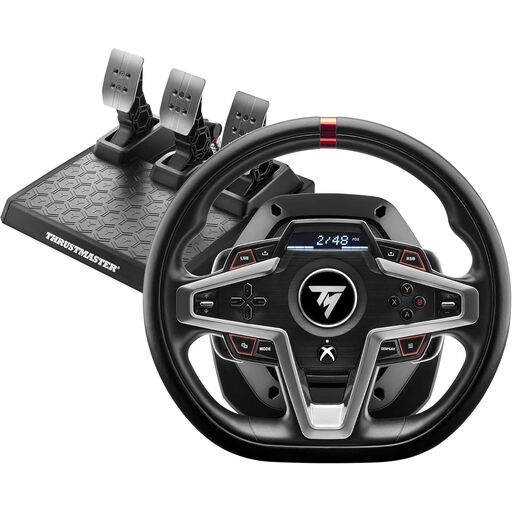 No image available
Consider this bundle if you need a wheel as well as pedals for practising brake-to-throttle transitions. The product listing describes three pedals, a load-cell brake and adjustable pedal spacing, height and angle. Before buying, confirm how the included brake is calibrated and whether your intended mount stays stable at a comfortable braking force.
Not automatically: a capacity figure describes the sensor or pedal design, not the force you should use or a lap-time result. Choose a force you can apply while your seat and pedals remain stable, then calibrate the input for your setup.
Set the seat distance and secure the pedals before fine-tuning their feel. At your intended braking force, check that you can keep your back supported without stretching or locking your knee; then adjust angle, spacing, travel or resistance as your pedals allow.
No: console compatibility depends on the exact pedals and how they connect. Thrustmaster lists T-LCM for PC, PS4, PS5 and Xbox, while Fanatec says its CSL Pedals Load Cell Kit needs CSL Pedals and a compatible Fanatec wheel base or racing wheel for console use. Confirm your complete pedal, wheel and console combination.
Faulty goods may give rise to consumer remedies distinct from a retailer’s change-of-mind returns policy. GOV.UK explains that consumer-rights law protects purchases made both remotely and in person; keep your order details and a record of the fault when contacting the seller.
Check the retailer’s electrical-waste take-back arrangements and your local disposal guidance rather than putting electronic pedals in ordinary household waste. GOV.UK says retailers must offer take-back for waste equipment of the same type as an item a customer buys; ask how the applicable arrangement works for your purchase.