Long-stint braking trainee
You want to practise controlled braking inputs across repeated virtual laps, rather than use a brake as a simple on/off control.


Consider a load-cell pedal set if practising pressure-based braking is central to your endurance stints and you can keep the seat and pedals stable. Physical adjustment matters for a repeatable driving position, but check the connection path for your exact PC or console setup and the pedal mounting pattern before choosing; a higher brake-force setting is not automatically more suitable.
You want to practise controlled braking inputs across repeated virtual laps, rather than use a brake as a simple on/off control.
You need pedal spacing, angle and height to work with your seat position during extended sessions, without the seat or pedal base shifting.
You already have a PC, console or wheelbase and need to establish how the pedals will connect, particularly if you are mixing equipment from different brands.
For a fixed endurance-practice setup, establish the connection path and a stable driving position before choosing how much brake and pedal adjustment you need.
| Concern | Buying check | Who this matters to |
|---|---|---|
| Repeatable braking | Check whether the brake senses force and how its resistance can be adjusted. Match the setting to the stability of your rig. | If I am practising pressure-based braking over many laps, I want a brake input I can set up consistently. Around 40% of consumers would make repeatable braking their primary concern. |
| Stable rig fit | Check pedal position, mounting-hole compatibility and whether the seat and pedal base stay put under your intended brake force. | For a long stint, I need a position that feels comfortable without the pedals or seat moving; stable rig fit would come first for around 30% of consumers. |
| Platform connection | Confirm the exact PC or console, wheelbase and pedal connection path against the manufacturer's compatibility information. | If my existing wheelbase or console dictates what can connect, a suitable brake is of little use until that connection is settled. Around 20% of consumers would prioritise compatibility. |
| Adjustment and calibration | Check which pedal-position and brake settings are adjustable, and whether software is required for the settings you intend to use. | When I refine my setup or share the rig, I want to change settings without losing a repeatable baseline; tuning flexibility would be the primary need for around 10% of consumers. |
A firmer brake setting can move an unsecured pedal base, chair or cockpit, making a consistent driving position harder to maintain.
Check seat and pedal stability together. Start with a manageable brake-force setting, then adjust it while confirming that your position stays stable.
A sturdier stand or compatible mounting adaptor may be needed if your current arrangement moves under braking.
MOZA Racing documents direct PC connection for the SRP2 Pedals, while Thrustmaster lists PC and console platforms for the T-LCM Pedals. Those statements do not establish the same connection path for every setup.
Check the exact pedal, wheelbase, PC or console and any required connection equipment in the relevant manufacturer documentation before ordering.
Changing position, brake feel and calibration at once can make it difficult to tell which adjustment changed your braking input.
Record the pedal position and calibration after fitting, then change one setting at a time as you refine the rig.
The T-LCM Pedals are a three-pedal load-cell option to examine for a compatible PC or console setup.
The PRO Racing Pedals offer a modular three-pedal layout for buyers planning pedal placement in a fixed rig.
The SRP2 Pedals are a direct-PC-connection option for a games-room rig where physical and software adjustment matter.
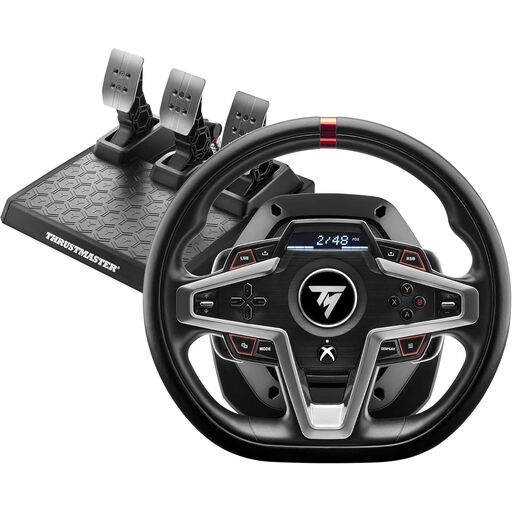
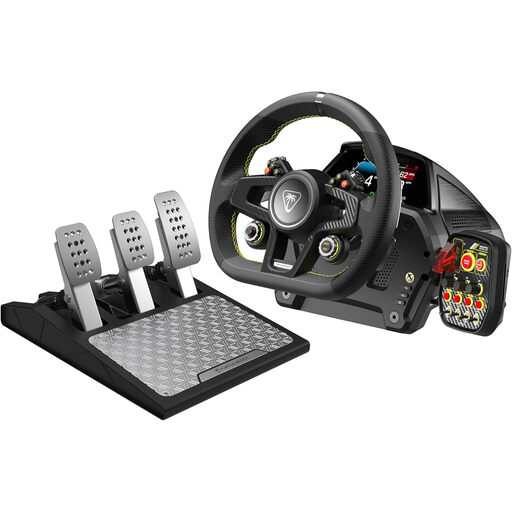
These bundles pair a racing wheel with pedals for the Xbox and PC or Windows platforms named in their titles. If braking feel is your main reason for buying, confirm the exact brake mechanism, adjustment options and pedal mounting fit for your rig.
 No image available
Consider this wheel-and-pedal bundle if you are building an Xbox or PC racing setup. For endurance braking practice, confirm the included brake mechanism and adjustment options, then check how the pedal base will mount in your rig.
 No image available
Consider this wheel-and-pedal system for an Xbox or Windows 10/11 racing setup. Confirm the precise brake-sensing mechanism and available adjustments before choosing it for pressure-based practice, and check pedal-base fit in your cockpit.
No: a load-cell brake is worth considering when practising pressure-based braking is your priority and your seat and pedals can remain stable. Thrustmaster describes load-cell sensing as measuring applied pressure rather than pedal travel; a simpler travel-based setup can still suit less focused practice.
Secure the pedals and driving position, choose a manageable brake setting, then calibrate the controls for your game. Thrustmaster documents brake-force and dead-zone adjustment for the T-LCM Pedals, while MOZA Racing documents pedal-travel and signal-output-curve adjustment for the SRP2 Pedals.
Possibly, but check the mounting pattern before buying. Thrustmaster offers a T-LCM Cockpit Adaptor for cockpits configured for T3PA or T3PA-PRO pedals; that does not establish fit with other pedal plates or rigs.