Rally practisers focused on braking consistency
If you repeat stages to refine braking points, look for a brake you can calibrate and press consistently. Its settings still need to suit your pedal mount and seating position.


For virtual rally practice on one monitor, prioritise a brake you can press consistently and a pedal base and seat that stay put; compare load-cell brakes alongside the resistance your setup can support. Choose three pedals if you plan to use a physical clutch, while two may suffice if your game and shifting controls support that plan. Confirm the connection to your wheelbase and platform before ordering.
If you repeat stages to refine braking points, look for a brake you can calibrate and press consistently. Its settings still need to suit your pedal mount and seating position.
If you do not use a permanent cockpit, check whether the pedal base and your seat remain stable under braking. Adjustable brake resistance can help you find a setting your arrangement supports.
If your rally controls call for a clutch pedal, check the included pedal count as well as spacing and position adjustments that suit how you sit and shift.
| Concern | What to check | Who this matters to |
|---|---|---|
| Repeatable braking | Check the brake sensing method and how its resistance or calibration can be adjusted. A larger sensor rating alone does not establish better control. | When I repeat a stage, I want a brake input I can reproduce without pushing beyond what my setup supports; around 36% of consumers put repeatable braking first. |
| Mounting stability | Check how the pedals attach to your floor setup, stand or cockpit, and whether you can reduce brake resistance if the base or seat moves. | A moving pedal base makes hard braking difficult to repeat, so I need my seat and pedals to stay in place; roughly 29% of consumers prioritise mounting stability. |
| Clutch and pedal position | Confirm whether a physical clutch is included, then check the available pedal-spacing and position adjustments. | If my shifting method uses a clutch, I need a third pedal positioned where I can use it comfortably; around 21% of consumers put clutch and pedal layout first. |
| Hardware connection | Check the exact pedal, wheelbase and platform combination, including whether it needs USB, a wheelbase connection or a named adapter. | I need the pedals to work with the hardware I already use, rather than assuming PC support also means console support; about 14% of consumers prioritise the connection route. |
A load-cell brake still needs a stable pedal base and seating position. Thrustmaster describes adjustable brake force for T-LCM, while Heusinkveld specifies full-frame-rig mounting for Sprint.
Check your chair, floor and mounting arrangement before increasing brake resistance. Start with a setting that does not move the pedals or seat.
A pedal plate or reinforcement may be needed if your current mounting arrangement cannot hold the pedals securely.
MOZA describes the standard CRP2 set as throttle and brake. A separate discussion of clutch adjustment does not mean a clutch is included in that set.
If you intend to use a physical clutch, check the exact box contents and either choose a three-pedal set or confirm a compatible clutch configuration.
SIMAGIC specifies USB or Simagic-wheelbase connection for P1000, while Logitech documents particular component combinations through its Racing Adapter. Neither statement establishes universal compatibility.
Check your pedal model, wheelbase, platform and game together, then confirm the required connection with the manufacturer.
Some hardware combinations may require a compatible adapter.
Manufacturers describe different measures: a load-cell sensor rating is not necessarily the force applied at the pedal. Heusinkveld, for example, distinguishes its Sprint load-cell rating from its stated maximum actual pedal force.
Compare the available brake adjustments and choose a resistance you can press repeatedly without moving your setup.
The T-LCM is a three-pedal option to consider if you need a clutch and want to check a set listed for PC, PS4, PS5 and Xbox.
PRO Racing Pedals suit a three-pedal shortlist, particularly if you are planning a connection within Logitech's racing hardware range.
Sprint is a PC-oriented option for consumers with a full-frame rig who want to adjust brake resistance and pedal geometry.
CRP2 is a two-pedal throttle-and-brake option if your shifting method does not need an included physical clutch.
P1000 is a modular route for a cockpit setup where the pedal configuration may change over time.
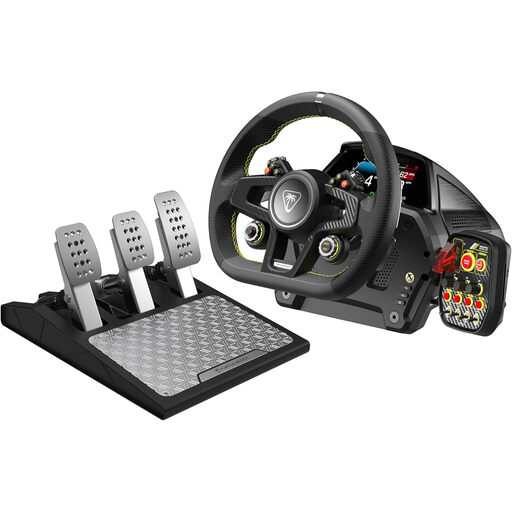
This wheel-and-pedal system is relevant if you are considering an Xbox or Windows 10/11 rally setup and need a wheel as well as pedals, rather than a standalone pedal replacement.
 No image available
Consider this complete wheel-and-pedal system if your rally setup needs both components, rather than pedals alone.
Before ordering, check the included pedal count if you need a physical clutch, confirm the brake adjustments you want, and make sure your mounting surface will stay stable under repeated braking.
No particular pedal specification follows from using one monitor. Choose around the braking input, mounting arrangement and controls you intend to use for rally practice.
Two pedals can be enough if your game and chosen shifting method do not require a physical clutch. If you plan to use one, choose a set that includes a clutch or confirm a compatible addition; MOZA describes the standard CRP2 set as throttle and brake.
No universal connection should be assumed. Check the precise pedal and wheelbase models, platform, adapter requirements and game support; manufacturers specify different routes for products such as SIMAGIC P1000 and Logitech's Racing Adapter combinations.
Check your local authority's or retailer's current collection arrangements for electrical equipment before disposing of old pedals. The available route may depend on where you live and how you are replacing them.