What matters when choosing
For braking-point practice, establish a pressure input and a stable seating position before refining pedal feel; check the connection route against your existing equipment before ordering.
| Concern |
What to check |
Who this matters to |
| Repeatable brake pressure |
Check whether the brake senses force or pressure and whether its input can be calibrated. |
If I want to brake at the same virtual marker each lap, I need an input I can practise repeating rather than judging pedal travel alone. Around 40% of consumers would put repeatable brake pressure first. |
| Adjustment and calibration |
Check the documented brake-resistance options and available calibration controls. |
When I am establishing a practice routine, I want to find a comfortable brake feel and leave that setting in place. Roughly 30% of consumers would make adjustment and calibration their main concern. |
| Stable rig fit |
Check mounting provisions and whether the pedal position suits your fixed seat. |
If the pedals or my seating position shift under braking, the same setting becomes harder to use consistently. About 20% of consumers would prioritise stable fit in their games room. |
| Platform compatibility |
Confirm the exact pedal, platform, wheel-base and connection combination. |
Before comparing brake feel, I need the pedals to work with the PC or console and wheel base I intend to use. Around 10% of consumers would put compatibility ahead of the other concerns. |
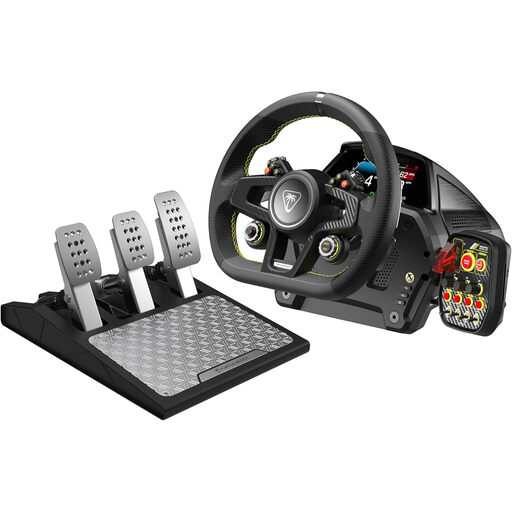
Joybuy wheel-and-pedal option
This wheel-and-pedal bundle is a route to pressure-based braking practice for a dedicated Windows PC or Xbox setup; check whether its pedal settings and your game suit your routine.
 No image available
Turtle Beach VelocityOne Race Wheel & Pedal System for Xbox & Windows 10/11
The included load-cell brake makes this bundle relevant to pressure-based braking practice. It is a wheel-and-pedal system rather than a pedal-only purchase; check its brake-adjustment and calibration options, mounting fit and support for your game.
View on Joybuy
Common questions
Do I need a load-cell brake to learn virtual braking points?
No, but a load-cell brake is relevant if you want to practise a chosen pressure input. Fanatec says its load cell measures pressure rather than pedal position, while Thrustmaster describes brake-force sensing in its T-LCM pedals; neither feature guarantees quicker laps.
How should I set up pedals for consistent practice?
Keep the pedals and seat stable at the braking force you actually use, then calibrate a comfortable setting and retain it while practising. If you change springs, resistance or pedal position, test one change at a time so you can tell what it affects.
Can I connect racing pedals directly by USB to a console?
Do not assume that PC USB support also covers consoles. Fanatec specifies standalone USB use on PC for its CSL Elite Pedals V2 and connection through a supported wheel base by RJ12; confirm the complete pedal, wheel-base, console and game combination for your setup.
Is a 200 kg load-cell rating better for braking-point practice?
Not on its own: MOZA Racing’s 200 kg figure and the different figures published for other pedals describe hardware specifications, not the force you should use. Choose a repeatable setting that your mounting and seating position can support comfortably.
Should I reject a pedal set in Great Britain if its listing shows CE rather than UKCA?
Not solely on the basis of a listing image; check which requirements apply to the specific product and inspect its documentation. GOV.UK guidance from the Office for Product Safety & Standards, updated in March 2025, says Great Britain continues to recognise certain goods meeting EU requirements, including CE marking, but that does not establish compliance for an individual pedal set; Northern Ireland has different rules.


