Seated desk or floor learners
If you practise without a dedicated cockpit, the pedals need to stay in position while you repeat brake and throttle movements. Think about both the pedal base and whether your chair moves under braking.


For seated virtual pit-entry practice, choose pedals you can keep steady and a brake response you can tune to your position. If the pedals will sit on the floor, plan how to brace them before choosing a high-force brake; if you use a stand or cockpit, pedal-position adjustment may matter more. Check the connection path for your exact PC or console, wheel and game separately from the pedals’ physical fit.
If you practise without a dedicated cockpit, the pedals need to stay in position while you repeat brake and throttle movements. Think about both the pedal base and whether your chair moves under braking.
If you use a stand or cockpit, or can add one, adjustable brake resistance and pedal placement can help you set the controls for your seating position rather than working around a fixed layout.
If your wheel and pedals come from different brands, look for a pedal set that the manufacturer says can connect independently to your PC. That PC connection does not establish console compatibility.
Start with the seated setup you can keep stable, then assess brake adjustment and the connection your platform requires. A suitable pedal mechanism is less useful for pit-entry practice if its base moves or the game does not register the intended input.
| Concern | What to check | Who this matters to |
|---|---|---|
| Repeatable braking | Check the brake mechanism and whether you can adjust resistance or brake force for the way the pedals are braced. | If I am rehearsing the same braking point before a virtual pit line, I want a brake input I can control without the setup shifting. Around 46% of consumers put repeatable brake modulation first. |
| Stability and posture | Check how the pedal base will be restrained and whether pedal angle, height or spacing can suit your seated position. | At a desk or in a stand, I need my feet to reach the pedals comfortably and the base to stay where I placed it. For around 36% of consumers, stability and seated position are the primary concern. |
| Connection and calibration | Confirm the exact platform, wheel and pedal connection, then check how to set the game’s minimum and maximum pedal inputs. | If I mix equipment or play on a console, I need the pedals to be recognised before I can judge my technique. Compatibility and calibration come first for around 18% of consumers. |
A pedal base that slides, or a chair that rolls, changes your foot position between pit-entry attempts. Adjustable braking force does not secure either one.
Measure the available floor space and identify a solid stop, wall brace, stand or cockpit mounting point. Begin with a lower brake-force setting and increase it only while the setup remains stable.
A suitable wall-support accessory, mounting plate or stand may be needed for the position you use.
MOZA describes cross-brand USB use for SRP2 on PC. Fanatec specifies a compatible Fanatec wheelbase or racing wheel for console use with the CSL Pedals Load Cell Kit. Neither PC statement establishes an equivalent console connection.
Match your exact pedals, wheel, wheelbase, platform and game against the manufacturer’s stated connection method before ordering.
If the game registers an input while your foot is off the pedal, or never registers full travel, your on-screen braking or throttle may not follow your foot movement as intended.
After installation, check zero and full input in the available pedal software and in the game. Recheck those settings before changing your braking technique to compensate.
Fanatec says its CSL Pedals Load Cell Kit fits CSL Pedals, not every Fanatec pedal set.
Check the complete model name of the pedals you own before choosing an add-on brake or tuning kit.
These examples illustrate different setup and connection routes; a brand name alone does not establish fit for your seat, wheel or platform.
RS Pedals are a route to examine if you need a load-cell brake in a floor or desk setup.
T-LCM is a three-pedal option to examine when you want to adjust brake feel and pedal placement for a seated setup.
SRP2 is a PC-oriented option if you want separately connected USB pedals and physical adjustment.
The CSL Pedals Load Cell Kit is an upgrade route for people who already own CSL Pedals.
These wheel-and-pedal systems offer ways to start practising with a seated racing setup. For each one, check how you will restrain the pedal base; a wheel’s desk mounting does not by itself secure the pedals on the floor.
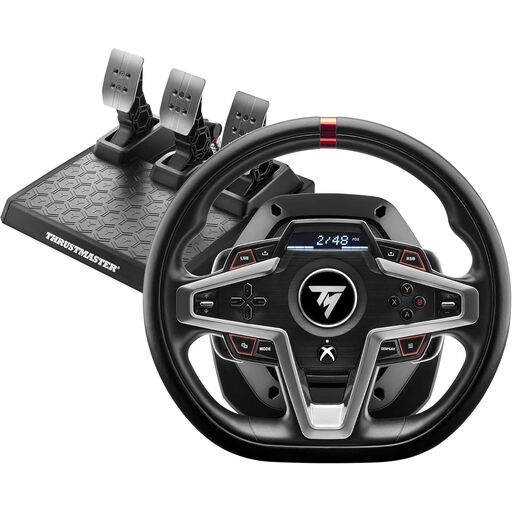 No image available
A wheel-and-pedal option for practising from a seated position on Xbox or PC. Check how the pedal base will be restrained and whether the brake settings suit your setup before relying on it for repeated pit-entry practice.
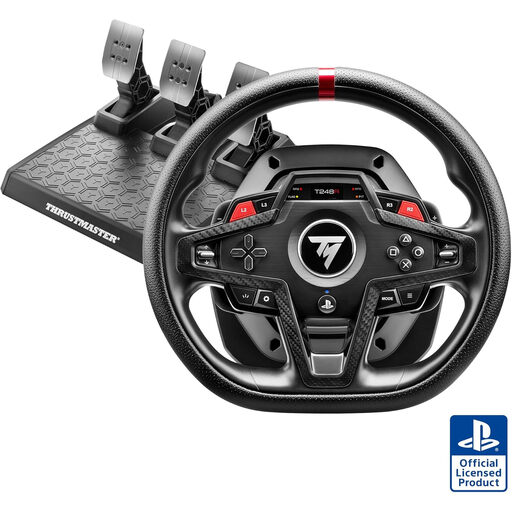 No image available
A wheel-and-pedal set to consider if you practise on PS5, PS4 or PC. If brake type is central to your choice, confirm it for this exact set rather than assuming it matches a separately sold Thrustmaster pedal model. Plan how to keep the pedals steady at your seat.
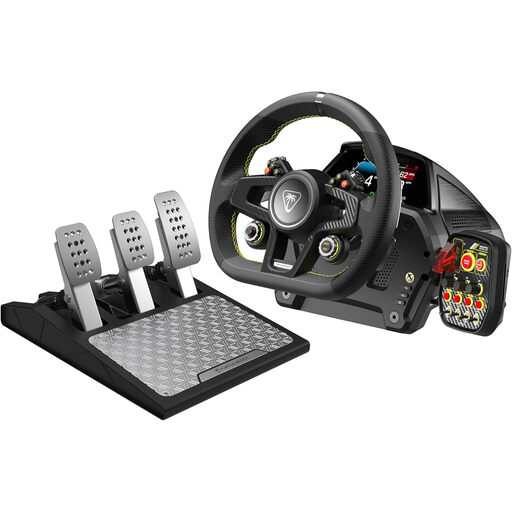 No image available
A wheel-and-pedal system for seated practice on Xbox or Windows 10/11. If you need to tune pedal response, check the controls available for this exact system and game, as well as how the pedal base will be secured.
No. A load-cell brake is one option if you want to practise repeating a chosen braking pressure, but it cannot compensate for pedals or a chair that move. Check that the brake response can be set for your position and that the game registers the input correctly.
Yes, if the named pedals suit floor use and you can keep both them and your chair stable. Logitech G describes wall braces for RS Pedals; MOZA describes floor placement and an optional wall-support bracket for SRP2. Check the space and stopping point available in your own setup.
On PC, MOZA says SRP2 can connect directly by USB for use with other sim-racing brands. Fanatec states that its CSL Load Cell Kit can connect by USB on PC when fitted to CSL Pedals. Check console combinations separately rather than extending either PC connection claim to them.
Check that the game reads zero input when your feet are off the pedals and responds across the intended pedal movement. Then adjust available brake-force, travel or dead-zone settings as needed for your setup; Thrustmaster documents brake-force and dead-zone adjustment for T-LCM, while MOZA documents travel and response controls for SRP2.