Choose racing pedals around the braking input you want to practise and the setup that will keep the pedals still; using one monitor does not determine the sensor type. A load-cell brake suits pressure-based braking practice when you have stable mounting, while a lower-force, slip-resistant set may be more practical at a desk. Check the exact wheel-base, platform and connection requirements before buying.
Who these pedals suit
Learners practising repeatable downhill braking
If you replay the same virtual mountain circuit, a pressure-sensing load-cell brake gives you a way to practise applying a consistent force into corners. Your pedals need to remain stable under that force.
Drivers using a compact setup
At a desk or light wheel stand, keeping the pedal base still may matter more than choosing a firm brake. Look at placement, slip resistance and whether you can use a manageable brake setting.
Rig owners adjusting pedal position
With a compatible pedal deck, you can consider sets that let you change resistance, preload, travel, angle or spacing to suit your seating position. Confirm the mounting points before choosing a set for those adjustments.
What matters when choosing pedals
Slip-resistant Hall-sensor pedals
Consider when: You need a lower-force starting point for a desk or light stand.
Check: An anti-slip design does not establish standalone compatibility; MOZA lists its SR-P Lite pedals as compatible only with the R5 Bundle.
Adjustable load-cell pedals
Consider when: You want to practise braking by applied pressure and can keep the pedals stationary.
Allow for: Firmer settings may call for more secure mounting; choose a resistance you can repeat and calibrate the brake afterwards.
Rig-mounted load-cell pedals
Consider when: You have a rigid pedal deck and want to tune pedal resistance and position.
Check: Sim-Lab says the fit of its XP1 pedals depends on the exact deck and mounting points.
| Concern |
What to check |
Who this matters to |
| Repeatable braking |
Check the brake sensor type and how to set a manageable resistance and calibrate the usable range. |
Replaying downhill corners calls for a braking input I can reproduce without the pedals shifting. Around 36% of consumers put repeatable braking first. |
| Setup stability |
Check slip resistance or mounting options against your floor, stand or pedal deck. |
At a desk or light stand, I need the pedal base to stay put before I increase brake force. Stability comes first for roughly 29% of consumers. |
| System compatibility |
Confirm the exact PC or console, wheel base and required USB, wheel-base or bundle connection. |
If I already own a wheel, the pedals must connect in my intended setup. Compatibility is the primary concern for around 21% of consumers. |
| Position and adjustment |
Look for documented spacing, height, angle or resistance adjustments that suit your seating position. |
For longer practice sessions, I want a pedal position and brake feel I can use consistently. Roughly 14% of consumers prioritise physical fit and adjustment. |
Common buying mistakes
-
Assuming any load-cell set will work on a light stand
A firmer brake can move an unsecured pedal base or stand, making consistent inputs harder.
Check the mounting holes and intended brake setting against your stand. Begin with a manageable setting and increase resistance only if the setup stays still.
A sturdier stand, pedal plate or mounting hardware may be needed.
-
Treating an add-on or bundle pedal set as standalone
Connection rules differ: MOZA lists SR-P Lite as compatible only with the R5 Bundle, while its SR-P pedals use USB. Fanatec's CSL load-cell kit is an upgrade for CSL Pedals.
Check the exact model and revision against the manufacturer's connection instructions, including whether it connects to a PC, through a wheel base or only as part of a bundle.
-
Starting with the stiffest brake setting
Excessive resistance can shift a light setup or make controlled braking harder to practise.
Set a force you can apply consistently. Change one spring, elastomer or software setting at a time, then recalibrate the brake.
Brands to consider for these pedal setups
Logitech G
Its PRO Racing Pedals offer a three-pedal, modular load-cell option.
- Logitech G specifies a pressure-detecting load-cell brake, movable or removable pedal modules, and swappable springs and brake elastomers.
- Check the exact console, wheel-base, game and mounting compatibility for your planned setup.
Thrustmaster
The T-LCM Pedals provide a load-cell route with physical adjustment.
- Thrustmaster lists PC, PS4, PS5 and Xbox platforms, a 100 kg load-cell brake, six adjustable springs, and pedal height, inclination and spacing adjustments.
- Check support for your complete wheel-and-console combination, not just the pedal listing.
MOZA
Its SR-P Lite and SR-P pedals suit different connection and braking requirements.
- MOZA specifies anti-slip features and Hall sensors for SR-P Lite; SR-P uses USB and a load-cell-plus-angle brake sensor.
- MOZA lists SR-P Lite as compatible only with the R5 Bundle. For an SR-P mounting bracket, check the hole pattern.
Sim-Lab
The XP1 Loadcell Pedal Set is an option for a compatible rigid pedal deck.
- Sim-Lab specifies adjustment of resistance, preload and pedal angle, with springs and elastomers included.
- The exact fit depends on the pedal deck and mounting points.
Fanatec
The CSL Pedals Load Cell Kit is an upgrade path for owners of CSL Pedals.
- Fanatec documents the kit's pedal-position planning and RJ12-to-wheel-base or USB-to-PC connection routes.
- Do not assume the kit fits other pedal sets or every console arrangement.
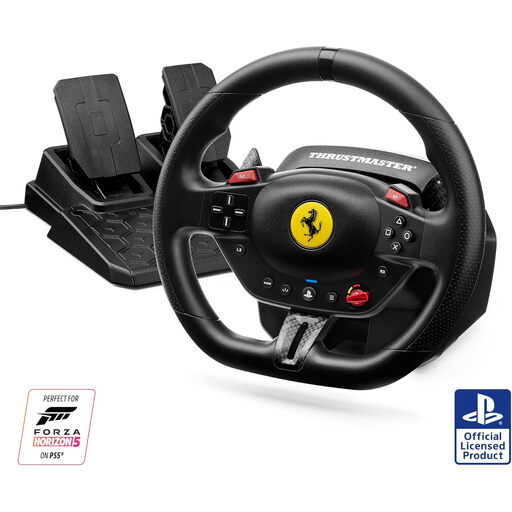
Joybuy wheel-and-pedal bundle
This complete wheel-and-pedal bundle is an option if you are starting a PS5, PS4 or PC racing setup, rather than replacing pedals alone.
 No image available
Thrustmaster T98-P Ferrari 296 GTB wheel-and-pedal set
Consider this bundle if you need a wheel and pedals together for PS5, PS4 or PC, rather than pedals for an existing wheel base.
Before choosing it for downhill-braking practice, check the included pedals' brake adjustment and how the pedal base will stay stable in your space.
View on Joybuy
Frequently asked questions
Do I need a load-cell brake to learn a virtual mountain circuit?
No, but a load-cell brake is worth considering if you want to practise braking by applied pressure and can keep the pedals stable. Choose a manageable resistance and calibrate it; a firmer setting alone will not establish a more useful practice setup.
Does using one monitor change which pedals I should buy?
One monitor does not determine the pedal sensor type. Base the choice on the braking input you want to practise, pedal stability, connection requirements and physical fit.
Can I use racing pedals without a cockpit?
Yes, if the particular pedals remain stable at a brake force you can use consistently. MOZA describes an anti-slip design for SR-P Lite, while Thrustmaster describes T-LCM spring settings for desk, wheel-stand and cockpit setups; check each product's connection and placement requirements too.
How do I check whether pedals will work with my wheel?
Match the exact pedal model to your platform, wheel base and required connection route before buying. MOZA lists SR-P Lite as compatible only with the R5 Bundle, and Fanatec documents RJ12-to-wheel-base or USB-to-PC connection for its CSL Pedals Load Cell Kit.


